WhatsApp Business Charges From October 1, 2026: New India Pricing Explained

Table of Contents
ToggleWhatsApp Business Charges From October 1, 2026: New Rules and India Pricing Explained
WhatsApp Business pricing is changing in India from October 1, 2026, and businesses that use WhatsApp for customer support, order updates and automated conversations need to understand the new rules.
Meta is changing the way it charges businesses using the WhatsApp Business Platform. From October 1, certain messages that were previously free within the 24-hour customer-service window will become chargeable.
The change is particularly important for online sellers, retailers, D2C brands, travel agencies, service providers, e-commerce companies, real-estate businesses and companies using WhatsApp APIs, chatbots or automated customer support.
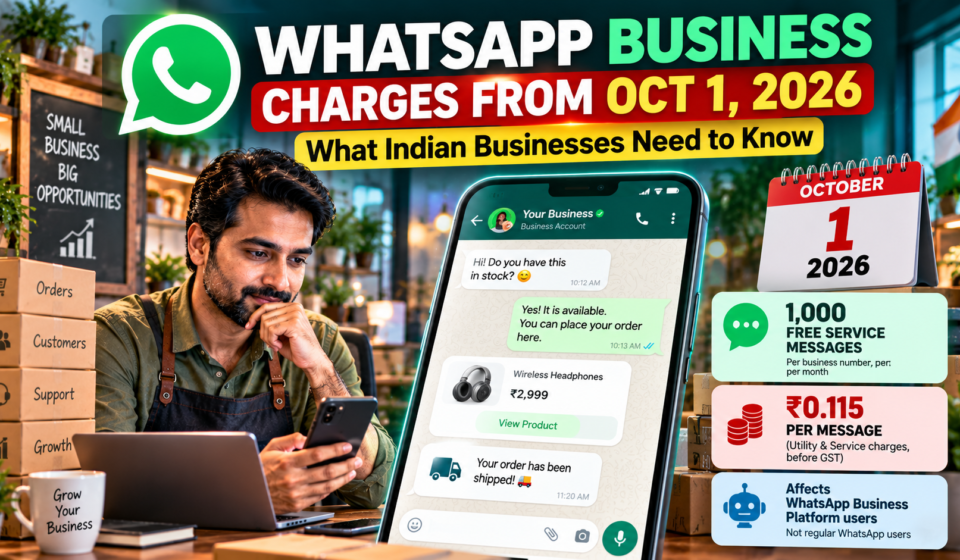
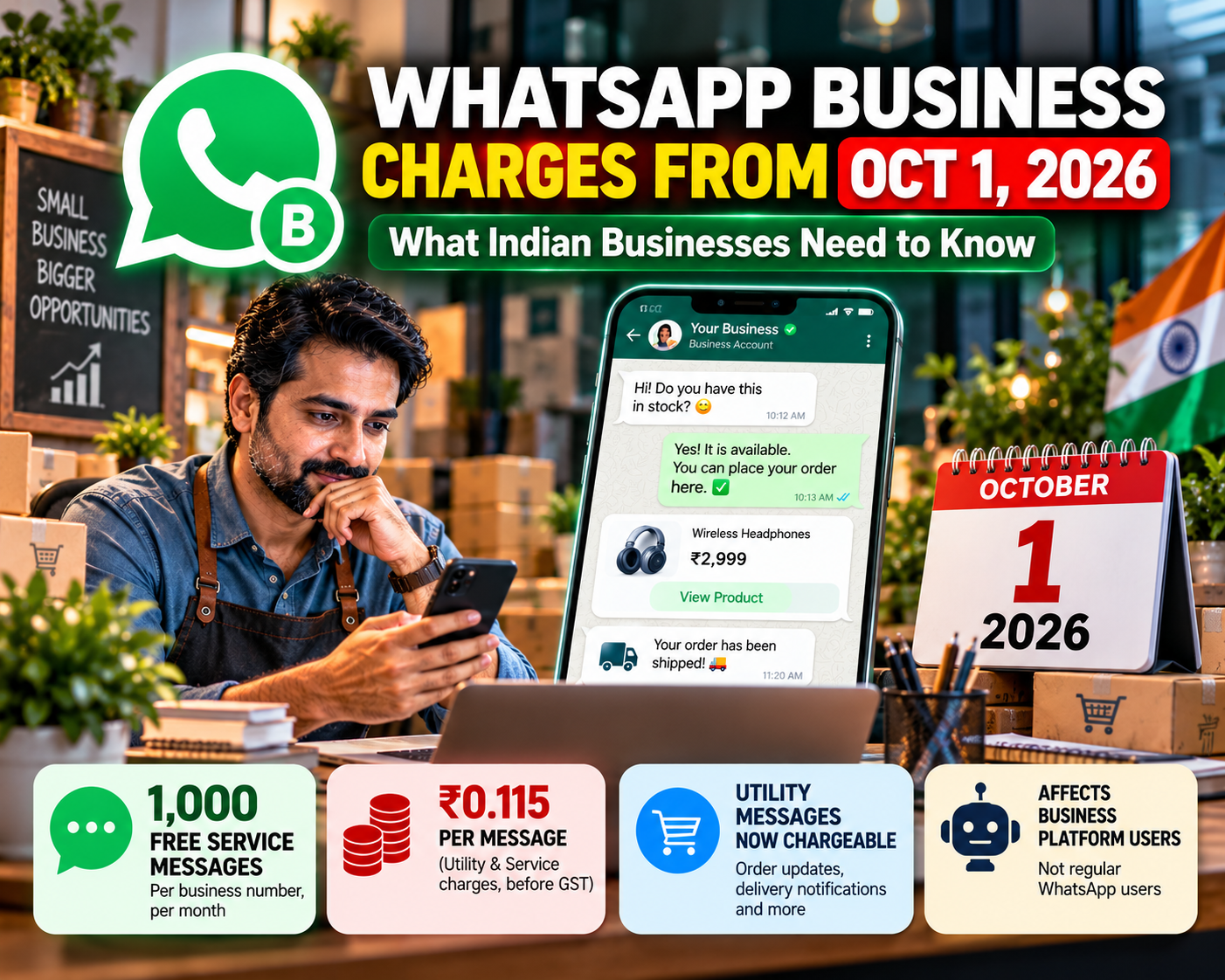
Quick answer: From October 1, 2026, WhatsApp Business Platform service replies will remain free for the first 1,000 service messages per business phone number per month. Additional service messages will be charged. Qualifying utility messages sent within the 24-hour customer-service window will also become chargeable.
What Is Changing on WhatsApp Business From October 1?
The biggest change concerns the way Meta treats service messages and utility messages on the WhatsApp Business Platform.
Until September 30, businesses using the platform could respond to customers within the 24-hour customer-service window without paying Meta messaging charges for those service replies. Certain utility messages sent within that window also received free treatment.
Starting October 1, 2026, that changes.
Businesses will receive 1,000 free service replies per month for each business phone number. Once that allowance is exhausted, additional service replies will be charged at the applicable market rate.
At the same time, qualifying utility messages sent within the 24-hour customer-service window will become chargeable.
Who Is Actually Affected?
This announcement does not mean that WhatsApp is becoming a paid messaging application for ordinary users.
The change primarily affects businesses using the WhatsApp Business Platform, including businesses using:
- WhatsApp APIs
- Customer-support software
- CRM integrations
- Chatbots
- Automated messaging systems
- Third-party WhatsApp Business Solution Providers
- AI-powered customer-service systems
Regular WhatsApp users are not being asked to pay for sending or receiving normal WhatsApp messages.
Businesses using only the standard WhatsApp Business application should also distinguish that product from the WhatsApp Business Platform before interpreting the pricing announcement.
What Are Service Messages?
Service messages are generally responses to customers who have initiated a conversation with a business.
For example, imagine that a customer sends a message to an online store:
Customer: Is the blue backpack available in 30 litres?
The business may reply:
Business: Yes, the blue 30-litre backpack is currently available.
This type of customer-support interaction falls within the service-message category on the WhatsApp Business Platform.
Service conversations can be handled by human customer-service agents as well as eligible automated or AI-powered systems.
For the official pricing framework and message categories, businesses should refer to Meta's WhatsApp Business Platform Pricing documentation.
What Is the 24-Hour Customer-Service Window?
The 24-hour customer-service window opens when a customer sends a message to a business.
It allows businesses to respond to the customer within the applicable WhatsApp messaging rules.
The important point is that the 24-hour window is not being removed.
Instead, Meta is changing the pricing treatment of certain messages sent during that window.
From October 1, qualifying utility messages sent during the window will no longer automatically receive the previous free treatment.
How Many Service Messages Will Be Free?
The 1,000-message allowance is important for businesses because it provides a monthly free threshold for service replies.
For example, if a business sends 700 eligible service replies during a month, those messages remain within the free allowance.
If the business sends 1,500 service replies, the first 1,000 are covered by the allowance and the remaining 500 are chargeable at the applicable service rate.
What About Utility Messages?
Utility messages are generally transactional messages connected to a customer's activity or request.
Examples include:
- Order confirmations
- Payment confirmations
- Shipping updates
- Delivery notifications
- Appointment reminders
- Account-related notifications
One of the most important October 1 changes is that qualifying utility messages sent within the 24-hour customer-service window will become chargeable.
Utility messages sent after the 24-hour window were already subject to applicable charges, so businesses should not confuse the new change with a completely new pricing category.
How Much Will WhatsApp Business Messages Cost in India?
The price depends on the message category and the recipient's market.
For India, current reporting on Meta's October 1 pricing indicates a standard rate of approximately ₹0.115 per delivered message for utility messages, before GST. Service messages after the free monthly allowance use the applicable service rate, which is aligned with the relevant market pricing.
| Message category | Typical use | India pricing indication |
|---|---|---|
| Service | Customer support replies | First 1,000/month free; then applicable rate |
| Utility | Orders, delivery and transactional updates | Approximately ₹0.115/message before GST |
| Authentication | OTP and verification messages | Approximately ₹0.115/message before GST |
| Marketing | Promotions and offers | Different, higher category rate |
Note: Rates can vary by market, category, pricing updates, taxes and third-party provider fees. Businesses should verify the current Meta rate card before making financial decisions.
Example: What Could the New Charges Mean for a Business?
Consider an Indian online business that sends 1,500 customer-service replies through the WhatsApp Business Platform during one month.
Under the new structure:
- First 1,000 service replies: free
- Remaining 500 service replies: chargeable
- Indicative India rate: ₹0.115 per message before GST
The messaging charge for the additional 500 messages would therefore be approximately:
500 × ₹0.115 = ₹57.50
before applicable GST and third-party fees
This is only an illustration. The actual amount paid by a business can depend on its messaging mix, provider, taxes and other applicable charges.
Will Customers Have to Pay?
No.
Customers do not have to pay Meta simply for receiving WhatsApp messages from businesses.
The pricing change applies to businesses using the WhatsApp Business Platform.
For consumers, normal WhatsApp messaging remains unaffected by this business-platform pricing change.
What Will Remain Free?
Despite the October 1 changes, several important aspects remain free or have separate treatment.
- The first 1,000 eligible service replies per business phone number each month remain free.
- Customers can continue sending messages to businesses without paying Meta messaging charges.
- Eligible 72-hour free-entry-point conversations associated with qualifying Click-to-WhatsApp ads and Facebook Page call-to-action experiences retain their special treatment.
Why This Matters for Indian Small Businesses
WhatsApp has become an important business communication channel in India.
Small businesses use it to answer questions, provide product information, confirm orders, share delivery updates and generate leads.
Meta itself says that Business AI on WhatsApp in India can help eligible small businesses answer customer queries, capture leads, recommend products and support sales around the clock.
That makes the October pricing change particularly interesting.
Businesses are getting more powerful automation and AI capabilities at the same time that certain messaging interactions are becoming chargeable.
For businesses, the goal should therefore not simply be to send more automated messages.
The goal should be to make every message useful.
How AI Could Change WhatsApp Business Costs
AI-powered customer support can potentially allow businesses to handle many more customer conversations without hiring a large support team.
For example, AI can help answer frequently asked questions about:
- Product availability
- Pricing
- Discounts
- Shipping
- Delivery status
- Business hours
- Appointments
- Returns and basic support
Meta has already introduced Business AI for eligible Indian businesses using the WhatsApp Business app.
According to Meta, Business AI can operate in India's native languages and can help businesses respond to customers around the clock.
Read more about this development on Meta's official announcement about Business AI on WhatsApp in India.
What Should Businesses Do Before October 1?
1. Check Your WhatsApp Setup
Find out whether your business uses the WhatsApp Business Platform, an API connection, CRM integration or a third-party WhatsApp provider.
2. Analyse Your Monthly Message Volume
Look at the number of service, utility, authentication and marketing messages your business sends each month.
3. Separate Customer Support From Marketing
Different WhatsApp message categories have different pricing rules. Businesses should understand which messages are being sent and how they are classified.
4. Review Automated Workflows
If your chatbot sends multiple messages for one simple customer question, consider whether the workflow can be simplified.
5. Check Your Billing Details
Businesses using the WhatsApp Business Platform should verify that their Meta Business account has the appropriate payment and billing setup.
6. Estimate Your Monthly Cost
Use your previous three months of messaging data to estimate how many service and utility messages you are likely to send after October 1.
WhatsApp Is Becoming a Bigger Part of India's Digital Economy
The pricing change comes at an interesting time for WhatsApp in India.
WhatsApp is no longer being used only for personal conversations.
Meta has been expanding its role in payments, business communication, customer support and commerce.
In September 2026, Meta announced the rollout of bill payments on WhatsApp in India, providing access to thousands of billers across categories such as electricity, gas, water, FASTag, insurance, credit-card and loan repayments.
Read the official Meta announcement about WhatsApp bill payments in India.
This broader expansion makes WhatsApp increasingly important as a digital platform rather than simply a messaging application.
WhatsApp Business Pricing Change: Key Points
- Effective date: October 1, 2026
- Mainly affected: WhatsApp Business Platform users
- Free service allowance: 1,000 service replies per business phone number per month
- After 1,000: Additional service replies become chargeable
- Utility messages: Qualifying messages inside the 24-hour window become chargeable
- Regular WhatsApp users: Not affected
- WhatsApp Business app: Different from the Business Platform and should not be confused with it
Frequently Asked Questions
Is WhatsApp becoming a paid app from October 1, 2026?
No. WhatsApp is not becoming a paid messaging app. The change concerns businesses using the WhatsApp Business Platform.
Will normal WhatsApp users have to pay?
No. Customers will not have to pay to send or receive normal WhatsApp messages because of this pricing change.
How many WhatsApp service messages are free?
Businesses using the WhatsApp Business Platform will receive 1,000 free service replies per business phone number per month. Additional eligible service replies will be charged at the applicable market rate.
Will order confirmations become chargeable?
Yes. Qualifying utility messages such as order confirmations and delivery updates sent within the 24-hour customer-service window will become chargeable from October 1, 2026.
Will WhatsApp Business App users be charged per message?
The October 1 pricing change is aimed at the WhatsApp Business Platform. Businesses should distinguish the Business Platform from the standard WhatsApp Business app before assessing their exposure.
What is the India WhatsApp Business utility message rate?
Current reporting indicates an India rate of approximately ₹0.115 per delivered utility message before GST. Rates can change, so businesses should verify Meta's live pricing documentation before budgeting.
What should businesses do before October 1?
Businesses should check their WhatsApp setup, analyse message volumes, review automated workflows, verify billing details and estimate the effect of the new pricing on monthly operating costs.
Final Takeaway
The WhatsApp Business pricing change taking effect on October 1, 2026 is important, but it is also easy to misunderstand.
WhatsApp itself is not becoming a paid app.
The change affects businesses using the WhatsApp Business Platform and introduces charges for certain messages that previously received free treatment.
For small businesses with relatively low messaging volumes, the financial impact may be limited. For companies handling thousands of customer interactions every month, however, message volume and automation efficiency could become much more important.
The smartest approach is to start measuring your WhatsApp communication now.
Know how many messages you send, understand which categories they fall into and identify which conversations can be handled efficiently without unnecessary message volume.
As WhatsApp continues expanding into AI, payments, customer service and commerce in India, understanding its business pricing model will become increasingly important for digital-first businesses.
October 1, 2026 is an important date for businesses using WhatsApp Business Platform in India.
Last updated: October 1, 2026
Disclaimer: WhatsApp Business Platform pricing can vary according to message category, recipient market, applicable pricing tiers, taxes and third-party provider fees. Businesses should verify the latest Meta pricing documentation before making financial or operational decisions.
Related