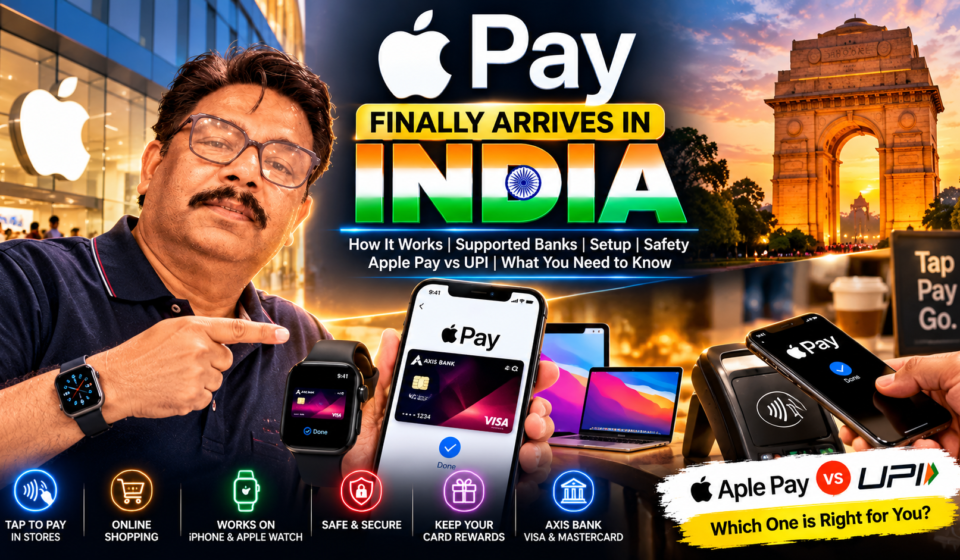
Apple Pay Finally Arrives in India : But There’s a Catch

Apple Pay vs UPI: Why has Apple entered India after 12 years—and can it actually change the way Indians pay?
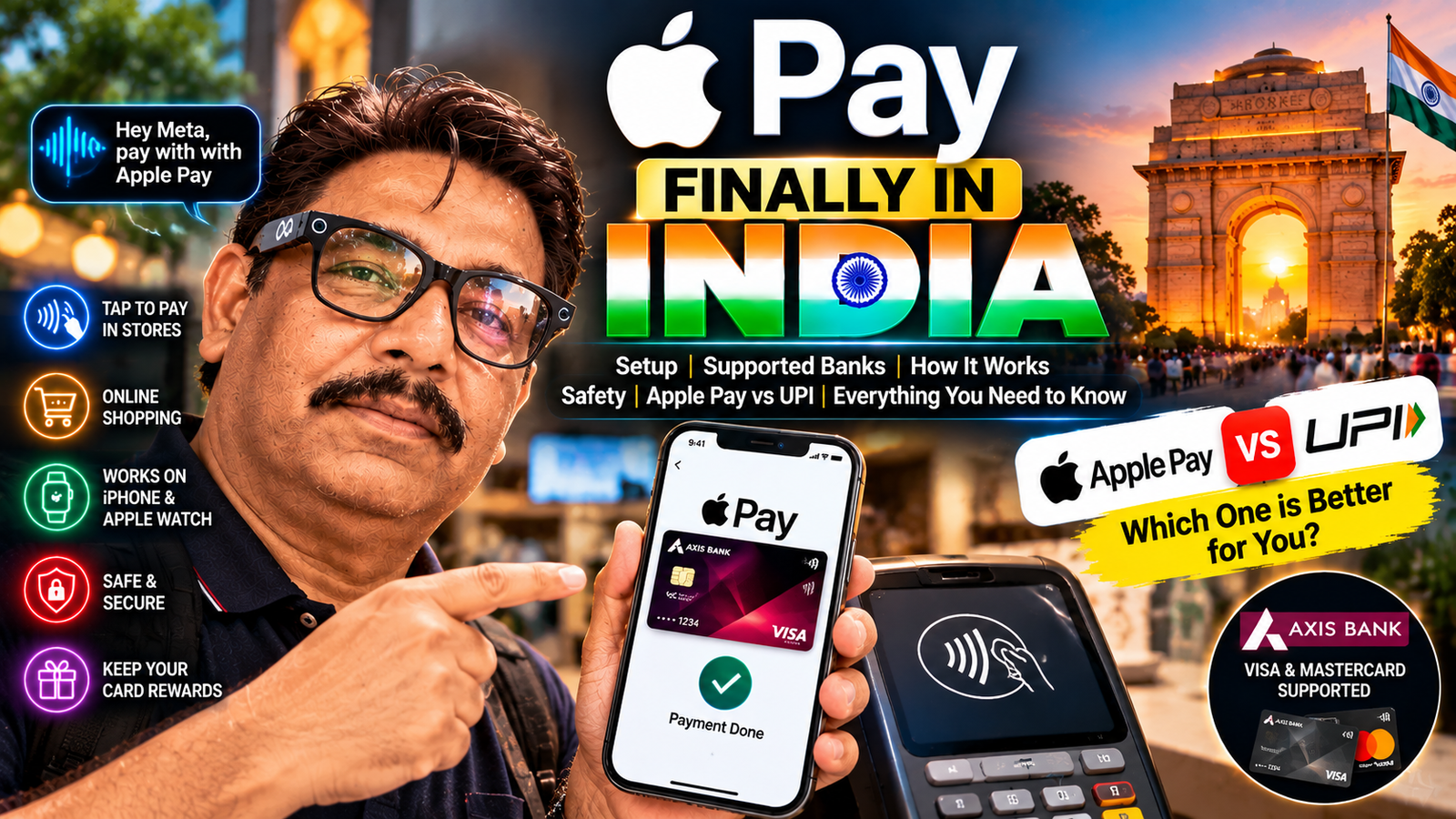
Table of Contents
ToggleApple Pay Finally Arrives in India: How It Works, Supported Cards, Setup, Security & Apple Pay vs UPI
Apple Pay is finally in India. After years of waiting, Apple has officially launched its contactless payment service in the country. The launch took place on 30 September 2026, initially in partnership with Axis Bank.
For millions of Indian iPhone users, this sounds like a simple new payment feature. But there is a much bigger question behind the launch:
Apple Pay enters India with a very different approach. Instead of replacing UPI, it brings Apple's card-based, device-integrated contactless payment experience to Indian users.
In this detailed guide, we explain what Apple Pay is, who can use it, which cards are supported, how to set it up, how payments work, how secure it is, and how Apple Pay differs from UPI.
Apple Pay India Launch: What Happened?
Apple officially launched Apple Pay in India on 30 September 2026. At launch, eligible Axis Bank Visa and Mastercard credit cards can be added to Apple Wallet and used through Apple Pay.
Apple says users can make payments using compatible iPhone, iPad and Apple Watch devices at participating merchants, in apps and on websites. Mac support is expected to arrive later.
The launch is significant because Apple Pay has been available internationally for years, while Indian consumers have largely relied on UPI apps and domestic payment infrastructure.
According to Apple's official announcement, Apple Pay is already available in more than 90 countries and regions and works with more than 11,000 bank and network partners globally.
Read Apple's official Apple Pay India announcement
Who Can Use Apple Pay in India Right Now?
This is one of the most important things to understand before trying Apple Pay.
| Requirement | Current Position |
|---|---|
| Bank | Axis Bank |
| Card network | Visa and Mastercard |
| Card type | Eligible Axis Bank credit cards |
| iPhone | Compatible iPhone running supported software |
| Apple Watch | Compatible Apple Watch |
| iPad | Supported for eligible purchases |
| Mac | Support coming soon |
Apple's current India bank-support page lists Axis Bank Visa and Mastercard credit cards as eligible cards. The supported-bank list can expand as additional issuers are added.
Check Apple's current list of supported banks and cards
Apple Pay vs UPI: Are They Actually the Same?
No. This is perhaps the biggest misconception surrounding Apple Pay's arrival in India.
Apple Pay and UPI can both be used to make digital payments, but their underlying models are different.
| Feature | Apple Pay | UPI |
|---|---|---|
| Primary model | Card-based | Bank-account based |
| Payment method | NFC/contactless and supported online checkout | UPI ID, QR, UPI-enabled checkout and other supported methods |
| Physical card required? | Eligible card must be added to Wallet | No |
| Authentication | Face ID, Touch ID or passcode | UPI PIN or supported authentication method |
| Best known use case | Tap-to-pay with a stored card | Everyday bank-account payments and QR transactions |
Therefore, Apple's entry should not be viewed simply as another UPI competitor. It is bringing a different payment layer into the Indian ecosystem.
Why Apple Pay Could Be Interesting for Indian iPhone Users
Imagine walking into a store where contactless card payment is supported.
Instead of taking out your physical credit card, you can double-click the relevant button on your iPhone, authenticate and hold the phone near the contactless terminal.
With Apple Watch, the payment experience can be even more convenient because the watch itself becomes the payment device.
This is particularly relevant for people who already use credit cards for rewards, cashback, travel benefits or other card-specific advantages.
Apple says users continue to receive the rewards and benefits offered by their cards when using Apple Pay.
How to Set Up Apple Pay in India
The setup process is relatively straightforward for an eligible Axis Bank card.
Method 1: Add the Card Through Apple Wallet
- Open the Wallet app on your iPhone.
- Tap the + button.
- Follow the instructions to add your eligible Axis Bank credit card.
- Verify the card with Axis Bank.
- Complete the authentication process.
- Your card can then be used through Apple Pay where supported.
Method 2: Add the Card Through Axis Bank
Eligible customers can also add their card using the Axis Bank mobile banking application and follow the verification instructions.
See Axis Bank's official Apple Pay setup guide
How to Pay in a Physical Store Using Apple Pay
Once your eligible card is added, the process is designed to be quick.
- Look for the contactless payment symbol at the payment terminal.
- Double-click the side button on your iPhone.
- Authenticate using Face ID, Touch ID or your device passcode when required.
- Hold the top portion of the iPhone near the contactless reader.
- Wait for the confirmation.
With Apple Watch, users can similarly authenticate and hold the watch near the contactless terminal.
Can Apple Pay Be Used for Online Shopping?
Yes.
Apple Pay can also be used in supported apps and websites. Instead of repeatedly entering card details, billing information and other checkout information, the user can select Apple Pay and authenticate on the device.
Apple says the service is already supported by a range of merchants and apps in India.
At launch, Apple's listed participating merchants include services and brands such as Apple Store, Blinkit, Chaayos, Croma, Ixigo, Reliance brands, Tata 1mg and Zomato, among others.
Is Apple Pay Safe?
Security is one of the major reasons Apple has positioned Apple Pay differently from conventional card payments.
Apple says the actual card number is not stored on the device or Apple's servers and is not shared with merchants during Apple Pay transactions.
Instead, Apple Pay uses a unique Device Account Number that is encrypted and stored in the device's Secure Element.
In simple terms, the merchant does not receive your actual card number in the same way it would when you hand over your physical card details.
What Happens If Your iPhone Is Lost?
This is another interesting part of Apple's ecosystem.
Apple says that if an iPhone is lost or stolen, users can use the Find My service to locate, lock or suspend payments from the device.
This adds another layer of control that is difficult to replicate with a physical card left in a wallet.
Apple Pay Does Not Mean You Can Forget UPI
This point deserves emphasis.
Apple Pay is arriving in a country where UPI has become deeply integrated into everyday commerce.
From vegetable vendors and roadside tea stalls to supermarkets, restaurants, e-commerce websites and bill payments, UPI QR codes are now an extremely familiar payment mechanism.
Apple Pay's initial Indian model is different because it is centred on eligible cards and contactless/card-based payments.
Therefore, an iPhone user could potentially use both UPI and Apple Pay depending on the merchant, transaction type and preferred funding source.
Apple Pay's Biggest Limitation in India Right Now
The biggest limitation at launch is straightforward:
Limited bank support.
Apple Pay currently starts with eligible Axis Bank Visa and Mastercard credit cards. That means an iPhone owner with a different bank's card cannot automatically assume that the card can be added.
Apple's support list can change as more banks join the platform, so users should check the official list rather than relying on older social-media posts or videos.
Another important distinction is that the current launch does not mean that every type of Indian payment card is supported.
What About RuPay Cards?
At launch, Apple's India support information specifies Axis Bank Visa and Mastercard credit cards.
That means users should not assume that an Axis Bank RuPay card is supported simply because Apple Pay is now available in India.
Card-network and issuer eligibility matter.
Why Did Apple Take So Long to Bring Apple Pay to India?
Apple Pay launched internationally many years ago, but India's payment ecosystem developed along a very different path.
India's UPI infrastructure made bank-account-to-bank-account digital payments extremely easy, while QR-based payments became deeply embedded in daily commerce.
Apple Pay, meanwhile, was built primarily around payment cards and contactless infrastructure.
That difference helps explain why Apple Pay's Indian launch is more interesting than simply another digital-wallet announcement.
It represents the entry of Apple's global card-payment ecosystem into one of the world's most sophisticated and heavily used digital-payment environments.
Apple Pay and UPI Could Coexist
The most realistic way to look at the Indian market is not necessarily “Apple Pay versus UPI.”
They solve somewhat different problems.
- UPI: extremely useful for direct bank-account payments and QR transactions.
- Apple Pay: designed around eligible payment cards and seamless device-based contactless payments.
- Credit-card users: may find Apple Pay useful when they want to continue earning card rewards without physically using the card.
- Apple Watch users: gain an additional contactless payment option directly from the wrist.
Where Apple Pay Could Become Particularly Useful
1. Shopping Malls
Contactless-enabled payment terminals are increasingly common in organised retail environments. Apple Pay provides another way to use an eligible card.
2. Restaurants
At supported terminals, a customer can authenticate on the Apple device and tap rather than handing over a physical card.
3. Travel
For frequent travellers who prefer credit cards for rewards and expense tracking, carrying a digital version of an eligible card can be convenient.
4. Online Shopping
Supported apps and websites can offer Apple Pay at checkout, reducing the amount of information that users have to manually enter.
5. Apple Watch Users
The ability to make contactless payments from the wrist is one of the most distinctive parts of Apple's ecosystem.
Apple Pay vs Google Pay vs PhonePe vs UPI: Why This Comparison Is Complicated
It may be tempting to put Apple Pay, Google Pay and PhonePe into one simple ranking. But technically they are not identical services.
Google Pay and PhonePe are deeply integrated into India's UPI ecosystem, while Apple Pay's initial Indian implementation is centred around eligible payment cards.
That means consumers may use them for overlapping situations but through different payment rails.
| Service | Core Model | Typical Indian Use |
|---|---|---|
| Apple Pay | Card/contactless | Eligible card payments |
| Google Pay | UPI and other supported payment services | QR and digital payments |
| PhonePe | UPI and financial services | QR, transfers and bill payments |
| UPI | Bank-account payment infrastructure | Transfers and merchant payments |
Apple Pay's Privacy Approach
Privacy is another major part of Apple's pitch.
Apple says it does not store the actual card number on its servers for Apple Pay transactions and does not share the actual card number with merchants.
Apple also states that transaction information that can be tied back to the user is not retained by Apple.
For consumers increasingly concerned about how payment information is handled, this is an important part of the Apple Pay proposition.
Read Apple's official Apple Pay privacy and security information
Will Apple Pay Replace UPI in India?
Apple Pay's arrival does not mean UPI is going away.
In fact, the two systems can coexist because they are designed around different payment mechanisms.
The bigger question is how far Apple can expand its Indian banking partnerships and how many users find value in combining their iPhone or Apple Watch with their existing credit-card usage.
More banks and card networks joining Apple Pay would significantly broaden its potential reach.
What Apple Pay Means for the Future of Digital Payments in India
Apple Pay's arrival is important beyond Apple users.
India has become one of the world's most advanced digital-payment markets, and international technology companies have to adapt their payment products to an ecosystem that is already highly developed.
Apple is therefore entering an established market rather than creating one from scratch.
The coming months should reveal whether Indian consumers use Apple Pay primarily for contactless credit-card payments, online checkout, Apple Watch payments or a combination of all three.
The Big Question
Apple Pay does not need to replace UPI to become useful in India. Its real opportunity may be to become the easiest way for Apple users to carry and use their eligible credit cards without carrying the physical card.
Frequently Asked Questions About Apple Pay India
Is Apple Pay available in India?
Yes. Apple Pay officially launched in India on 30 September 2026.
Which bank supports Apple Pay in India?
At launch, eligible Axis Bank Visa and Mastercard credit cards are supported. Apple says its list will be updated as additional banks are added.
Can I use Apple Pay with UPI?
Apple Pay and UPI are different payment systems. Apple Pay's initial Indian launch is based on eligible payment cards, while UPI is a bank-account payment infrastructure.
Can I use Apple Pay on Apple Watch?
Yes. Apple Pay is available on supported Apple Watch devices in India.
Can Apple Pay be used for online shopping?
Yes. Apple Pay can be used at supported apps and websites.
Does Apple Pay require an OTP for every payment?
Apple's India launch materials describe device authentication through Face ID, Touch ID or passcode for supported payments rather than repeatedly entering card details, PINs or OTPs at checkout.
Are RuPay cards supported?
The initial Apple Pay India support list specifies eligible Axis Bank Visa and Mastercard credit cards. Users should check Apple's current supported-card list for future additions.
Is Apple Pay safe?
Apple uses tokenisation and the device's Secure Element. Apple states that the actual card number is not stored on Apple's servers or shared with merchants during Apple Pay transactions.
Final Take: Apple Pay Has Finally Entered India's Payment Story
Apple Pay's arrival in India is an important technology milestone, but its significance is easy to misunderstand.
This is not simply another UPI app. Apple is bringing its established card-based payment ecosystem into a market where UPI has already transformed everyday digital payments.
For an eligible Axis Bank cardholder using an iPhone or Apple Watch, Apple Pay could provide a convenient way to make contactless payments while keeping the benefits of the existing credit card.
For everyone else, the most important thing to watch is what happens next: which banks join, which card networks become available, and how widely Apple Pay expands across Indian merchants and apps.
The launch may therefore be less about replacing the way Indians pay and more about giving India's rapidly evolving digital-payment ecosystem another major technology layer.
Useful Official Resources
- Apple Pay India – Official Apple Announcement
- Apple Pay – Supported Banks and Cards in India
- Axis Bank – Apple Pay Setup and FAQ
- Apple Pay – Official Security and Privacy Information
Explore More on ExploreWithArvind
For more technology, digital lifestyle, travel and consumer-interest stories, visit ExploreWithArvind.
You may also enjoy our detailed technology-focused article on The Electric Vehicle Revolution: A Global Outlook for 2030 and Beyond.
Editor's Note: Payment services, supported banks, card eligibility, devices and merchant acceptance can change after publication. Readers should verify eligibility and current terms with Apple and their card issuer before relying on this information for a transaction.
Related