
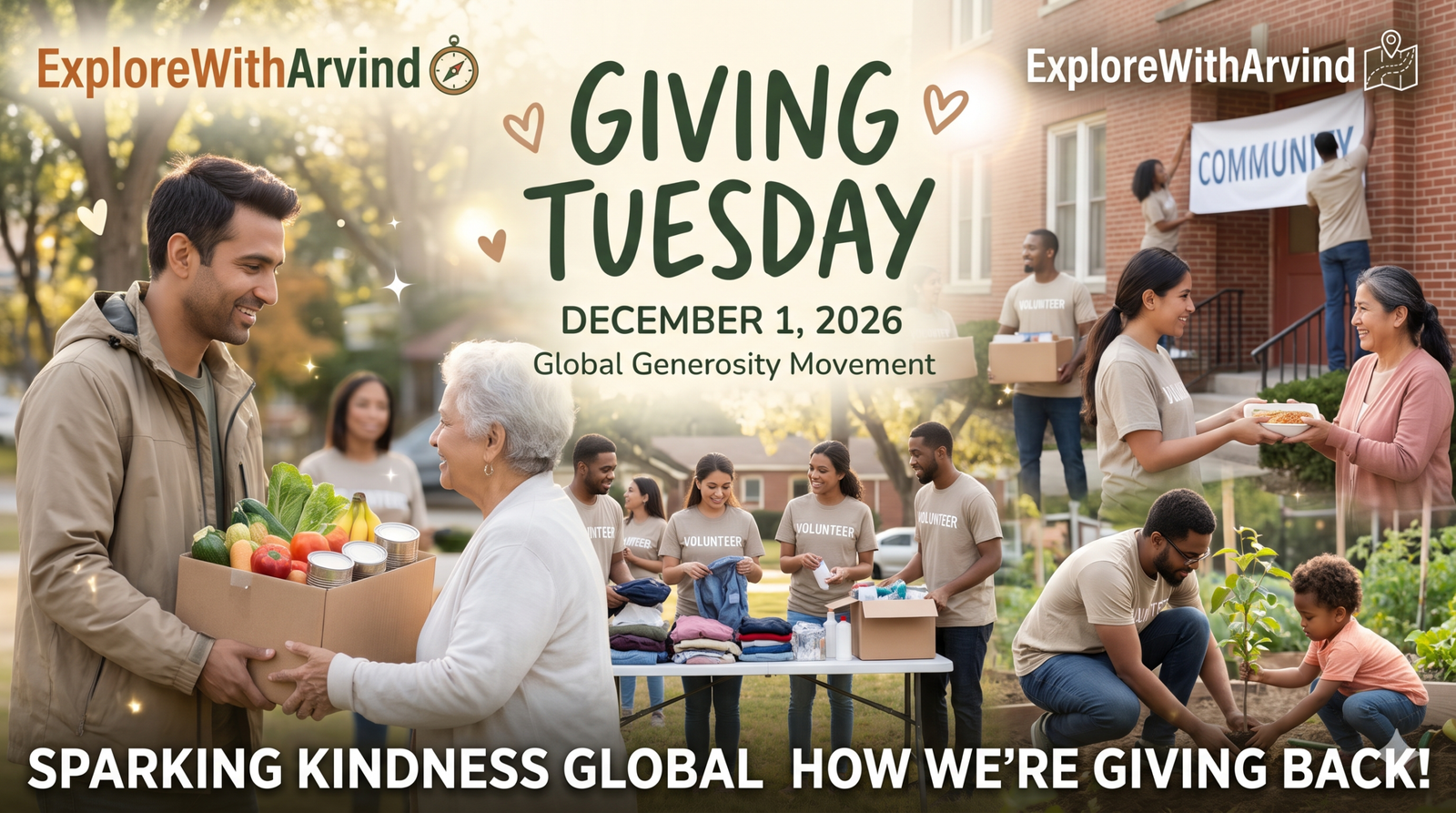
Giving Tuesday 2026 falls on December 1. Discover its history, global significance, ways to give, volunteer opportunities and how to make a difference.
Table of Contents
ToggleGiving Tuesday 2026: Date, History, Meaning, Global Movement and How to Make a Difference
What if, after days of shopping, discounts and online deals, the world paused for a moment to celebrate something completely different? What if, instead of asking what we could buy, we asked what we could give?
That is the beautiful idea behind Giving Tuesday, a global movement that encourages people to embrace generosity, support meaningful causes and make a positive difference in their communities.
Following Thanksgiving, Black Friday and Cyber Monday, Giving Tuesday offers a refreshing reminder that the value of a season is not measured only by what we purchase, but also by what we share with others.
Giving Tuesday 2026 will be celebrated on Tuesday, December 1, 2026. People, charities, businesses, community groups and individuals around the world are encouraged to participate through donations, volunteering, sharing skills and simple acts of kindness.
And here is the most important message: you do not need to be wealthy to participate. You do not need to donate a large amount of money. Sometimes, an hour of your time, a helping hand, a useful skill or a thoughtful gesture can make a meaningful difference.
- Date: Tuesday, December 1, 2026
- Day: Tuesday
- Origin: United States
- Started: 2012
- Purpose: Encourage generosity, giving and community action
- Participation: Donations, volunteering, sharing skills, advocacy and acts of kindness
- Official website: GivingTuesday.org
1. What Is Giving Tuesday?
Giving Tuesday is a global generosity movement that encourages people to do good and contribute positively to society.
It is not simply a fundraising campaign or a day reserved for wealthy philanthropists. It invites everyone to participate in whatever way they can.
A person may donate money to a charitable organisation. Another may volunteer at a local shelter. Someone else may teach children, help an elderly neighbour, donate books or organise a neighbourhood cleanliness drive.
All these actions reflect the same spirit: generosity.
The movement promotes the idea of radical generosity—a belief that empathy, compassion and collective action can help create stronger and more caring communities.
Giving Tuesday also encourages people to think beyond a single day. Its broader vision is to make generosity an everyday habit rather than an occasional activity.
2. When Is Giving Tuesday 2026?
Giving Tuesday 2026 falls on Tuesday, December 1, 2026.
The annual event takes place on the Tuesday following Thanksgiving in the United States. Since Thanksgiving is observed on the fourth Thursday of November, the date of Giving Tuesday changes every year.
| Event | 2026 Date | Day |
|---|---|---|
| Thanksgiving | November 26 | Thursday |
| Black Friday | November 27 | Friday |
| Small Business Saturday | November 28 | Saturday |
| Cyber Monday | November 30 | Monday |
| Giving Tuesday | December 1 | Tuesday |
Although the date is linked to the American Thanksgiving calendar, the movement has grown internationally. People in participating countries can take part in local activities and initiatives suited to their communities.
3. The History of Giving Tuesday: How Did It Begin?
Giving Tuesday began in 2012 in New York City as a simple but powerful idea.
After Thanksgiving, the American shopping calendar was dominated by Black Friday and Cyber Monday. These events encouraged consumers to spend money, purchase gifts and prepare for the holiday season.
A group at the 92nd Street Y, working through its Belfer Center for Innovation & Social Impact, wondered whether the same collective energy could be used to encourage generosity.
Could there be a day dedicated not to buying things, but to doing good?
That question inspired the creation of Giving Tuesday in 2012.
From a simple idea to a global movement
The original campaign used social media and collaboration to encourage individuals and organisations to support causes they cared about.
The idea quickly gained attention. Charities, community groups, businesses and individuals began sharing their own stories of generosity.
Over time, Giving Tuesday developed into an independent nonprofit organisation and an international network of local leaders and communities.
Today, the movement inspires people across countries and cultures to contribute through donations, volunteering, community participation and everyday kindness.
What makes its journey remarkable is that it did not begin with a demand for large donations. It began with a simple invitation: do something good.
4. Why Does Giving Tuesday Follow Black Friday and Cyber Monday?
The timing of Giving Tuesday is meaningful.
Black Friday and Cyber Monday are associated with shopping, discounts and consumer spending. Giving Tuesday follows these events with a different message: generosity deserves a place in our lives too.
It does not suggest that shopping is wrong or that people should stop buying things. Instead, it introduces a balance between consumption and contribution.
The sequence creates an interesting contrast:
- Black Friday: A major retail shopping event.
- Small Business Saturday: Encourages support for small and local businesses.
- Cyber Monday: A major online shopping event.
- Giving Tuesday: Encourages generosity and giving back.
In a world where advertisements constantly tell us what we should own, Giving Tuesday asks a different question: what can we do for someone else?
5. How Has Giving Tuesday Become a Global Movement?
One reason behind the growth of Giving Tuesday is its inclusive nature.
Different countries have different traditions of charity, community service and philanthropy. The movement does not require everyone to follow the same model. Instead, it encourages local communities to express generosity in ways that make sense for them.
Its global network includes local leaders, nonprofit organisations, businesses, volunteers and individuals who organise activities throughout the year.
Different ways countries and communities participate
- Organising fundraising campaigns for local charities.
- Supporting food banks and community kitchens.
- Encouraging volunteering in schools and community centres.
- Collecting books, clothes and essential supplies.
- Promoting environmental activities and neighbourhood clean-ups.
- Sharing stories that inspire people to help others.
- Encouraging businesses to support social causes.
The movement has also demonstrated how digital platforms can connect people who may be separated by geography but united by a common cause.
6. Giving Tuesday in India: Can Indians Participate?
Absolutely. Generosity is not limited by geography, and India has a long tradition of community service, charity and helping those in need.
Indian culture has many expressions of giving and service. Concepts such as daan (charitable giving), seva (selfless service) and paropkar (working for the welfare of others) reflect values that are closely aligned with the spirit of Giving Tuesday.
From community kitchens and blood donation camps to education initiatives and disaster relief, people across India already participate in activities that support others.
Giving Tuesday provides another opportunity to recognise, organise and share such efforts.
Practical ways to participate in India
- Support education: Donate books, stationery, school bags or learning materials to children who need them.
- Support food initiatives: Contribute to a verified community kitchen or help distribute meals through an established organisation.
- Help senior citizens: Spend time with elderly people, assist with essential errands or help them access digital services.
- Donate useful items: Give clean clothes, blankets, toys and household essentials in good condition.
- Volunteer your skills: Offer free tutoring, career guidance, computer training or professional advice.
- Support animal welfare: Help verified animal shelters or local rescue groups.
- Protect the environment: Participate in a local clean-up, tree-care or waste-segregation initiative.
- Help people in need: Support reliable organisations working with vulnerable communities.
One does not have to wait for an international campaign to perform these actions. Giving Tuesday can simply be a reminder to begin—or continue—a habit of helping others.
7. Ten Meaningful Ways to Celebrate Giving Tuesday 2026
If you are wondering how to participate, here are ten practical ideas that do not require a large budget.
1. Donate something useful
Look around your home. Books, clothes, school supplies, toys and other useful items that are no longer needed by your family may be valuable to someone else.
Ensure that donated items are clean, safe and in usable condition.
2. Spend time with someone who feels lonely
Visit an elderly neighbour, call someone who lives alone or spend time with a person who may need companionship.
Sometimes, attention and conversation are among the most meaningful gifts we can offer.
3. Teach a skill for free
If you are good at mathematics, English, computers, music, art or another subject, consider offering a free learning session to someone who cannot easily access such opportunities.
4. Support a local community kitchen
Food insecurity remains a serious concern in many communities. You can support a verified food distribution programme through money, ingredients, volunteering or logistical assistance.
5. Donate blood if eligible
Eligible individuals can consider donating blood through a recognised blood bank or hospital following medical screening and professional guidance.
6. Help someone access digital services
Many people struggle with online forms, digital payments, smartphone settings and essential internet services. Helping someone navigate these systems can make everyday life easier.
7. Organise a neighbourhood cleanliness drive
Invite friends and neighbours to clean a public space, segregate waste or spread awareness about responsible disposal.
8. Support a small charitable organisation
Research a local organisation working on education, healthcare, animal welfare, environment or community development. Support its work after checking its credibility.
9. Offer professional guidance
Professionals can share knowledge through free career counselling, resume reviews, financial literacy sessions or mentorship programmes.
10. Start a kindness chain
Perform one thoughtful action and encourage a few friends to do something similar. Ask them to pass the idea forward without making participation compulsory.
A small act can inspire another, and that is how community spirit grows.
8. How Businesses and Organisations Can Participate
Giving Tuesday is not only for individuals. Companies, schools, colleges, resident welfare associations, professional groups and nonprofit organisations can also participate.
For businesses
- Organise employee volunteering programmes.
- Support a verified local nonprofit.
- Match employee donations where feasible.
- Donate professional services or useful equipment.
- Encourage customers and employees to participate voluntarily.
- Share genuine stories about community initiatives and their outcomes.
For schools and colleges
- Organise book and stationery collection drives.
- Encourage students to volunteer for community projects.
- Conduct awareness programmes on kindness and social responsibility.
- Arrange environmental activities.
- Invite students to share stories of people who inspire them through service.
For resident welfare associations
Neighbourhood communities can organise food collection, clothing donation, cleanliness drives, senior-citizen assistance and other activities based on local needs.
Such initiatives can strengthen relationships among residents and create a more supportive neighbourhood.
9. Digital Giving: How Social Media Is Helping Generosity Grow
Social media has played an important role in the growth of Giving Tuesday.
Earlier, charitable campaigns were often limited by geography and the reach of individual organisations. Digital platforms have made it easier to share fundraising appeals, volunteer opportunities and inspiring stories with a much wider audience.
A person can now discover a cause, learn about an organisation, contribute to a campaign or volunteer for an initiative through online platforms.
How digital platforms support Giving Tuesday
- Online donation pages make contributions easier.
- Social media helps organisations share their work.
- Digital storytelling introduces people to local causes.
- Online communities help coordinate volunteers.
- Virtual events allow participation across locations.
- Digital payment systems can simplify legitimate donations.
However, digital convenience must be accompanied by caution. Not every fundraising message shared online is genuine.
10. How to Verify a Charity Before Donating in India
Giving is meaningful, but it is equally important to ensure that your contribution reaches the intended organisation or cause.
Unfortunately, fraudulent donation appeals can appear during emergencies, festivals and charitable campaigns. Scammers may use emotional photographs, copied logos and urgent messages to persuade people to transfer money without verification.
A practical verification checklist
- Check the organisation's identity: Look for its registered name, address, official website and contact information.
- Check relevant registration details: Ask for the organisation's registration information and verify it through appropriate official records where available.
- Use NGO Darpan where relevant: The NITI Aayog NGO Darpan portal provides information about registered voluntary organisations and their Unique ID details. Registration on a portal should not be treated as a guarantee of the quality or legitimacy of every fundraising appeal.
- Check 80G status if claiming a tax benefit: If you expect a deduction under Section 80G, confirm that the donee organisation has the relevant valid approval and ask for the appropriate receipt or certificate.
- Check FCRA requirements where relevant: Organisations receiving foreign contributions in India are subject to the applicable Foreign Contribution (Regulation) Act requirements.
- Verify the payment destination: Confirm that the bank account or payment page belongs to the organisation or an authorised fundraising partner.
- Ask for documentation: Request a donation receipt and details about how the contribution will be used.
- Be cautious with personal UPI IDs: An appeal asking you to transfer money to an unrelated personal account deserves additional scrutiny.
Useful official resources:
- NITI Aayog NGO Darpan Portal
- Income Tax Department – India
- Ministry of Home Affairs – FCRA Information
A note on tax deductions: Not every donation qualifies for a tax deduction. Eligibility depends on the recipient, applicable approval, the type of donation and the donor's tax circumstances. Section 80G deductions are also subject to tax-regime rules. Check the current Income Tax Department guidance or consult a tax professional before claiming a deduction.
11. Does Giving Tuesday Mean You Must Donate Money?
Absolutely not.
This is perhaps the most important thing to understand about Giving Tuesday.
The movement recognises that people have different financial circumstances, abilities and opportunities. It encourages everyone to contribute in ways that are meaningful and possible for them.
- Your time to someone who needs support.
- Your knowledge to someone who wants to learn.
- Your skills to a community initiative.
- Your attention to someone who feels ignored.
- Your unused but useful possessions to someone who needs them.
- Your voice to raise awareness about a meaningful cause.
- Your money, if you are financially able and have verified the recipient.
Generosity is not measured only by the amount of money donated. The thought, sincerity and positive impact behind an action matter too.
12. The Psychology of Giving: Why Helping Others Matters
Generosity is not only beneficial to the person receiving help. Acts of kindness can also strengthen social connections and contribute to a sense of purpose and belonging.
When people volunteer, support a community initiative or help someone overcome a difficulty, they create opportunities for trust and human connection.
Giving can also remind us that our lives are connected to the lives of others.
Some wider benefits of generosity include:
- Stronger communities: People become more connected when they support one another.
- Greater social awareness: Helping others can improve understanding of challenges faced by different groups.
- Shared responsibility: Community initiatives encourage people to participate in solving local problems.
- Meaningful relationships: Volunteering and service can create friendships and lasting connections.
- A sense of purpose: Contributing to a cause can give people a meaningful way to use their time and abilities.
Of course, giving should be voluntary and sustainable. No one should feel pressured to contribute beyond their financial means, health or personal responsibilities.
13. Giving Tuesday and the Indian Philosophy of Seva and Daan
For Indian readers, the spirit of Giving Tuesday may feel familiar because the values of generosity and service have deep roots in Indian traditions.
Across different communities and traditions, the ideas of sharing, helping others and serving society have been expressed in many forms.
Daan – The spirit of giving
Daan represents the act of giving. It may involve money, food, knowledge, clothing or other forms of support.
Seva – Service without expectation
Seva refers to service performed for the welfare of others. It may involve helping a person in need, participating in community work or contributing one's skills without expecting personal reward.
Paropkar – Working for the welfare of others
Paropkar reflects the idea that our actions should contribute to the well-being of others and society.
These values offer a natural connection with the central message of Giving Tuesday: generosity is not merely a transaction; it is an expression of shared humanity.
14. A Simple Giving Tuesday Action Plan for December 1, 2026
If you want to participate but are unsure where to begin, here is a simple plan.
| Time | Suggested Activity |
|---|---|
| Morning | Identify one person or cause you would like to support. |
| Late morning | Make a donation of useful items or contribute a skill. |
| Afternoon | Volunteer, help a neighbour or participate in a community activity. |
| Evening | Share an inspiring story or encourage someone else to do good. |
| Before the day ends | Decide how you can continue the habit of giving throughout the year. |
You do not have to complete every activity. Choose one meaningful action that suits your circumstances.
15. Frequently Asked Questions About Giving Tuesday 2026
Q1. When is Giving Tuesday 2026?
Giving Tuesday 2026 will take place on Tuesday, December 1, 2026.
Q2. What is the purpose of Giving Tuesday?
Its purpose is to encourage generosity, charitable giving, volunteering, community participation and acts of kindness.
Q3. When did Giving Tuesday begin?
Giving Tuesday was created in 2012 by the team at the 92nd Street Y and its Belfer Center for Innovation & Social Impact in New York City.
Q4. Is Giving Tuesday celebrated in India?
People and organisations in India can participate in the global movement through local charity, volunteering, community service and acts of generosity. The activities should reflect local needs and circumstances.
Q5. Do I need to donate money to participate?
No. You can volunteer, share your knowledge, donate useful items, help a neighbour or support a community initiative. Financial donations are only one way to participate.
Q6. Is Giving Tuesday an official public holiday?
No. It is a global generosity movement and annual campaign, not an official public holiday.
Q7. What is the difference between Giving Tuesday and Cyber Monday?
Cyber Monday is a major online shopping event, while Giving Tuesday encourages people to give back through donations, volunteering and other acts of generosity.
Q8. Can businesses participate in Giving Tuesday?
Yes. Businesses can support charitable causes, organise employee volunteering, contribute useful resources or encourage community participation.
Q9. How can I make sure my donation reaches a genuine charity?
Check the organisation's identity, relevant registration and approval details, official payment destination and documentation. Avoid responding to unverified fundraising messages or urgent payment requests.
Q10. Does a donation automatically qualify for an income-tax deduction in India?
No. Only eligible donations to qualifying recipients may receive deductions under applicable tax provisions. Check the current Section 80G requirements and the tax regime applicable to you.
Conclusion: The World Needs More People Who Care
Giving Tuesday 2026 is more than another date on the international calendar. It is a reminder that generosity can bring people together, strengthen communities and create positive change.
In a world often dominated by competition, consumerism and individual achievement, a movement that encourages people to think about others carries a powerful message.
You may not be able to solve every problem. You may not be able to help everyone. But you can make a difference in someone's life.
You can teach a child, support an elderly neighbour, donate a book, volunteer your time, help an animal or contribute to a verified organisation.
And perhaps the most beautiful thing about generosity is that it does not have to end when December 1 is over.
Let Giving Tuesday 2026 be the beginning of a habit, not just a one-day celebration.
Because a better world is not built only by extraordinary people doing extraordinary things. It is also built by ordinary people doing small, thoughtful things every day.
Give what you can. Help where you can. Make kindness a habit.
Written by Arvind Sinha for Explore With Arvind.
