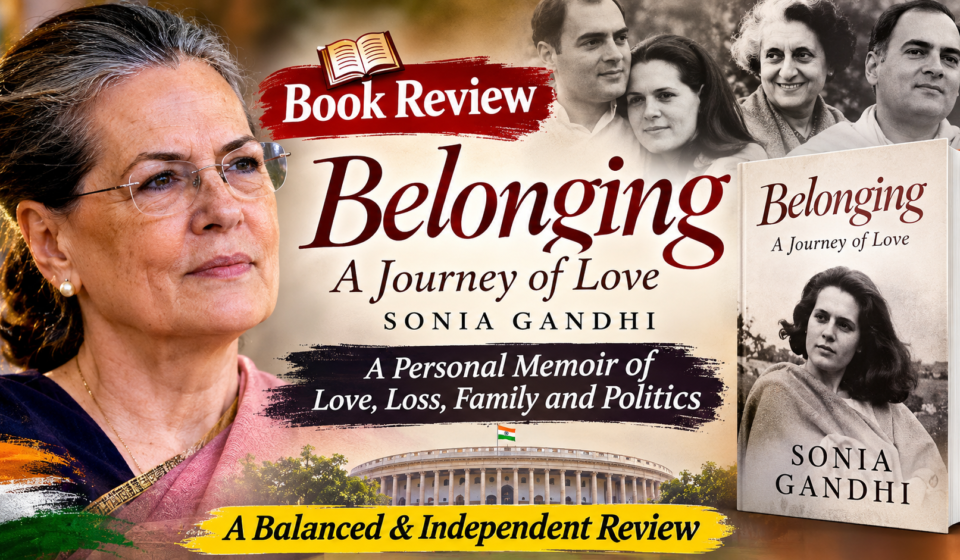
Book Review: Belonging – A Journey of Love by Mrs Sonia Gandhi

Table of Contents
ToggleHow convincingly Sonia Gandhi communicates her emotional journey.
This is a book by Mrs Sonia Gandhi, worth exploring for readers interested in Indian political history, the Nehru-Gandhi family, women’s experiences in public life and the human stories behind major historical events.
Belonging: A Journey of Love – More Than a Political Memoir Author: Sonia Gandhi
Some books are written to tell stories. Others are written to explain decisions, revisit memories and offer a glimpse into lives that the public believes it already knows.
Sonia Gandhi’s Belonging: A Journey of Love appears to belong to the latter category.One of the most anticipated political memoirs of recent times, the book takes readers through the extraordinary journey of a young Italian woman who arrived in India after falling in love with Rajiv Gandhi and eventually became one of the most influential political figures in contemporary Indian history. But is this merely a personal account of love and loss, or does it offer something more substantial about India’s political evolution?
The answer is probably a little of both.
1. A Love Story That Changed a Life: The narrative begins in 1965 in Cambridge, England, where nineteen-year-old Sonia Maino meets Rajiv Gandhi. What follows is a remarkable personal transformation. From her childhood in Italy to her marriage into the Nehru-Gandhi family, Sonia describes the emotional and cultural adjustments involved in making India her home. This is perhaps one of the most engaging dimensions of the book. The experience of moving to another country, learning a new language, adapting to unfamiliar customs and building relationships within a prominent political family offers readers a human perspective that conventional political histories often overlook. The idea of belonging becomes particularly meaningful here. Is belonging determined by birthplace, nationality, relationships or the emotional connection one develops with a country? It is a question that gives the memoir its central theme.
2. The Personal Cost of Being Part of a Political Family: The book becomes considerably more serious as it moves towards the tragedies that shaped Sonia Gandhi’s life. The deaths of Sanjay Gandhi, Indira Gandhi and, most devastatingly, Rajiv Gandhi form important chapters of this journey. The assassination of Indira Gandhi in 1984 and Rajiv Gandhi in 1991 were not merely family tragedies. They were defining moments in independent India’s political history.Sonia’s account offers an opportunity to understand these events from the perspective of someone who experienced their personal consequences. Her recollections of grief, insecurity, family responsibilities and the pressures of public life provide an emotional dimension to events that are usually discussed through political analysis.These passages are potentially among the most compelling parts of the memoir.
3. Politics Through the Eyes of an Insider: The most politically significant aspect of the book is its account of the Nehru-Gandhi family and its relationship with India’s political institutions. The memoir revisits important chapters of Indian history, including the Emergency, Operation Blue Star, the assassination of Indira Gandhi, the political developments surrounding Rajiv Gandhi and the Congress Party’s return to power in 2004. It also discusses Sonia Gandhi’s eventual entry into politics and her decision not to become Prime Minister despite the Congress-led alliance’s electoral victory.For readers interested in contemporary Indian politics, these accounts offer an insider’s perspective.However, an important distinction must be maintained. A political memoir is a personal recollection, not an independent historical investigation. The author’s experiences and interpretations deserve attention, but they should not automatically be treated as the final word on complicated historical events. Readers should be willing to compare these accounts with contemporary records, independent scholarship and the perspectives of other participants. That is particularly important when reading politically contentious chapters.
4. What Makes the Book Worth Reading? The strongest proposition of Belonging is that it attempts to move beyond the familiar public image of Sonia Gandhi. For decades, she has been discussed, criticised, defended and analysed through the lens of Indian politics. This memoir attempts to introduce readers to the individual behind that public personality. There is a considerable difference between reading about a political leader and understanding the experiences that shaped that person’s life. The book’s emphasis on identity, marriage, family, grief, loyalty and the meaning of home gives it relevance beyond party politics. It also provides an opportunity to examine how India’s political landscape changed over six decades through the recollections of someone who witnessed many of those developments from close quarters.
5. Where Readers Should Exercise Caution: A balanced reading also requires recognising the limitations of the genre. First, the book is written by a central participant in the events it describes. Consequently, its narrative naturally reflects her memories, priorities and interpretations.Second, the perspective of a political insider can be valuable, but it cannot replace independent historical scrutiny. Third, readers seeking a comprehensive account of the Congress Party’s political decisions, controversies, governance record or internal functioning should not expect a single memoir to provide every perspective.
There is also a larger question: How much of a political family’s private history can one person’s recollections establish? These are not necessarily shortcomings unique to Sonia Gandhi. They are limitations that apply to almost every political memoir. The book will be more rewarding if readers approach it with curiosity rather than unquestioning acceptance.
6. My Overall Assessment Belonging: A Journey of Love is an important addition to the literature surrounding India’s contemporary political history. Its greatest potential strength lies not in presenting a political defence or settling historical arguments, but in offering a personal narrative of a woman whose life became inseparable from the political developments of her adopted country. Whether readers agree with Sonia Gandhi’s political positions or disagree with them, her journey from Italy to the centre of Indian public life is undeniably remarkable. The book also raises an interesting question about the relationship between personal identity and national belonging. Can a country become one’s home through love, relationships, experiences and shared suffering rather than merely through birth? That question gives the memoir a significance beyond its political context.
Final Verdict: this is a book worth exploring for readers interested in Indian political history, the Nehru-Gandhi family, women’s experiences in public life and the human stories behind major historical events. However, it should be read as one important personal account, not as an objective or comprehensive history of India.
Its real value will ultimately depend on how honestly it confronts uncomfortable memories, acknowledges complexity and allows readers to form their own conclusions. A book need not make us agree with its author to make us understand the person behind the pages and perhaps that is the most interesting question Belonging invites us to consider.
Related