
Google is testing a “Buy” button for selected Flipkart products


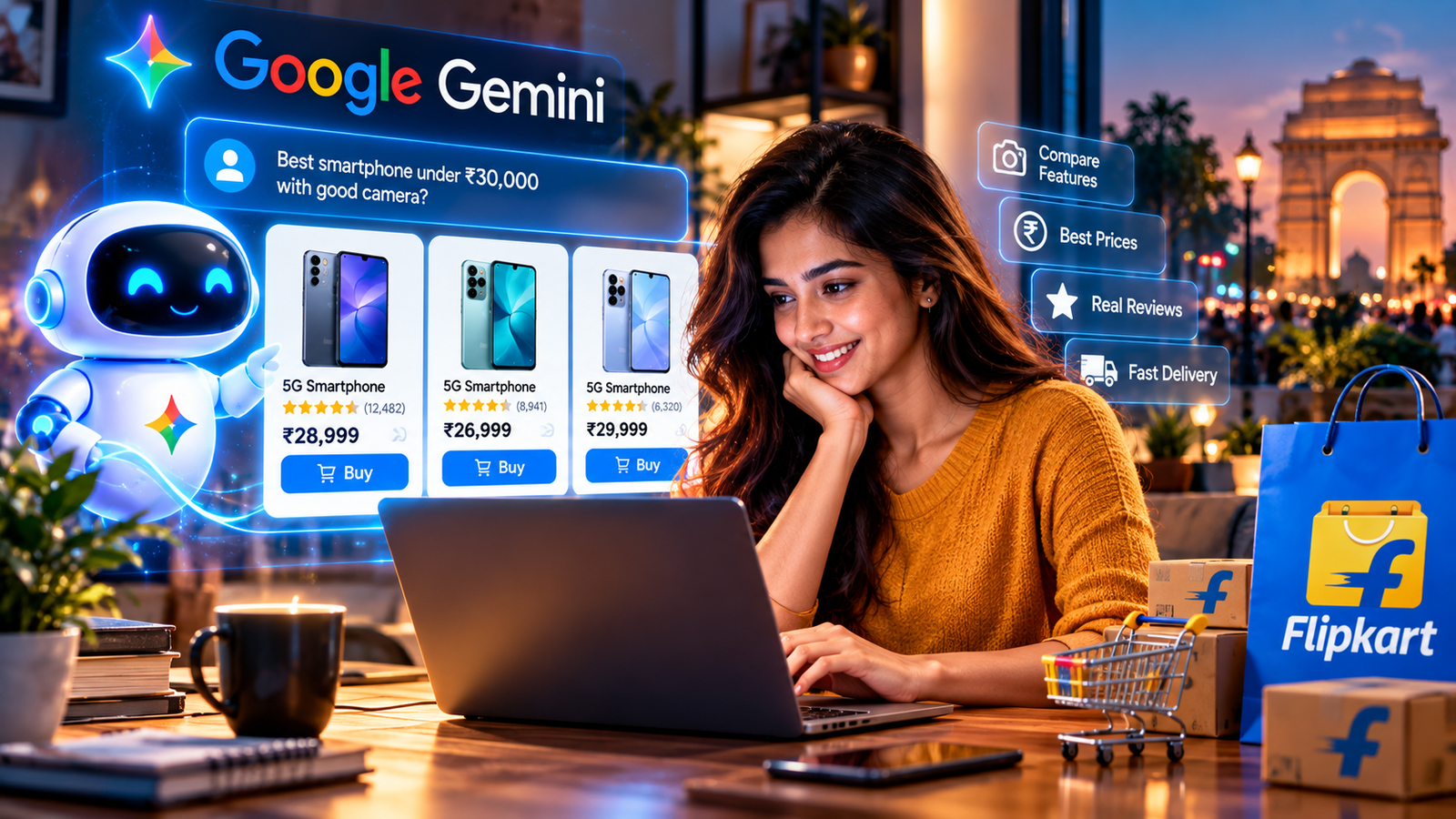
Table of Contents
ToggleGoogle Gemini Flipkart Buy Button in India: How AI Shopping Is Changing in 2026
Google is testing a new AI-powered shopping experience in India that could change the way people discover and buy products online. Selected users are reportedly seeing a “Buy” button for Flipkart products inside Google Gemini and Google’s AI Mode, allowing them to move from AI-powered product discovery toward checkout without the traditional process of switching between multiple pages.
The experiment is still limited, but it signals an important change in online shopping: AI assistants are moving beyond recommending products and increasingly becoming part of the purchasing journey.
Here is everything you need to know about the Google Gemini and Flipkart shopping test in India, how it works, who can use it and what it could mean for the future of online shopping.
What Is Google's New Flipkart Buy Button?
Google is reportedly testing a feature that allows some users in India to purchase selected Flipkart products through the Google AI interface.
According to reports, selected Flipkart product listings appearing in Gemini and Google AI Mode can display a “Buy” button. When an eligible user taps the button, the shopping journey can proceed to a Flipkart-branded checkout experience without requiring the user to manually leave the AI interface and search for the product again.
The current test is limited to a small number of users and selected products. Reported categories include smartphones, electronics and mobile accessories.
Other users may continue to see normal Flipkart product listings without the direct purchase option.
How Does Buying Through Gemini Work?
The concept is relatively simple.
- Open Google Gemini or Google Search's AI Mode.
- Ask about a product you want to purchase.
- Gemini or AI Mode presents relevant product information and listings.
- If an eligible Flipkart product appears, some test users may see a Buy button.
- Tapping the button takes the shopper into a Flipkart checkout flow.
- The shopper can then review the purchase details and complete the transaction through the available checkout process.
The important change is not simply the presence of another shopping button.
The bigger change is that AI can potentially connect product discovery, comparison and purchasing much more closely together.
Is the Google Flipkart Buy Button Available to Everyone?
No.
The feature is currently being tested with selected users and a limited selection of Flipkart products. According to reporting based on the early test, many users will still see ordinary product listings without a direct Buy option.
A broader rollout has reportedly been planned for later in October, although the exact availability, eligible products and final user experience could change before a wider launch.
Therefore, users should not assume that the feature is already available across every Gemini account in India.
Which Products Can Be Purchased Through Gemini?
The early test reportedly covers a limited range of products.
These include categories such as:
- Smartphones
- Consumer electronics
- Mobile accessories
- Other selected Flipkart products
The selection may expand if Google proceeds with a wider rollout.
It is also important to remember that the current experience is an experiment. The products and categories available during testing do not necessarily represent the final version of the feature.
Why Is Google Bringing Shopping Into Gemini?
Google has already been transforming its search experience with artificial intelligence.
Instead of simply displaying a list of links, AI-powered search can understand a shopper's question, compare products, summarise information and help users make purchasing decisions.
Google has previously introduced AI-powered shopping capabilities in India that combine Gemini models with its Shopping Graph. These experiences can provide product listings, comparisons, prices and other shopping information directly within Google's AI experiences.
The latest Flipkart test takes that concept one step further: from helping people decide what to buy toward helping them start the purchase itself.
Google has also been developing technologies designed to allow AI agents to interact with merchants across different stages of the shopping journey.
Google AI Shopping Could Change Online Shopping in India
For years, online shopping generally followed a familiar process:
Search → Open shopping website → Compare products → Read reviews → Add to cart → Checkout
AI-powered shopping could make that process considerably more conversational.
A shopper might instead say:
“I need a smartphone under ₹30,000 with a good camera, strong battery life and enough performance for travel photography. Compare the best options available in India.”
An AI assistant can potentially understand the requirements, compare relevant products and present a more personalised selection.
If direct purchasing becomes widely available, the journey could eventually become:
Ask AI → Compare → Decide → Buy
That represents a significant change in the way consumers interact with online stores.
Why India Is an Important Market for AI Shopping
India is one of the world's largest internet markets and has a rapidly expanding digital consumer base.
The country's online shopping market also becomes especially active during major festive periods, when consumers purchase smartphones, electronics, appliances, fashion products and gifts.
That makes India an important testing ground for new digital shopping experiences.
Google has already introduced AI-powered shopping features for Indian users, including conversational product discovery and comparison capabilities. Its latest Flipkart experiment could be another step toward integrating AI more deeply into India's e-commerce ecosystem.
What Does This Mean for Flipkart?
For Flipkart, appearing directly within AI-powered shopping experiences could provide another route through which customers discover its products.
Instead of relying only on users opening the Flipkart app or website and conducting a search themselves, products could be discovered while consumers are having a conversation with an AI assistant.
This could become increasingly important as consumers change the way they search for information.
Google and Flipkart already have a technology relationship, and Google has also invested in Flipkart. However, the current Buy-button experiment should be understood as a reported test rather than evidence that the final commercial arrangement has been fully announced.
What About Amazon Products?
One interesting aspect of the reported test is that product listings from competing retailers can appear alongside Flipkart products in Google's AI shopping experience.
However, the reported direct purchase option has been associated with selected Flipkart listings in the early test.
This raises an important question for the future of AI shopping:
Will AI assistants eventually allow consumers to purchase from multiple retailers through the same interface?
If that happens, AI could become an important new layer between consumers and traditional e-commerce websites.
How AI Could Change the Role of Online Shopping Websites
Traditional e-commerce platforms have historically controlled much of the customer journey.
A consumer visits the website, searches for products, filters the results, reads reviews and eventually completes a purchase.
AI introduces another possible starting point.
The consumer may begin with a conversation instead of a shopping website.
For example:
- “Which phone should I buy for photography?”
- “Find a laptop for video editing under ₹80,000.”
- “Compare these three refrigerators.”
- “Find the best headphones for long flights.”
- “I need a travel camera under ₹1 lakh.”
This means product discovery could increasingly happen through questions rather than keywords.
What Does This Mean for Consumers?
For consumers, AI-powered shopping could make product research faster and more convenient.
Instead of opening several websites, shoppers could ask an AI assistant to compare products based on specific requirements.
Potential benefits include:
- Faster product discovery
- Conversational product comparisons
- Less time spent searching
- Personalised recommendations
- Easier access to product information
- A more streamlined route from discovery to purchase
However, convenience should not replace careful decision-making.
Consumers should still check the final product details, seller information, price, warranty, delivery terms and return policy before making an expensive purchase.
Could AI Shopping Affect Product Reviews and Recommendations?
Yes, potentially.
AI assistants can increasingly summarise large amounts of product information for consumers.
That could change how people interact with traditional product reviews.
Instead of reading 100 reviews individually, a shopper may ask an AI system:
“What are the most common complaints about this smartphone?”
Or:
“Which of these two laptops has better long-term user feedback?”
This makes the quality and reliability of the information used by AI systems increasingly important.
What About Privacy and Payment Security?
As AI becomes involved in shopping and transactions, privacy and security will become increasingly important.
Consumers should pay attention to:
- Where payment information is stored
- Which company processes the transaction
- Whether the checkout page is genuine
- What information is shared with the retailer
- Whether the final price matches the advertised price
- Return and refund policies
Users should also avoid approving purchases simply because an AI assistant recommends a product.
An AI recommendation is a starting point for research, not a guarantee that a product is the right choice.
Will AI Agents Eventually Buy Products Automatically?
This could be one of the biggest developments in online shopping.
Today's AI systems primarily help users search, compare and decide. The next generation of AI agents could potentially perform more steps on behalf of users.
For example, a consumer might eventually tell an AI assistant:
“Find me a good pair of running shoes under ₹10,000. Check the available sizes, compare prices and buy them if you find a suitable option.”
The AI could potentially handle much of the research and transaction process while asking the user for confirmation before the final purchase.
The technology is still evolving, and the exact capabilities, safeguards and business models will vary between platforms.
Google Gemini Shopping vs Traditional Online Shopping
| Traditional Shopping | AI-Powered Shopping |
|---|---|
| User searches manually | User can describe what they need conversationally |
| Multiple websites may need to be opened | AI can bring information together |
| User compares products independently | AI can help compare products |
| Shopping begins on an e-commerce platform | Shopping can begin inside an AI interface |
| Checkout happens on the retailer's platform | AI interfaces may increasingly connect directly to checkout |
What Happens Next?
The current Flipkart Buy-button experiment is still limited, so it is too early to know exactly how Google's final shopping experience will look.
However, the direction is clear.
Google is investing heavily in making AI more useful for shopping, while e-commerce companies are increasingly looking at ways to connect AI-based discovery with transactions.
If the experiment expands successfully, Indian shoppers could see more AI-powered shopping features during the country's major festive shopping season.
Google Gemini and Flipkart: Frequently Asked Questions
Can I currently buy Flipkart products directly through Gemini?
The feature is currently being tested with selected users and selected products in India. It is not yet available universally.
What is the Google Gemini Flipkart Buy button?
It is a reported experimental feature that allows some users to see a Buy button on selected Flipkart product listings inside Gemini and Google AI Mode.
Which Flipkart products are included?
The early test reportedly includes products such as smartphones, electronics and mobile accessories. The product selection may change as testing continues.
When will the feature be available to everyone?
A broader rollout has reportedly been planned for later in October 2026, but Google has not publicly confirmed that every user in India will receive the feature at that time.
Is Gemini becoming an online shopping platform?
Gemini is not being positioned simply as another traditional e-commerce website. Instead, Google is integrating shopping discovery, comparison and purchasing capabilities into its AI experiences.
Should I trust every product recommendation from AI?
No. AI can help with product research and comparison, but consumers should independently verify important details such as price, specifications, seller, warranty, reviews, delivery and return policies before purchasing.
Final Takeaway
Google's reported Flipkart Buy-button test may look like a small feature, but it represents a much larger change in online shopping.
The future of e-commerce may not begin with “Which website should I visit?” but with “What exactly do I need?”
AI assistants are increasingly becoming the place where people ask questions, compare options and make decisions. If direct purchasing becomes a standard part of these experiences, the traditional boundary between search, recommendation and e-commerce could become much less visible.
For Indian consumers, the change could mean faster and more conversational shopping. For retailers, it could mean a new battle for visibility inside AI-generated recommendations.
And for Google, the Flipkart experiment could be another step toward making Gemini and AI Mode part of the complete shopping journey.
The AI shopping revolution may have already begun—and India is becoming one of its important testing grounds.
Last updated: 28 September 2026
Disclaimer: The Flipkart Buy-button feature discussed in this article is reportedly in limited testing. Availability, participating products and the final user experience may change as Google continues its experiments.
Related