
Table of Contents
ToggleIs IndiGo's Crisis Directly or Indirectly Related to Adani's?
As India’s largest airline IndiGo faces an unprecedented pilot shortage and mass flight cancellations, Adani Group’s timely acquisition of FSTC — India’s biggest flight training center — could turn this aviation crisis into a long-term strategic advantage.
India’s Sky Turns Turbulent
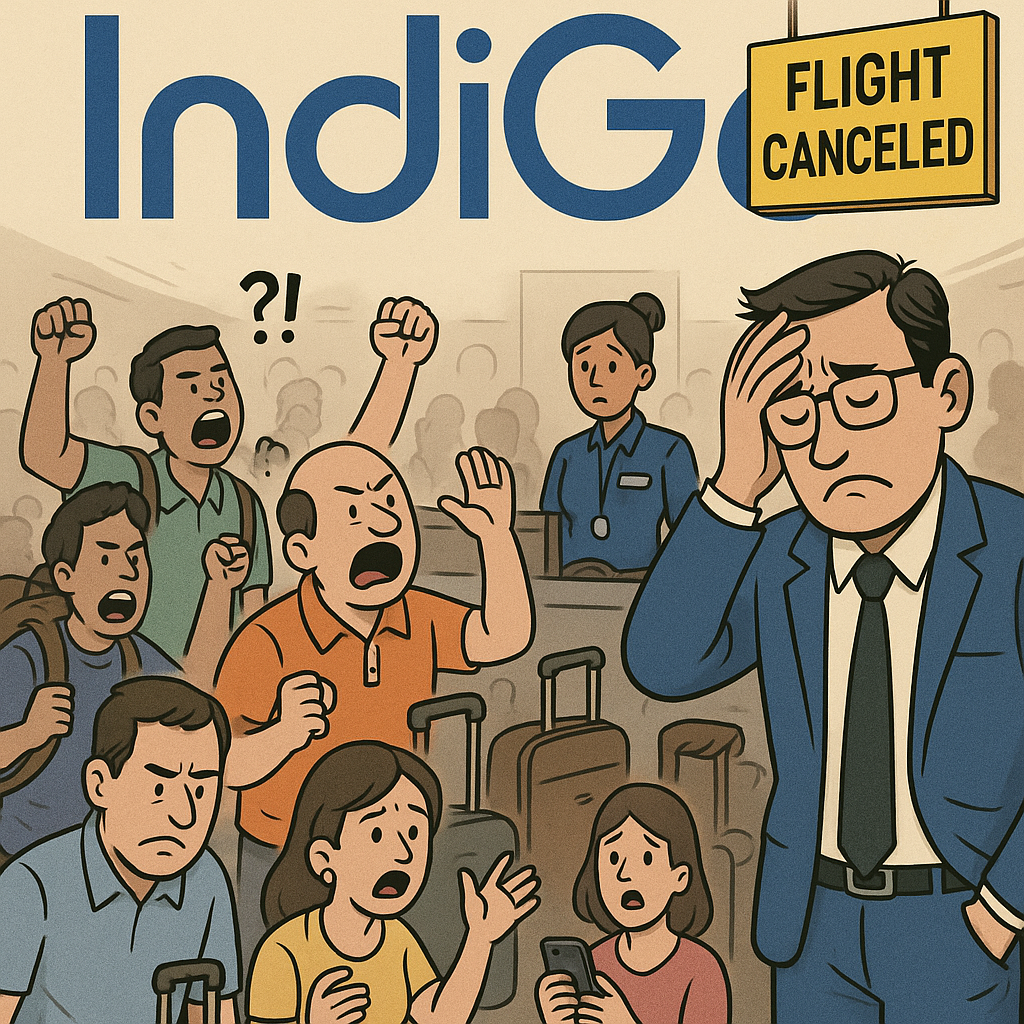
Early December 2025 brought chaos to Indian skies. Over 1,000 IndiGo flights were canceled in a single day, stranding nearly 200,000 passengers and sparking widespread outrage. Airports across major cities — Delhi, Mumbai, Bengaluru, and Hyderabad — saw serpentine queues, frustrated travelers, and uncertain schedules.
The cause? Not bad weather or technical snags — but a massive pilot shortage triggered by new Flight Duty Time Limitation (FDTL) norms enforced by the Directorate General of Civil Aviation (DGCA).
These updated safety rules, aimed at reducing pilot fatigue, capped annual flying hours at 900 hours, imposed tighter monthly limits, and restricted consecutive night landings. While the regulations were announced back in January 2024 and phased in through 2025, airlines were caught unprepared.
The Root of the Crisis: Planning Failure
The new FDTL norms were meant to make flying safer — but poor planning by airlines, especially IndiGo, has turned them into an operational nightmare.
The Federation of Indian Pilots (FIP) has blamed IndiGo for a hiring freeze and poor workforce planning, claiming the airline failed to recruit an estimated 13–14 additional pilots per aircraft, a necessary buffer to handle reduced duty hours.
The airline industry was already battling a chronic pilot shortage, worsened by booming air travel demand and an aggressive aircraft induction plan — over 1,500 new planes are expected to join Indian fleets in the next few years.
The result: A human resource shock at the heart of India’s fastest-growing aviation market.
Adani Steps In — Perfect Timing, Perfect Move
Just as this crisis reached a boiling point, a major development quietly reshaped India’s aviation landscape.
On November 27, 2025, Adani Defence Systems & Technologies Ltd (ADSTL), a subsidiary of the Adani Group, acquired a 73% majority stake in Flight Simulation Technique Centre Pvt Ltd (FSTC) — India’s largest independent pilot training and simulation provider — in partnership with Prime Aero Services LLP.
The deal, valued at ₹820 crore, gives Adani control of:
11 full-flight simulators
17 training aircraft
Training centers in Gurugram, Hyderabad, Bhiwani, and Narnaul
Comprehensive pilot training programs from ab-initio (student) to airline-ready certification
This acquisition is not just another business expansion — it’s a strategic strike at the very heart of the ongoing aviation crisis.
The Clear Connection: Crisis Meets Opportunity
The IndiGo meltdown and the Adani-FSTC deal are not coincidental events — they are two sides of the same coin.
While airlines are struggling to find and train enough pilots, Adani now owns the largest flight training infrastructure in India. As a result:
FSTC can immediately absorb increased demand for pilot training.
Airlines desperate to fill vacancies may outsource training to Adani’s centers.
The government’s push for Atmanirbhar Bharat (self-reliant India) in aviation gets a powerful private ally.
In short, what’s a crisis for IndiGo could be a growth engine for Adani.
Building an Integrated Aviation Empire
Adani’s move is not random — it’s part of a larger aviation blueprint.
The Adani Group already operates seven major Indian airports (including Mumbai, Ahmedabad, Lucknow, and Mangaluru), manages MRO (maintenance, repair, and overhaul) facilities, and aims to handle 200 million passengers annually within five years.
By acquiring FSTC, Adani adds another crucial vertical: pilot supply.
This creates a self-sustaining aviation ecosystem — from airports to aircraft maintenance, and now to the people who fly them. Few players in India have such end-to-end integration.
The Business Advantage
Let’s look at how this crisis directly benefits Adani in measurable ways:
Factor Impact on Adani
Pilot Shortage Surge in demand for FSTC’s training programs
Airline Hiring Delays Airlines outsource training to Adani’s centers
Government Push for Domestic Training Policy and funding support for Adani’s expansion
Growing Fleet Size Continuous demand for skilled pilots
Global Training Costs Rising Domestic option (Adani-FSTC) becomes cost-effective
This synergy positions Adani as a critical partner for every airline operating in India — from IndiGo to Air India to new entrants like Akasa.
Long-Term Vision: Making India a Pilot Hub
The Indian pilot training market is expected to grow exponentially over the next five years. Experts estimate the need for over 12,000 new pilots by 2030 — a massive number for an industry that currently trains just a few hundred annually.
With its robust infrastructure and corporate backing, Adani’s FSTC could scale up quickly, attracting both domestic and international cadets.
In the long run, India could even export trained pilots to other Asian and Middle Eastern carriers — and Adani’s brand would stand at the forefront of that transformation.
The Balancing Act
However, there are challenges too:
The DGCA will need to ensure training quality and compliance across expanding facilities.
Industry voices warn against monopolistic concentration, as Adani’s growing influence across multiple aviation domains could raise competition concerns.
But so far, the government’s tone has been supportive, viewing the investment as a solution, not a threat.
The Bottom Line
The December 2025 aviation chaos has exposed how fragile India’s airline operations can be when manpower planning fails. But in the midst of this turbulence, Adani Group has positioned itself as the unexpected stabilizer.
With the acquisition of FSTC, Adani isn’t just entering the pilot training business — it’s locking in a strategic advantage at a time when every airline is scrambling for solutions.
In short:
IndiGo’s turbulence might just be Adani’s tailwind.