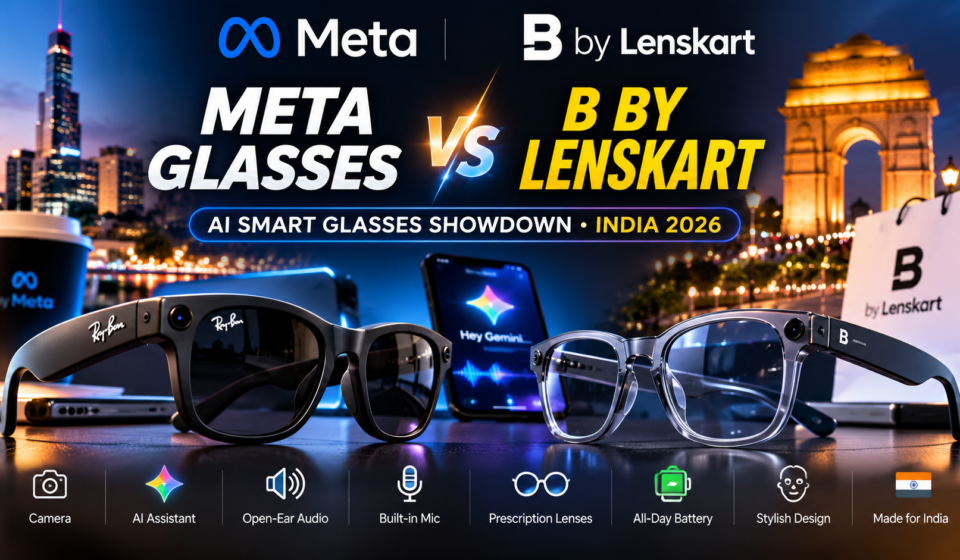
Meta Glasses vs B by Lenskart: Ultimate AI Smart Glasses Comparison 2026

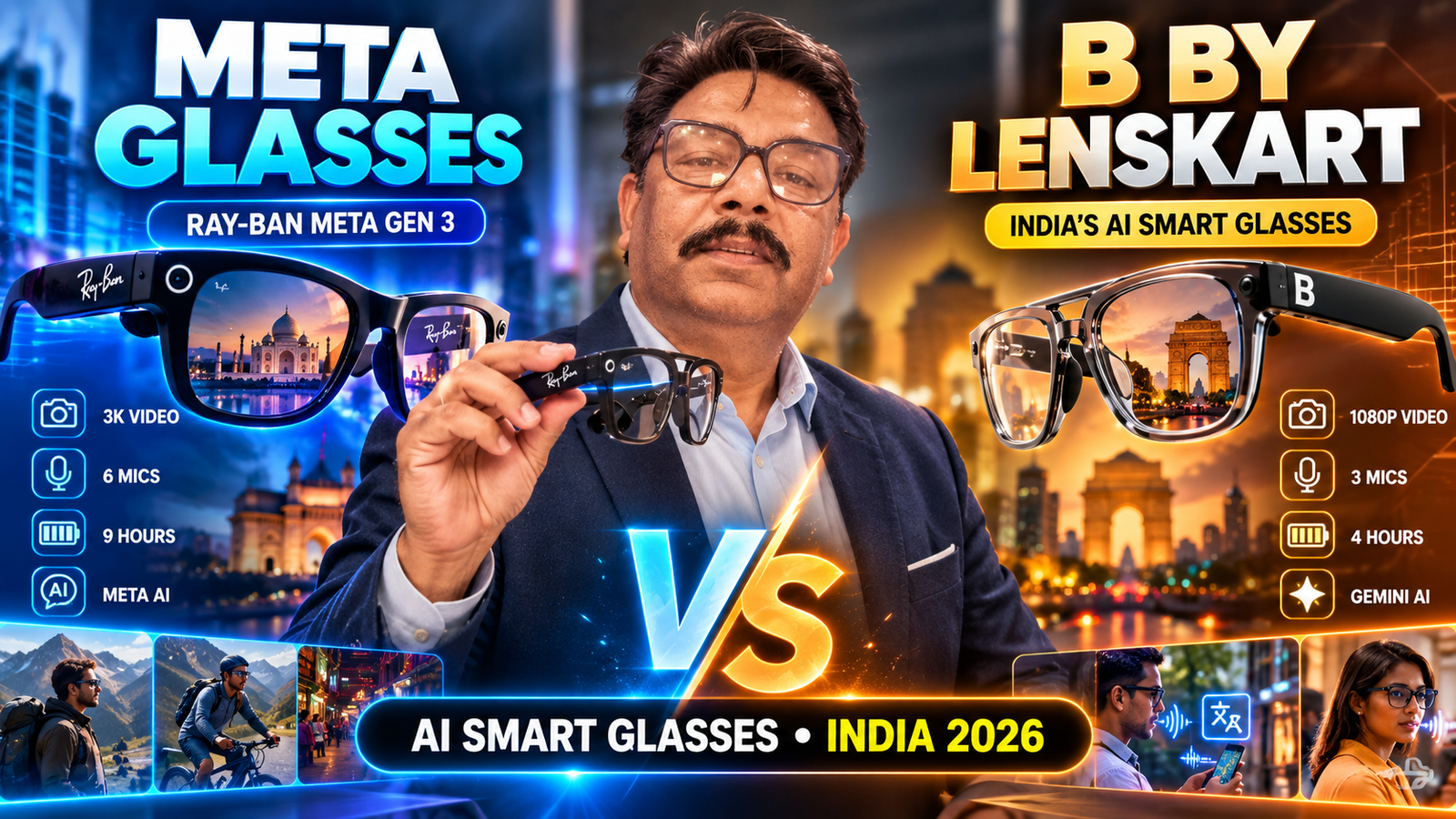
Table of Contents
ToggleMeta Glasses vs B by Lenskart: The Ultimate AI Smart Glasses Showdown in India 2026
What if your next pair of spectacles could see what you see, hear what you hear, answer your questions, record your memories, take phone calls and become an AI assistant sitting right on your face?
That future is no longer science fiction.
India's smart-glasses market has entered a fascinating new phase, and two names are now impossible to ignore: Ray-Ban Meta and B by Lenskart.
And the timing could hardly be more interesting.
Ray-Ban Meta Gen 3 has now arrived in India, bringing a slimmer design, 12MP camera, 3K video recording, six microphones, Meta AI and up to nine hours of claimed battery life. At the other end, B by Lenskart is attempting something very different: a more affordable, India-focused AI smart-glasses experience built around everyday eyewear, prescription compatibility and Google Gemini.
On paper, this looks like a simple battle between an international technology giant and an Indian eyewear company.
In reality, it is much more interesting.
Because these two products are not merely competing on specifications. They represent two different visions of what smart glasses should become.
So, which one has the more interesting technology? Which one makes more sense for prescription users? What happens when you compare camera quality, AI, battery, audio, storage, privacy, software and price?
And perhaps the biggest question of all:
Is paying roughly twice as much for Ray-Ban Meta Gen 3 justified when B by Lenskart is available at a much lower price?
Let's take a deep dive.
Meta Glasses vs B by Lenskart: Quick Comparison
| Feature | Ray-Ban Meta Gen 3 | B by Lenskart |
|---|---|---|
| India price | From ₹44,300 | ₹22,000 listed price |
| Camera | 12MP ultra-wide | 12MP Sony ultra-wide |
| Video | Up to 3K at 30fps | Up to 1080p at 30fps |
| Storage | 32GB | 32GB |
| AI | Meta AI | Google Gemini-powered AI |
| Microphones | 6-microphone array | 3 microphones |
| Audio | Open-ear speakers | Dual directional speakers |
| Battery | Up to 9 hours | Up to 4 hours |
| Charging case | Up to 50 additional hours | Up to 48 additional hours |
| Lens compatibility | Prescription options available | -6 to +6 high-power compatibility |
| Display | No conventional AR display | No conventional AR display |
| Water resistance | IPX4 | IPX4 |
Specifications and prices can vary by model, lens configuration, promotions and software updates. Always verify the final configuration before purchasing.
First, What Exactly Are These Glasses?
Before comparing them, one misconception needs to be cleared up.
Neither Ray-Ban Meta Gen 3 nor B by Lenskart is a traditional augmented-reality headset with a large display floating in front of your eyes.
You don't look through the lenses and see Google Maps arrows floating on the road like you might expect from science-fiction glasses.
Instead, these products are best understood as AI-powered connected eyewear.
They combine ordinary-looking glasses with:
- A camera
- Speakers
- Microphones
- Bluetooth connectivity
- On-device storage
- Voice controls
- AI assistance
- A smartphone companion application
The result is surprisingly different from using a smartphone.
You don't have to take your phone out of your pocket every time you want to ask a question, capture a quick video or answer a call.
That is the real appeal of smart glasses.
Ray-Ban Meta Gen 3: What Has Changed?
Ray-Ban Meta Gen 3 is the newest generation of Meta's camera-equipped AI glasses.
Meta has concentrated on improving the things that matter when you wear a computer on your face: comfort, battery life, camera performance, audio capture and hands-free AI access.
Gen 3 features a 12MP ultra-wide camera and can record video at up to 3K resolution at 30fps. It also has a six-microphone array designed to improve voice pickup and reduce background noise.
The battery claim has also increased to up to nine hours, while the charging case can provide additional charging capacity.
There is also a new customizable action button for quick access to Meta AI or other functions.
And importantly for Indian buyers, Ray-Ban Meta has been expanding its AI capabilities and language support, including Hindi interaction.
B by Lenskart: Why Is It So Interesting?
B by Lenskart is fascinating for a completely different reason.
Instead of competing only through premium branding, Lenskart has approached smart glasses from the perspective of an eyewear company that already understands prescription lenses, frame fit and everyday optical wear.
The B smart glasses weigh 40 grams excluding lenses, according to Lenskart's specifications.
They use a Qualcomm Snapdragon AR1 Gen 1 platform, 32GB storage and Bluetooth 5.3.
The camera is a 12MP Sony sensor with a 16mm ultra-wide-angle lens, while video recording goes up to 1080p at 30fps.
The glasses also integrate a Google Gemini-powered AI experience and respond to the wake phrase "Hey Buddy."
That combination makes B by Lenskart particularly interesting for Indian users who want to experiment with AI eyewear without immediately spending more than ₹40,000.
Price: The First Big Difference
This is where the comparison becomes dramatic.
The current Lenskart product listing shows B by Lenskart at ₹22,000, while Ray-Ban Meta Gen 3 starts at ₹44,300 in India.
That means the starting price of Gen 3 is roughly twice the listed price of B by Lenskart.
And that immediately changes the buying question.
Instead of asking:
"Which glasses are better?"
the more useful question becomes:
"What exactly am I getting for the additional money?"
That is the question this comparison will answer.
Camera Battle: 12MP vs 12MP Does NOT Mean the Same Thing
At first glance, the camera specifications appear almost identical.
Both glasses have 12MP cameras.
But the video capabilities are very different.
Ray-Ban Meta Gen 3
- 12MP ultra-wide camera
- Up to 3K Ultra HD video
- 32GB storage
- Hands-free photography
- Dynamic photo capabilities
- Built-in recording indicator
B by Lenskart
- 12MP Sony camera
- 16mm ultra-wide lens
- 4032 × 3024 photo resolution
- 1080p video at 30fps
- 32GB storage
If your priority is high-resolution video for travel vlogging, Reels, Shorts and first-person footage, the 3K video capability of Meta Gen 3 is a major advantage on paper.
B by Lenskart, however, is not a toy camera.
A 12MP Sony sensor with a wide field of view can still be extremely useful for POV photography, travel moments, quick documentation and social-media content.
And there is another important point:
Smart glasses are about perspective as much as resolution.
A phone camera may produce a technically better-looking image, but it cannot reproduce exactly what you see from your own eye level while walking, travelling or interacting with people.
For Travel Vloggers, This Feature Matters More Than Megapixels
Imagine walking through a crowded market in Jaipur, exploring the streets of Bangkok, driving through the hills or visiting a famous monument.
With conventional cameras, you have to reach for your phone, hold it up and frame the shot.
With camera glasses, your hands remain free.
You simply look.
That makes smart glasses particularly interesting for:
- Travel creators
- Vloggers
- Walking-tour creators
- Food reviewers
- Event coverage
- Family memories
- Behind-the-scenes content
For creators, this may be one of the biggest reasons to buy either product.
AI Battle: Meta AI vs Google Gemini
This may ultimately be the most important part of the comparison.
The camera is hardware.
The AI is what can make the hardware useful every day.
Ray-Ban Meta: Meta AI
Ray-Ban Meta glasses are deeply integrated into Meta's AI ecosystem.
You can interact with Meta AI using your voice and ask questions, get information, interact with supported services and use vision-related features.
Meta has also been expanding translation and multilingual capabilities.
Gen 3 benefits from Meta's rapidly evolving AI ecosystem and software updates.
B by Lenskart: Gemini-powered AI
B by Lenskart takes a different route by integrating Google's Gemini-powered AI experience.
The official B product information lists AI features including answers on the go, multilingual interaction and Live AI.
Lenskart's FAQ also describes features such as Look & Tell, where the glasses can use the camera to understand what the wearer is looking at, and Live AI, which provides real-time visual assistance.
There is also a Record Meeting feature designed to listen to conversations and generate summaries through the companion app.
That is a surprisingly ambitious feature set for a ₹22,000-class smart-glasses product.
Gemini vs Meta AI: Which Ecosystem Is More Interesting?
This is where personal usage matters.
If you already spend much of your digital life inside Meta's ecosystem—WhatsApp, Instagram, Messenger and Meta AI—the Ray-Ban Meta experience can feel extremely natural.
If you are heavily invested in Google's ecosystem and like Gemini's conversational approach, B by Lenskart has an obvious attraction.
And because AI services are being updated rapidly, today's difference may not remain the same for very long.
Hardware changes slowly. AI changes every few weeks.
That is why software support should be considered just as seriously as megapixels and battery capacity.
Battery Life: A Huge Gen 3 Advantage
Battery life is one of the least glamorous specifications—and one of the most important.
According to their respective specifications:
- Ray-Ban Meta Gen 3: up to 9 hours
- B by Lenskart: up to 4 hours
Actual runtime depends on how the glasses are used. Camera recording, calls, music and AI processing can all increase battery consumption.
Still, the claimed difference is significant.
If you are travelling all day and want to use the glasses for photography, audio, calls and AI, Gen 3's larger claimed endurance could make a meaningful difference.
B by Lenskart's charging case helps compensate by providing additional charges, but the glasses themselves have a shorter claimed active-use window.
Audio and Calls
Both products use open-ear or directional audio concepts rather than traditional earbuds.
This means you can hear music or a voice response while remaining aware of the environment around you.
Ray-Ban Meta Gen 3 uses a six-microphone array.
B by Lenskart uses three microphones and dual directional speakers.
For voice calls and AI commands in noisy outdoor environments, microphone performance is particularly important.
On paper, Meta's six-microphone configuration gives it a more sophisticated hardware platform for voice capture.
But real-world performance depends on software processing, wind conditions, environment and how the glasses fit the wearer.
Prescription Lenses: One of the Most Important Questions
This is where smart glasses become much more personal.
If you already wear spectacles, you probably don't want to carry one pair for vision correction and another pair for AI features.
You want your smart glasses to become your normal glasses.
Ray-Ban Meta
Ray-Ban Meta offers prescription configurations, including optical models designed specifically around prescription use. Ray-Ban also offers clear, sun and Transitions lens configurations on supported models.
Gen 3 therefore has a strong proposition for prescription users who want premium eyewear combined with AI hardware.
B by Lenskart
B by Lenskart is explicitly designed around prescription-lens capability.
Lenskart currently lists high-power compatibility from -6 to +6.
However, there is an important distinction readers should understand.
Lenskart's current publicly available B specifications confirm the -6 to +6 compatibility, but do not explicitly state on the specification page that every progressive-lens configuration is supported.
Therefore, if you require progressive lenses, do not assume that any progressive prescription will automatically fit the B frame.
Confirm the exact progressive-lens availability, prescription range and fitting requirements with Lenskart before ordering.
This is particularly important for users who need multifocal correction.
Can B by Lenskart Be Used With Third-Party Lenses?
This is another important difference.
Lenskart's official FAQ states that B smart glasses are designed to work with Lenskart lenses only.
The company warns that using third-party lenses may affect fit, performance or durability and may also affect warranty eligibility.
For buyers, this means lens selection should be considered part of the original purchase—not something to casually replace later.
Design and Everyday Wear
Smart glasses have one enormous challenge that smartphones don't have.
You have to wear them on your face.
That means weight, balance, frame shape, temple thickness and comfort become extremely important.
B by Lenskart lists a 40g frame weight excluding lenses.
Ray-Ban Meta Gen 3 is designed around a slimmer form factor and adjustable fit features.
The Ray-Ban name also gives Meta a significant advantage in one area that is difficult to measure with a specification sheet:
fashion credibility.
People already wear Ray-Ban glasses because they like the way they look.
B by Lenskart, on the other hand, has a different advantage: it comes from a company whose core business is eyewear and prescription glasses.
That makes the competition much more interesting than a normal technology-versus-technology battle.
Storage: Surprisingly, It's a Draw
Both products list 32GB storage.
That is enough to make the glasses more than simple Bluetooth accessories.
You can capture photos and videos and sync them to the companion smartphone application.
The actual number of files you can store depends heavily on video length, resolution and software behaviour.
For heavy creators, however, storage management and regular syncing will remain important.
Water Resistance
Both product ecosystems include IPX4-level water resistance in their specifications.
That means users should think in terms of resistance to splashes rather than waterproofing.
Rain, sweat and accidental splashes are very different from swimming or submerging the glasses.
Neither product should be treated like a waterproof action camera.
Privacy: The Conversation We Cannot Ignore
A camera on your face changes the privacy conversation.
When you point a smartphone camera at someone, people can usually see what you are doing.
With camera glasses, recording can be considerably more discreet.
Both companies use recording indicators to signal camera activity.
B by Lenskart states that its recording indicator cannot be disabled.
Meta has also continued to emphasise recording indicators and privacy controls for its camera-equipped glasses.
Users should nevertheless follow the rules of the location they are visiting and respect people's privacy.
Do not assume that because a camera can technically record something, you should record it.
This becomes especially important in:
- Private homes
- Hospitals
- Changing rooms
- Schools
- Workplaces
- Religious places
- Security-sensitive locations
- Private meetings
Meta's New Privacy Conversation in 2026
Privacy has become even more relevant as Meta expands AI-powered visual features.
Meta recently introduced additional controls relating to the storage of visual data from AI experiences on its camera-equipped glasses.
That is a reminder that AI glasses are not simply cameras and speakers.
They are wearable AI devices that can potentially process what the wearer sees and hears.
Before buying either product, consumers should read the latest privacy policies and understand what data is stored, synced or processed.
What About UPI Payments?
This is one of the most exciting India-specific areas of smart-glasses development.
Lenskart previously announced plans around UPI functionality for its B smart glasses, including a concept in which users could scan a QR code and complete a payment through voice interaction.
Meta has also announced testing around UPI Lite payments on Ray-Ban Meta Gen 2 in India.
However, payment availability is highly dependent on software rollout, supported accounts, regulatory requirements and the specific generation of glasses.
Do not buy either product solely because of a promised payment feature unless it is confirmed as available on your exact model at the time of purchase.
Which One Is More Interesting for Content Creators?
This is where the comparison becomes particularly relevant for YouTubers, bloggers and travel creators.
For content creation, the key questions are:
- How good is the camera?
- How good is the video?
- How quickly can files be transferred?
- How long does the battery last?
- Can I control it without touching my phone?
- Can AI help me while I am filming?
- How comfortable is it for long shoots?
Ray-Ban Meta Gen 3's 3K video capability and longer claimed battery make it particularly interesting for creators who place a premium on POV video.
B by Lenskart's lower price, 12MP Sony camera and Gemini-powered AI make it an intriguing option for creators who want to enter the category at a much lower cost.
For travel creators, however, the biggest advantage of either device may simply be hands-free capture.
What About AI for Travel?
This is where smart glasses could become genuinely transformative.
Imagine walking through an unfamiliar city.
You see a monument.
You ask:
"Hey Buddy, what is this building?"
Or:
"Hey Meta, translate this sign."
Or:
"What dish is this?"
Instead of taking out your phone, typing a question, taking a photograph and waiting for a response, you can potentially interact with AI while continuing to look at the world.
That is the real promise of AI glasses.
They can make technology feel less like something you operate and more like something you simply talk to.
Where B by Lenskart Has a Fascinating Advantage
B by Lenskart's biggest story isn't simply price.
It is local relevance.
The product has been designed by an Indian eyewear company, is being developed around Indian consumers and integrates Gemini-based AI with features relevant to everyday use.
Its support for multiple languages, prescription-lens focus and India-oriented development make it particularly interesting for the domestic market.
Lenskart has also said that B is part of a longer-term hardware-plus-software journey rather than a one-off gadget.
That means the first generation should perhaps be viewed as the beginning of a platform rather than the final product.
Where Ray-Ban Meta Has a Strong Advantage
Meta has something that is difficult for a new entrant to reproduce quickly:
years of software development, a global AI platform, the Ray-Ban brand, an established smart-glasses ecosystem and a huge user base.
Gen 3 also pushes the hardware further with 3K video, six microphones, improved battery life and a more refined design.
The result is a product that feels less like an experiment and more like a mature consumer electronics category.
Meta Glasses vs B by Lenskart: Who Should Consider Which?
If You Want Maximum Camera Capability
Look closely at Ray-Ban Meta Gen 3, particularly if 3K video recording and longer battery endurance matter to you.
If You Want to Enter AI Glasses at a Lower Price
B by Lenskart is the more accessible starting point based on current listed prices.
If You Wear Prescription Glasses
Both ecosystems offer prescription-oriented options, but the exact lens configuration matters. B lists -6 to +6 high-power compatibility, while Ray-Ban offers dedicated prescription configurations on supported models.
If You Depend on Progressive Lenses
Check the exact lens configuration before purchasing. Do not assume that a general "prescription compatible" statement automatically means every progressive prescription is supported.
If You Are Deeply Invested in Google Gemini
B by Lenskart's Gemini-powered experience is naturally attractive.
If You Are Deeply Invested in Meta's Ecosystem
Ray-Ban Meta's integration with Meta AI and Meta's broader communications ecosystem may be more relevant.
If You Are a Travel Creator
Both are interesting because of hands-free POV capture. Gen 3's higher video capability and longer claimed battery give it a particularly strong hardware proposition.
The Most Important Thing Buyers Should Know
Don't buy smart glasses because the specification sheet looks impressive.
Buy them because you can identify three or four things you will actually do with them every week.
If those things are:
- Taking POV photos
- Recording travel videos
- Listening to music
- Answering calls
- Using AI without touching your phone
- Getting visual information hands-free
then smart glasses can make genuine sense.
But if you expect a full augmented-reality display, navigation arrows floating in front of your eyes or a replacement for your smartphone, neither of these products should be purchased with that expectation.
The Bigger Story: India Is Becoming a Smart-Glasses Battleground
The most exciting part of this comparison isn't actually Meta versus Lenskart.
It is what the competition means for Indian consumers.
Until recently, AI glasses were still perceived as an expensive and relatively niche category.
Now an Indian eyewear company is offering a Gemini-powered smart-glasses product at around half the entry price of the newest Ray-Ban Meta generation.
That creates pressure for the entire category.
More competition can mean:
- Better cameras
- Longer battery life
- Better AI assistants
- More Indian-language support
- Better prescription options
- More stylish designs
- More affordable prices
- More useful everyday applications
And this is only the beginning.
What Could Smart Glasses Look Like in the Next 3 Years?
The biggest leap may not come from another megapixel increase.
It may come from AI agents.
Imagine telling your glasses:
"Remember where I parked the car."
Or:
"Read this menu and tell me which vegetarian dishes are suitable."
Or:
"Translate what that person is saying."
Or:
"Record the next two minutes and summarise the important points."
As AI becomes more capable, the glasses could evolve from a camera-and-audio accessory into a genuinely contextual personal assistant.
That is the technology worth watching.
Final Verdict: Meta Glasses vs B by Lenskart
There is no need to pretend that these two products are identical.
Ray-Ban Meta Gen 3 is positioned as a premium AI eyewear platform. It combines Ray-Ban's fashion identity with Meta's AI ecosystem, 3K video, six microphones, 32GB storage and a claimed battery life of up to nine hours.
B by Lenskart is a more price-conscious, India-focused approach to AI eyewear. It brings a 12MP Sony camera, Gemini-powered AI, 32GB storage, prescription-lens capability, multilingual features and a claimed battery life of up to four hours into a considerably lower-priced package.
And that is why this comparison is so fascinating.
The question isn't simply which pair has more features.
The real question is:
How much are you willing to pay to make AI part of what you already wear every day?
For some people, the answer may be a premium Ray-Ban Meta.
For others, B by Lenskart may make the idea of AI glasses much easier to try.
Either way, one thing is becoming increasingly clear:
The smartphone may still be in our hands—but the next generation of AI may increasingly be on our faces.
Frequently Asked Questions
Is B by Lenskart cheaper than Ray-Ban Meta Gen 3?
Yes. Lenskart's current product listing shows B by Lenskart at ₹22,000, while Ray-Ban Meta Gen 3 starts at ₹44,300 in India. Prices can vary by frame, lens and configuration.
Does B by Lenskart have Gemini AI?
Yes. Lenskart's official specifications describe the glasses as powered by Gemini and include AI capabilities such as answers on the go and Live AI.
Does Ray-Ban Meta Gen 3 record 4K video?
No. Ray-Ban's current Gen 3 specifications list video recording up to 3K at 30fps.
Does B by Lenskart record 4K video?
No. Lenskart currently lists video recording up to 1080p at 30fps.
Can I use prescription lenses with B by Lenskart?
Yes. Lenskart describes B as prescription-lens capable and lists high-power compatibility from -6 to +6. Exact lens availability should be confirmed for your prescription.
Can I use progressive lenses with B by Lenskart?
Lenskart's public B specifications confirm prescription compatibility but do not clearly state that every progressive-lens configuration is supported. If you require progressive lenses, confirm the exact configuration with Lenskart before ordering.
Can Ray-Ban Meta Gen 3 use prescription lenses?
Yes. Supported Ray-Ban Meta Gen 3 configurations are available with prescription options.
Which has better battery life?
On the manufacturers' published claims, Ray-Ban Meta Gen 3 offers up to nine hours, while B by Lenskart lists up to four hours. Actual battery life depends on usage.
Do these glasses have a display?
Ray-Ban Meta and B by Lenskart are not conventional display-based AR glasses. Their core experience is based on cameras, audio, voice interaction and AI.
Are smart glasses safe to use in public?
Users should respect privacy, local rules and the expectations of people around them. Camera indicators help communicate when recording is active, but users remain responsible for how they use the device.
Official Resources
For the latest specifications, pricing and availability, always check the manufacturers' websites:
Editor's Note
This comparison is based on publicly available manufacturer specifications and current India listings checked on 1 October 2026. Smart-glasses features can change through firmware and AI updates, while prices and lens configurations can change without notice. Readers should verify the exact model, lens configuration, price and feature availability before purchase.
Did you know that B by Lenskart and Ray-Ban Meta are taking two very different approaches to the future of eyewear? Share this article with someone who is considering buying AI smart glasses in India.
Disclaimer: This is not a sponsored post.
Related