
Table of Contents
ToggleThe Invisible Surgeons: How Microscopic Nanobots are Redefining Modern Medicine
Miracles come and go. But none carry the transformative weight of microscopic nanobots. We are no longer just talking about science fiction like Fantastic Voyage; we are talking about the reality of 2025, where “sub-cellular surgeons” are entering clinical trials.
As a medical science scholar with 30 years of experience, I have witnessed the transition from mass-manufactured pills to gene editing. But we are now entering the most transformative era yet: the age of nanomedicine. We are moving beyond science fiction like Fantastic Voyage and into a reality where “sub-cellular surgeons” are entering clinical trials to save lives from the inside out.
For the first time, we are treating the human body not just as a biological organism, but as a complex system that can be repaired at the molecular level.
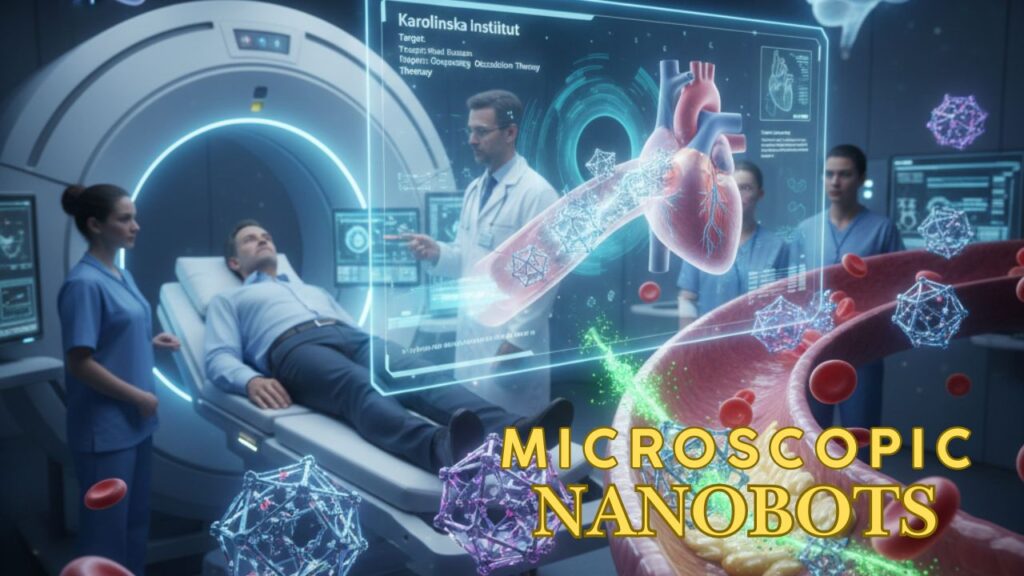
What are Nanobots?
In simple terms, a nanobot is a programmable machine built at the scale of a nanometer—that’s one-billionth of a meter. To visualize this: if a human hair were a massive highway, a nanobot would be a small bicycle traveling down it.
Unlike the gears and bolts of a traditional robot, these are often constructed from DNA strands (known as “nubots”) or synthetic polymers. These machines are designed to navigate the complex, high-pressure environment of your cardiovascular system without being detected as “intruders” by your immune system.
How They Work: The “FedEx” of Medicine
As a researcher, the most fascinating aspect of nanobots is their autonomous navigation. How does something so tiny move against the rush of your heartbeat?
- Magnetic Steering: Many nanobots contain magnetic particles. Doctors use external magnetic fields—similar to a specialized MRI—to “steer” them to a specific organ or tumor.
- Chemical Sensors: They are “smart.” They can be programmed to ignore healthy cells and only react when they detect a specific pH level or protein signature—the “scent” of a disease.
- Targeted Payload Delivery: Think of them as a microscopic FedEx truck. Once they find the “address” (a diseased cell), they unlock a tiny cargo hold to release medicine, sparing the rest of your body from toxic side effects.
Practical Breakthrough: The Swedish “Drill” for Heart Blockages
A stellar example of this technology in action is currently unfolding in Sweden, specifically at institutions like the Karolinska Institutet. Researchers there are pioneering a micro-robotic approach to heart disease that replaces invasive surgery with microscopic precision.
Clearing Arteries Without a Scalpel
When an artery is blocked by calcified plaque, traditional surgery involves stents or bypasses. The Swedish model proposes a “nanoswimmer” approach:
- The “Soft Drill” Action: These bots use high-frequency oscillations. They vibrate at a specific frequency that breaks down hard plaque but leaves the elastic, healthy walls of the artery completely unharmed.
- DNA Origami: Swedish scientists are masters of folding DNA into “nanoscopic cages.” These cages carry “clot-busting” drugs like tPA. The drug remains locked safely inside the cage while traveling through the body, only opening when it physically touches a blood clot. This prevents the dangerous internal bleeding often associated with traditional blood thinners.
The Ethics: Should We Fear “Grey Goo”?
A common question I hear at medical conferences is: “Can these robots take over?” While “nanobot horror stories” get clicks, the scientific reality is governed by strict Bio-Ethical Guardrails:
- No Self-Replication: Medical nanobots are “sterile.” They cannot make copies of themselves.
- Biocompatibility: Most are made of materials that the body naturally breaks down and flushes out via the kidneys once their mission is complete.
- Limited Power: They are “one-trick ponies”—a bot designed to clear a heart blockage cannot suddenly decide to enter the brain.
Conclusion: The Future is Small
We are moving away from the era of “one size fits all” medicine. In the next decade, your doctor might not prescribe a pill, but a “fleet” of microscopic workers. As a scholar who has seen medicine evolve from basic antibiotics to the brink of molecular robotics, I can confidently say: the smallest machines will make the biggest impact on human longevity.
Video Credit: McMaster University & YouTube