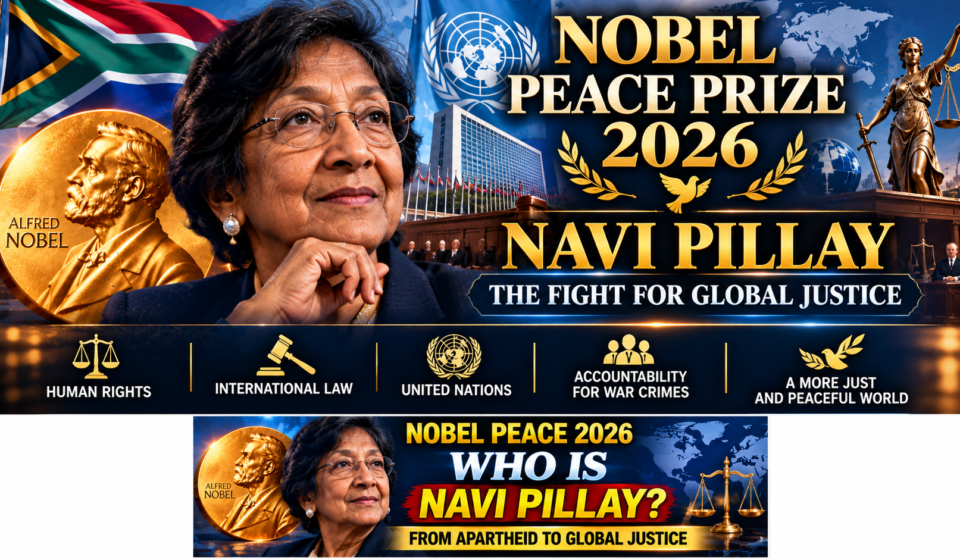
Nobel Peace Prize 2026: Who Is Navi Pillay? Her Inspiring Journey from Apartheid to Global Justice

Navi Pillay wins the 2026 Nobel Peace Prize for promoting peace and international law. Discover her Indian Tamil roots, anti-apartheid struggle, UN career and fight for global justice.
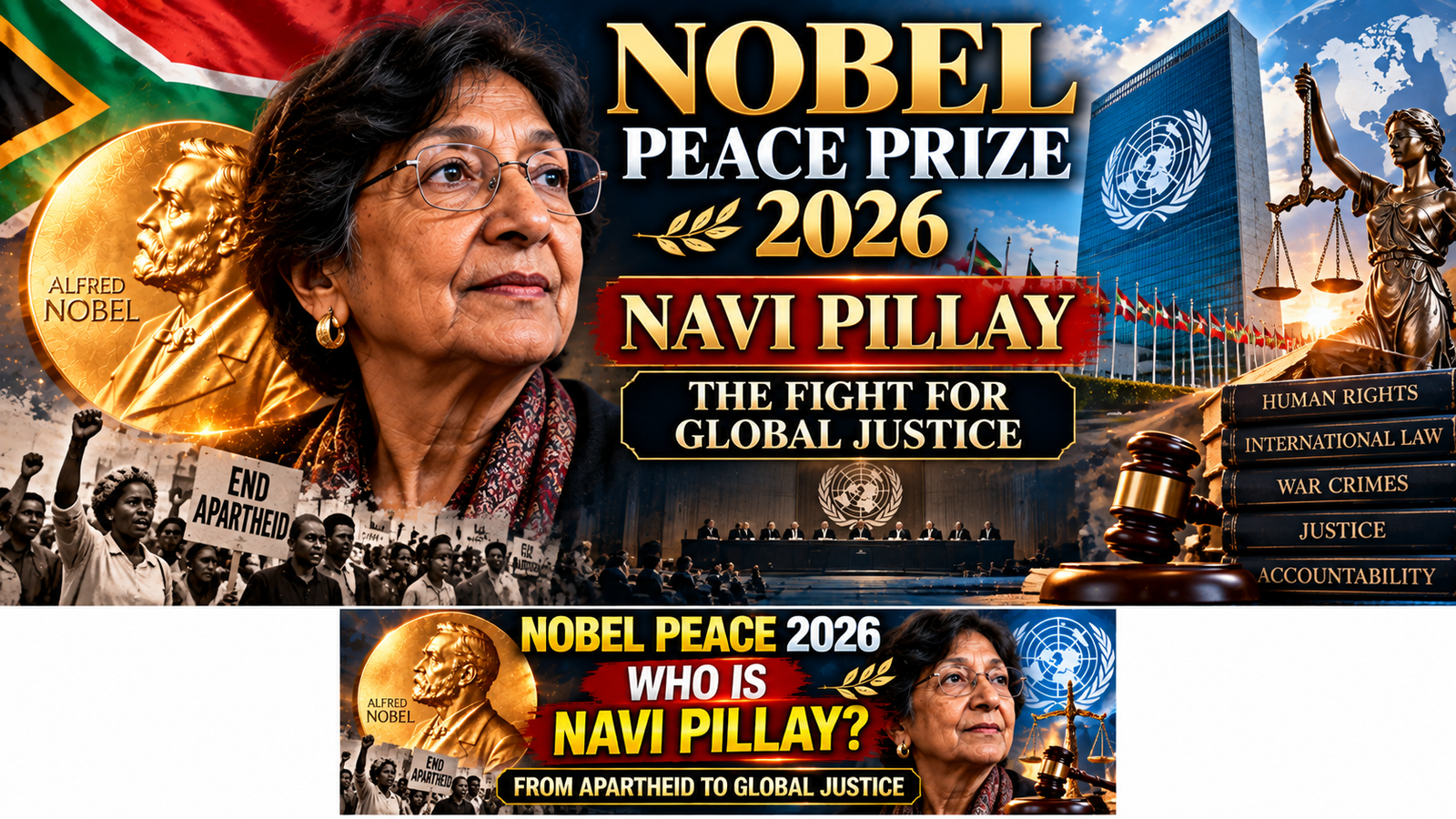
NOBEL PRIZE 2026 • PEACE • GLOBAL JUSTICE
Table of Contents
ToggleNobel Peace Prize 2026: Navi Pillay — The Woman Who Took the Fight for Justice to the World
From apartheid-era South Africa to the world's highest international legal institutions, Navi Pillay's extraordinary journey reflects a powerful question: Can justice become the foundation of lasting peace?
BREAKING: Nobel Peace Prize 2026 Winner Announced
The 2026 Nobel Peace Prize has been awarded to Navanethem “Navi” Pillay, a South African jurist of Indian Tamil origin, for her efforts to promote peace and international law.
The Norwegian Nobel Committee highlighted her contribution to strengthening international legal institutions and ensuring that war crimes, crimes against humanity and genocide can be prosecuted.
The announcement was made on 9 October 2026.
Read the official Nobel Peace Prize 2026 announcement and laureate profile.
When people think about the Nobel Peace Prize, they often imagine peace negotiations, historic agreements and leaders shaking hands after years of conflict.
But peace is not only about ending a war.
It is also about creating a world in which powerful individuals and governments are subject to the law, victims can seek justice, and human dignity is protected regardless of nationality, ethnicity or political influence.
That is the central theme behind the Nobel Peace Prize 2026, awarded to Navi Pillay.
Her career has taken her from apartheid-era South Africa into the international judicial system, including the International Criminal Tribunal for Rwanda, the International Criminal Court and the United Nations human rights system.
Her story is not simply a biography of a distinguished lawyer. It is also a story about the relationship between law, accountability, human rights and peace.
Who Is Navi Pillay?
Navanethem “Navi” Pillay is a South African jurist and former United Nations High Commissioner for Human Rights. She has held senior positions in national and international judicial institutions and has spent much of her career working on questions of discrimination, human rights and accountability for serious international crimes.
She was born in Durban, South Africa, in 1941, into a family of Indian Tamil descent. She grew up during apartheid, a system of racial segregation and discrimination that shaped South African society for decades.
Her background is important to understanding the direction of her career. She experienced the consequences of a system in which race could determine a person's opportunities, status and treatment under the law.
Rather than accepting those barriers, Pillay pursued a legal career and became an important figure in the development of international justice.
Quick Facts About Navi Pillay
| Detail | Information |
|---|---|
| Full name | Navanethem Pillay |
| Known as | Navi Pillay |
| Birth year | 1941 |
| Birthplace | Durban, South Africa |
| Family background | Indian Tamil ancestry |
| Profession | Jurist, lawyer and international judge |
| Former UN position | UN High Commissioner for Human Rights |
| Nobel Prize | Nobel Peace Prize 2026 |
| Award citation | For her efforts to promote peace and international law |
Why Did Navi Pillay Win the Nobel Peace Prize 2026?
The Norwegian Nobel Committee recognised Pillay's efforts to strengthen international law and promote peaceful resolution of conflicts through legal institutions.
Its announcement emphasised her work in ensuring that people responsible for war crimes, crimes against humanity and genocide can be brought before courts.
The committee also highlighted her personal integrity, judicial experience and courage in defending international legal principles at a time when those institutions face significant political pressure.
The central message of the award is that lasting peace requires justice and the rule of law.
The committee's decision is explained in its official announcement: Nobel Peace Prize for 2026.
What Is the Rule of Law, and Why Does It Matter for Peace?
The rule of law means that individuals, institutions and governments should be governed by publicly established laws rather than arbitrary decisions or the unchecked exercise of power.
It also requires fair procedures, independent courts and meaningful accountability.
At the international level, the principle becomes especially important when armed conflicts produce civilian deaths, forced displacement, torture or other serious violations.
International law provides frameworks through which alleged crimes can be investigated and prosecuted, although the effectiveness of these systems depends on jurisdiction, evidence, cooperation and enforcement.
Pillay's career has focused on strengthening these mechanisms and advancing the principle that serious violations should not automatically go unpunished because of a person's position or political influence.
In Simple Words
Peace is not merely the absence of fighting. It also requires institutions capable of protecting people, resolving disputes and holding perpetrators accountable.
Growing Up During Apartheid in South Africa
To understand Navi Pillay's journey, it is necessary to understand apartheid.
Apartheid was a system of institutionalised racial segregation and discrimination implemented in South Africa under white-minority rule. It restricted where people could live, work, study and participate in public life.
Pillay grew up in Durban in a family of Indian Tamil descent during this period. Her experience of the country's racial hierarchy formed part of the historical context for her later work as a lawyer and judge.
In 1967, she established her own law firm in South Africa, becoming a legal pioneer in a society where racial and gender barriers severely limited opportunities for many people.
Her early career included defending people involved in the anti-apartheid struggle. The experience helped shape her commitment to equal treatment, legal protection and human dignity.
Why Her Early Career Matters
Pillay's later international responsibilities were not disconnected from her early life. The struggle against apartheid demonstrated how laws and institutions can be used to maintain discrimination — and why independent legal safeguards are essential.
Her career subsequently focused on the opposite possibility: using law to challenge abuses, recognise victims and hold individuals accountable.
From Durban to Harvard University
Pillay continued her legal education and eventually studied at Harvard University, where she earned a Doctor of Juridical Science degree in 1988.
Her education and professional experience prepared her for work that would increasingly cross national boundaries.
International justice requires more than knowledge of domestic law. It involves complex questions about evidence, jurisdiction, state responsibility, individual criminal liability and the rights of victims and defendants.
Pillay's career brought her into institutions dealing with some of the most serious legal questions in the modern world.
A Historic Role in South Africa's Judiciary
In 1995, Pillay was appointed to South Africa's High Court.
The appointment came during a transformative period in South African history, following the end of apartheid and the establishment of a democratic constitutional order.
South Africa was attempting to build institutions that could protect rights and apply the law within a society emerging from decades of systematic racial discrimination.
Pillay's appointment marked an important stage in a career that would soon extend to international courts.
The Rwanda Genocide and the Search for Justice
One of the most consequential chapters of Pillay's career was her work at the International Criminal Tribunal for Rwanda (ICTR).
The 1994 genocide in Rwanda resulted in the mass killing of Tutsi people and moderate Hutu and others. The international community subsequently established the tribunal to prosecute individuals responsible for genocide and other serious violations of international humanitarian law.
Pillay joined the tribunal as a judge in 1995 and later served as its president.
Her judicial work contributed to an important legal development: the recognition that sexual violence can constitute acts of genocide and crimes against humanity when the relevant legal elements are established.
The Akayesu Case: A Landmark in International Criminal Law
One of the best-known cases associated with the ICTR is Prosecutor v. Jean-Paul Akayesu.
The tribunal's 1998 judgment was a landmark in the development of international criminal law. It recognised that rape and sexual violence could constitute acts of genocide when committed with the specific intent to destroy, in whole or in part, a protected group.
The judgment also addressed the relationship between sexual violence and crimes against humanity.
Pillay was one of the judges on the tribunal. Her work formed part of a wider judicial process that helped establish these legal principles.
The significance of the judgment extends beyond Rwanda. It helped clarify how international courts can address sexual violence committed during mass atrocities.
Why This Legal Development Was Important
- It strengthened recognition of sexual violence in international criminal law.
- It helped clarify how such crimes may relate to genocide.
- It demonstrated the importance of examining crimes committed against women and other victims.
- It contributed to the development of legal standards used in later international proceedings.
The case did not end sexual violence in conflicts, nor did it resolve every question of accountability. Its lasting importance lies in the legal recognition it established.
From the Rwanda Tribunal to the International Criminal Court
Pillay subsequently served as a judge of the International Criminal Court (ICC), an institution established to prosecute individuals for certain of the most serious international crimes.
The ICC differs from the International Court of Justice, which primarily resolves legal disputes between states and issues advisory opinions.
The ICC deals with individual criminal responsibility for crimes within its jurisdiction, including genocide, crimes against humanity, war crimes and, under defined conditions, the crime of aggression.
| Institution | Main Function |
|---|---|
| International Criminal Tribunal for Rwanda | Prosecuted people responsible for genocide and other serious crimes committed in Rwanda and by Rwandan citizens in neighbouring states during the relevant period. |
| International Criminal Court | Prosecutes individuals for specified international crimes within its jurisdiction. |
| International Court of Justice | Resolves legal disputes between states and provides advisory opinions on legal questions. |
| United Nations Human Rights Office | Promotes and protects human rights through monitoring, advocacy, technical assistance and international cooperation. |
Six Years as UN High Commissioner for Human Rights
From 2008 to 2014, Navi Pillay served as the United Nations High Commissioner for Human Rights.
The High Commissioner leads the UN human rights office, known as OHCHR, and plays a major role in international efforts to promote and protect human rights.
The position involves working with governments, international organisations, civil society and other stakeholders on issues ranging from discrimination and political repression to civilian protection and accountability.
It is a demanding role because human rights questions frequently arise in situations where governments, political movements and international powers disagree sharply.
Pillay's tenure placed her at the centre of international discussions about the protection of civilians, the responsibilities of states and the need for credible investigations into alleged abuses.
Her work also illustrated the limits of international institutions: they can investigate, document, recommend and advocate, but implementation often depends on political cooperation and the willingness of states to act.
Why International Law Is Under Pressure
The Nobel Committee's 2026 announcement placed considerable emphasis on the challenges facing international legal institutions.
International courts and accountability mechanisms operate in a world where countries have unequal political and military power. Cooperation can be difficult, and powerful actors may reject legal findings or resist investigations.
The committee's decision was therefore also a statement about the importance of preserving legal frameworks at a time of growing conflict and pressure on international institutions.
The award does not mean that international law always produces consistent outcomes. Its effectiveness remains affected by jurisdictional limits, political decisions, enforcement problems and disagreements about the application of legal standards.
Nevertheless, the Nobel Committee argues that strengthening these institutions is essential to a more peaceful international order.
Navi Pillay and the Israel-Palestine Conflict: Understanding the Context
Pillay's international work has included involvement in human rights investigations concerning the Occupied Palestinian Territory.
From 2021 to 2025, she chaired the UN Independent International Commission of Inquiry on the Occupied Palestinian Territory, including East Jerusalem, and Israel.
The commission examined alleged violations and abuses in the context of the conflict. Its work has been politically contentious, and findings and allegations concerning the conflict have been disputed by the parties involved.
The Norwegian Nobel Committee highlighted Pillay's work in international law and accountability as part of its explanation for the award.
It is important to distinguish between the committee's stated reasons for the Nobel Prize, the findings of particular investigations, the legal standards applicable to specific allegations and the positions taken by governments.
Israel has strongly criticised aspects of Pillay's work concerning the Palestinian territories. The award has consequently attracted both praise from human rights advocates and criticism from Israeli officials.
These reactions underline the politically sensitive environment in which international legal institutions operate. They do not, by themselves, settle the merits of individual legal allegations, which must be assessed using evidence and the applicable law.
What Does the Nobel Committee Want the World to Understand?
The 2026 Peace Prize is rooted in a central principle: lasting peace requires mechanisms that can resolve disputes without force and hold individuals accountable for serious crimes.
The committee's position is that international law should not depend entirely on the political or military strength of the parties involved.
It recognises the role of courts, tribunals and legal institutions in giving victims a route to justice and helping establish standards of conduct.
The award also highlights the people who work within these institutions, often amid political pressure and disagreement.
Why Navi Pillay's Indian Tamil Heritage Matters
Navi Pillay was born in South Africa to a family of Indian Tamil descent.
Her background connects her personal story to the wider history of the Indian diaspora in South Africa, including communities shaped by colonialism, migration and racial discrimination.
However, her achievement should not be reduced to her ancestry. Her Nobel Prize recognises her professional work in law, international justice and human rights.
Her journey also illustrates how a person from a historically marginalised community can help shape international institutions.
For readers in India and across the diaspora, this part of her story may be particularly meaningful: her family heritage is Indian Tamil, while her public career has been deeply rooted in South African and international law.
Is Navi Pillay India's Nobel Peace Prize Winner?
No. Navi Pillay is a South African jurist of Indian Tamil ancestry. She is not an Indian national laureate.
Her heritage is an important part of her background, but her nationality and professional career are South African.
This distinction matters when reporting the achievement accurately. It is appropriate to describe her as a South African Nobel Peace Prize laureate of Indian Tamil origin.
What Is the Nobel Peace Prize Worth in 2026?
The full Nobel Prize monetary award in 2026 is 12 million Swedish kronor.
The Peace Prize is formally presented in Oslo, Norway, on 10 December 2026, the anniversary of Alfred Nobel's death.
The Nobel Peace Prize ceremony is distinct from the ceremonies for the other Nobel Prizes, which take place in Stockholm.
How Navi Pillay's Career Changed International Justice
Pillay's career illustrates how international law develops through the work of judges, lawyers, investigators, governments and civil society.
Her contributions include participation in judicial proceedings that clarified the treatment of sexual violence under international criminal law, service in international courts and leadership of the United Nations human rights system.
These institutions are not perfect, and they cannot prevent every atrocity. Their work nevertheless creates legal standards, preserves evidence, gives victims a forum and helps establish that certain actions can carry individual criminal responsibility.
The 2026 Nobel Peace Prize recognises Pillay's role in advancing that system.
Five Lessons from Navi Pillay's Journey
1. Your Background Does Not Have to Define Your Limits
Pillay grew up under apartheid, yet built a distinguished career in law and international institutions. Her journey demonstrates the importance of education, determination and the removal of discriminatory barriers.
2. Law Can Protect Human Dignity
Legal institutions can provide ways to challenge discrimination, investigate serious crimes and hold individuals accountable.
3. Justice Must Include Victims
The development of international criminal law has helped recognise that sexual violence and other abuses can be central elements of mass atrocities, not merely secondary harms.
4. International Institutions Need Courageous People
Courts and human rights bodies depend on individuals prepared to apply legal standards even when their decisions are politically controversial.
5. Peace Requires More Than Good Intentions
Negotiations and diplomacy are vital, but durable peace also needs institutions, laws and credible processes for resolving disputes.
Nobel Peace Prize 2026: What Happens Next?
The award brings renewed attention to international law, human rights and the protection of civilians during conflict.
It does not automatically change the powers of international courts or guarantee that governments will comply with their decisions.
Its significance is partly symbolic and partly political: the Nobel Committee is using one of the world's most prominent peace awards to emphasise the importance of international legal institutions.
The longer-term impact will depend on how governments, courts, international organisations and civil society respond to the challenges facing the rules-based international order.
Nobel Prize 2026: Winners Announced So Far
| Date | Category | Laureate(s) |
|---|---|---|
| 5 October | Physiology or Medicine | Karl Deisseroth, Peter Hegemann and Georg Nagel |
| 6 October | Physics | Francis Halzen |
| 7 October | Chemistry | Henri B. Kagan and Kenso Soai |
| 8 October | Literature | Anne Carson |
| 9 October | Peace | Navanethem “Navi” Pillay |
| 12 October | Economic Sciences | To be announced |
Read the Complete Nobel Prize 2026 Series
- Nobel Prize 2026: Complete Guide
- Nobel Prize in Medicine 2026: The Brain's Light Switch
- Nobel Prize in Physics 2026: Francis Halzen and Cosmic Neutrinos
- Nobel Prize in Chemistry 2026: Kagan, Soai and Molecular Handedness
- Nobel Prize in Literature 2026: Anne Carson
Official Sources and Further Reading
- Norwegian Nobel Committee: Official 2026 Announcement
- Navi Pillay: Official Nobel Peace Prize Laureate Profile
- Office of the United Nations High Commissioner for Human Rights
- International Criminal Court
- International Court of Justice
- International Criminal Tribunal for Rwanda: Archive
Frequently Asked Questions
Who won the Nobel Peace Prize 2026?
Navanethem “Navi” Pillay, a South African jurist of Indian Tamil origin, won the 2026 Nobel Peace Prize for her efforts to promote peace and international law.
Why did Navi Pillay win the Nobel Peace Prize?
The Norwegian Nobel Committee recognised her work advancing international legal institutions and accountability for war crimes, crimes against humanity and genocide.
Is Navi Pillay of Indian origin?
Yes. Pillay was born in Durban, South Africa, into a family of Indian Tamil descent. She is a South African jurist.
Was Navi Pillay the UN High Commissioner for Human Rights?
Yes. She served as United Nations High Commissioner for Human Rights from 2008 to 2014.
What was Navi Pillay's role in the Rwanda tribunal?
She served as a judge and later president of the International Criminal Tribunal for Rwanda. The tribunal's work contributed to important developments in international criminal law, including the recognition that sexual violence can constitute genocide under the appropriate legal conditions.
Is Navi Pillay an Indian Nobel laureate?
No. She is a South African Nobel laureate of Indian Tamil ancestry. Her heritage and nationality should be distinguished when describing her achievement.
How much is the Nobel Peace Prize worth in 2026?
The full Nobel Prize monetary award in 2026 is 12 million Swedish kronor.
When will Navi Pillay receive the Nobel Peace Prize?
The Nobel Peace Prize ceremony is scheduled for 10 December 2026 in Oslo, Norway.
Final Verdict: Why Navi Pillay's Nobel Prize Matters
Navi Pillay's career has taken her from a society divided by apartheid to the international institutions responsible for addressing some of humanity's most serious crimes.
Her work has involved difficult questions: how should the world respond to genocide? How can victims of sexual violence obtain recognition? How should international courts address allegations against powerful individuals? And what happens when legal principles collide with political interests?
There are no simple answers to these questions. International institutions face real limitations, and their decisions can generate intense disagreement.
But the 2026 Nobel Peace Prize makes one point unmistakably clear: the Norwegian Nobel Committee believes that international law and accountability remain essential to lasting peace.
Pillay's journey also reminds us that the law is not only a collection of rules. It is shaped by people who interpret it, defend it and work to ensure that human dignity is not abandoned when political pressure becomes intense.
The central lesson of the Nobel Peace Prize 2026 is that peace is strongest when justice is possible and no one is automatically beyond the reach of the law.
NOBEL 2026 — THE IDEAS THAT CHANGED HUMANITY
From discoveries that transform science to literature that changes how we see the world and legal work that seeks to protect human dignity, the Nobel Prizes tell stories of human curiosity, courage and achievement.
Follow ExploreWithArvind.com for the final Nobel 2026 deep dive: the Sveriges Riksbank Prize in Economic Sciences in Memory of Alfred Nobel.
Related