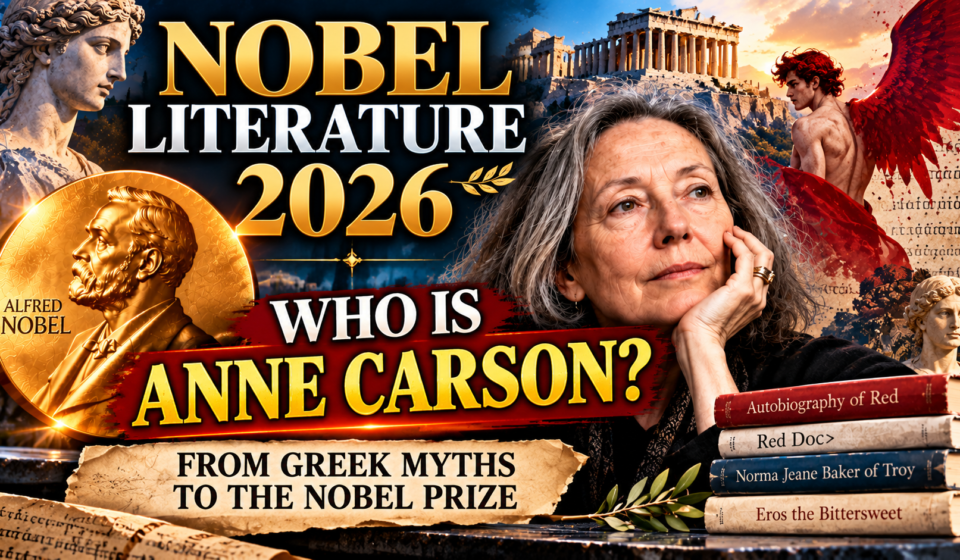
Nobel Prize in Literature 2026: Anne Carson Wins for Transforming Poetry and Classical Literature

Anne Carson wins the 2026 Nobel Prize in Literature for creating bold new literary forms through a playful dialogue with classical tradition. Discover her life, books, Greek mythology, writing style and why she made Nobel history.
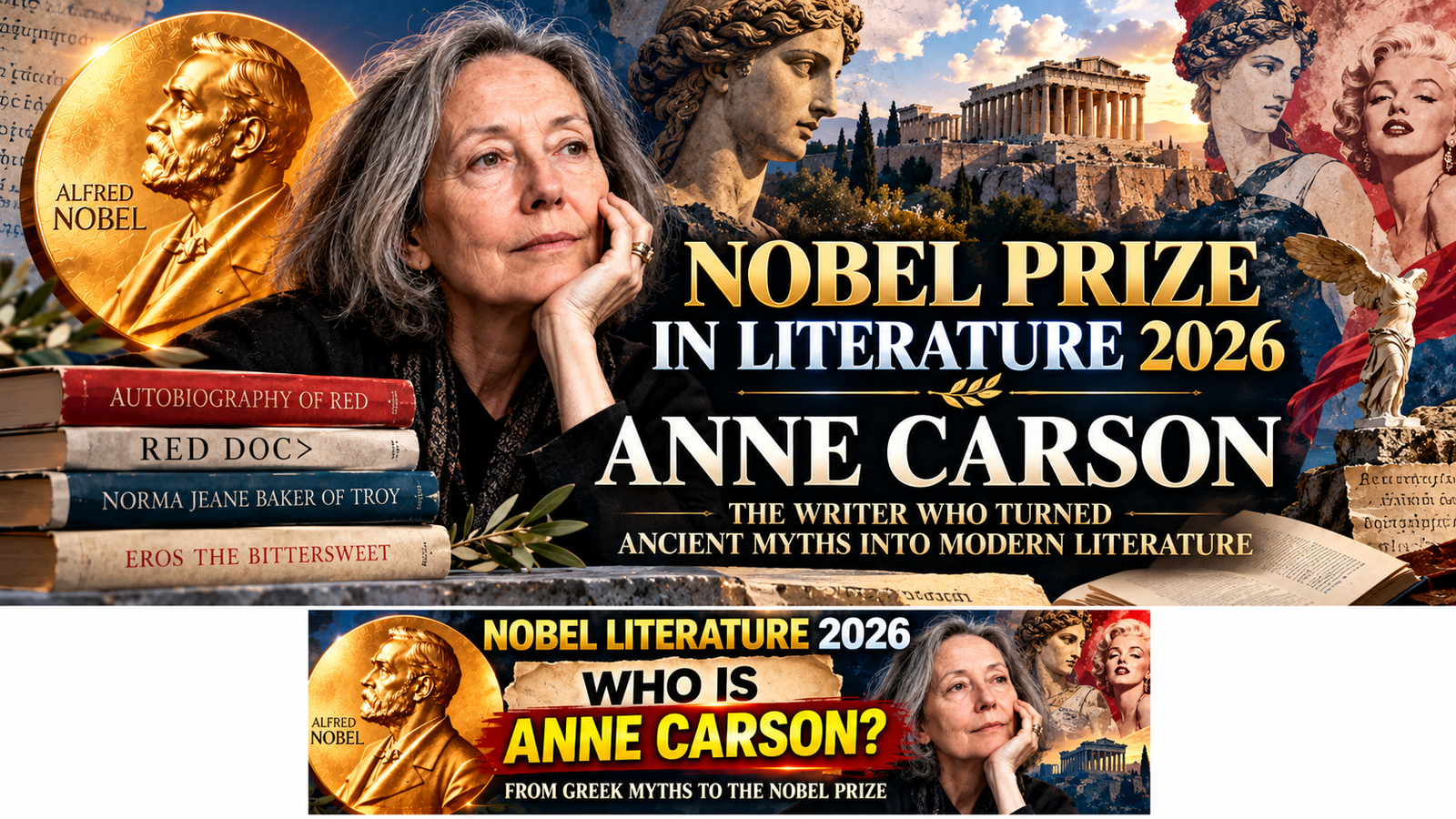
NOBEL PRIZE 2026 • LITERATURE • BREAKING NEWS
Table of Contents
ToggleNobel Prize in Literature 2026: Anne Carson Wins — The Writer Who Turned Ancient Myths Into Modern Literature
From ancient Greek mythology to Marilyn Monroe, from poetry to prose and translation, Anne Carson has spent decades breaking the boundaries of what literature can be.
BREAKING: Anne Carson Wins the Nobel Prize in Literature 2026
The 2026 Nobel Prize in Literature has been awarded to Canadian poet, essayist, classicist and translator Anne Carson.
The Swedish Academy honoured Carson for her “bold and inventive oeuvre” which, in playful dialogue with the classical tradition, has created new forms for contemporary literature.
The announcement was made in Stockholm on 8 October 2026.
For many readers, the name Anne Carson may not be as familiar as that of Hemingway, Gabriel García Márquez, Toni Morrison or Bob Dylan.
But that is precisely what makes this year's Nobel Prize in Literature so fascinating. Carson has built a remarkable literary career by refusing to stay inside conventional categories.
She writes poetry, essays, translations, dramatic works and experimental literary forms. She studies ancient Greek literature, yet her work frequently speaks directly to modern questions of love, identity, grief, desire, memory and human relationships.
In Carson's world, an ancient Greek myth can suddenly become a modern love story. A classical character can become a contemporary human being. A translation can become an act of artistic creation. And poetry can look remarkably different from what readers traditionally expect poetry to be.
Who Is Anne Carson?
Anne Carson was born in Toronto, Canada, on 21 June 1950. She became a poet, essayist, translator, classicist and academic whose work combines literature, philosophy, mythology and classical scholarship.
Carson studied at the University of Toronto, where she earned her BA, MA and PhD. Her academic background in Classics became one of the defining features of her literary career.
Rather than treating ancient Greek literature as something locked inside textbooks and museums, Carson repeatedly brings it into conversation with the modern world.
Her work has appeared in many forms, including poetry collections, verse novels, essays, translations, dramatic works and hybrid literary experiments.
Why Did Anne Carson Win the Nobel Prize?
The official Nobel citation is the key to understanding the award.
“For her bold and inventive oeuvre that, in playful dialogue with the classical tradition, has created new forms for contemporary literature.”
There are three ideas hidden inside that statement: boldness, classical tradition and new literary forms.
1. Boldness
Carson does not always follow conventional literary structures. Her books can combine poetry, prose, scholarship, translation, drama and visual elements.
2. Classical Tradition
Ancient Greece is one of the recurring foundations of her work. Greek myths, poets, philosophers and classical texts become raw material for contemporary literary exploration.
3. New Literary Forms
Perhaps the most important point is that Carson does not simply retell ancient stories. She transforms them.
She experiments with structure, voice, genre and perspective, creating works that can be difficult to classify using traditional labels.
Anne Carson's Literary Superpower: Breaking the Rules
Imagine a writer who refuses to answer the question: “Is this a poem, a novel, an essay or a play?”
That is part of the fascination of Anne Carson.
Her writing often exists somewhere between genres.
| Traditional Category | Carson's Approach |
|---|---|
| Poetry | Poetry mixed with narrative, philosophy and scholarship |
| Novel | Verse, mythology and contemporary storytelling |
| Translation | Classical texts reinterpreted for modern readers |
| Drama | Classical stories reinvented through modern performance |
| Essay | Philosophical and literary questions explored through unconventional forms |
Anne Carson's Most Famous Book: Autobiography of Red
If you want to understand why Anne Carson has become such an influential literary figure, Autobiography of Red is an excellent place to begin.
Published in 1998, the work is described as a verse novel. It draws inspiration from fragments of the ancient Greek poet Stesichorus and the myth of Geryon and Herakles.
But Carson does something extraordinary.
She takes an ancient myth and transforms Geryon into a modern red-winged teenage boy, giving the character emotions, relationships, loneliness and artistic ambitions that feel deeply contemporary.
The result is neither a conventional novel nor a conventional collection of poems. It is something in between.
That hybrid form is precisely the kind of literary experimentation for which Carson has become famous.
Why Autobiography of Red Matters
It demonstrates Carson's unique ability to take an ancient story and make it feel emotionally relevant to a modern reader without simply rewriting the original myth.
What Is the Story Behind Autobiography of Red?
At its foundation is the ancient myth of Geryon, a winged monster associated with the tenth labour of Herakles.
Carson transforms this mythological material into a contemporary coming-of-age story. Geryon becomes a young artist trying to understand himself, love and the complicated relationships around him.
The ancient and modern worlds therefore exist simultaneously.
That is one of Carson's greatest literary strengths: she does not treat the past as dead.
She makes the past speak to the present.
Red Doc> — Continuing the Story
In 2013, Carson published Red Doc>, which revisits characters and ideas from Autobiography of Red.
The work again mixes poetry, narrative and experimental literary techniques.
Instead of presenting a straightforward continuation of a traditional novel, Carson creates another unusual literary landscape where mythology, memory and modern life intersect.
Anne Carson and Ancient Greek Literature
Carson's relationship with classical Greek literature is not merely an influence. It is a major part of her intellectual and artistic identity.
She has translated works associated with ancient Greek writers including Aeschylus, Sophocles, Euripides and Sappho.
Her scholarship allows her to approach ancient texts not only as literature but also as living material that can be questioned, translated, rearranged and reimagined.
This helps explain the Nobel Academy's description of her work as being in “playful dialogue with the classical tradition.”
Norma Jeane Baker of Troy: When Marilyn Monroe Meets Ancient Greece
One of the most striking examples of Carson's imagination is Norma Jeane Baker of Troy.
The title itself tells you that something unusual is happening.
Norma Jeane Baker was Marilyn Monroe's birth name. Troy, meanwhile, immediately evokes the ancient Greek story of Helen of Troy.
Carson brings these two cultural figures into the same artistic universe.
The work draws upon Euripides' Helen while connecting the ancient story with the life and image of Marilyn Monroe.
The result is an unusual meditation on beauty, identity, fame, desire, war and the stories societies create around women.
Why Ancient Greek Myths Still Matter
One of the most interesting questions raised by Carson's Nobel Prize is: Why are ancient myths still relevant in 2026?
Because the technology changes, but many human emotions do not.
- Love still creates vulnerability.
- Power still changes relationships.
- People still struggle with identity.
- Grief still shapes memory.
- Beauty still influences society.
- People still tell stories to understand themselves.
That is why ancient mythology continues to return in modern literature, cinema, theatre and popular culture.
Carson's achievement is to make that connection particularly inventive.
Anne Carson's Writing Style Explained Simply
If traditional literature is like a clearly marked road, Anne Carson's writing is more like a city with many unexpected turns.
A poem can suddenly become an essay. An ancient character can become a modern person. A translation can become a creative reinterpretation. A historical reference can lead into an intensely personal emotion.
This is why Carson's work can feel intellectually challenging while also being deeply emotional.
Anne Carson's Major Works
| Work | Year | Why It Matters |
|---|---|---|
| Eros the Bittersweet | 1986 | Explores desire through Greek literature and philosophy |
| Glass, Irony, and God | 1995 | A major collection demonstrating her hybrid poetic style |
| Autobiography of Red | 1998 | Verse novel reinventing the myth of Geryon |
| The Beauty of the Husband | 2001 | A fictional essay structured around 29 tangos |
| Decreation | 2005 | Combines poetry, essays and opera |
| Nox | 2010 | An experimental work combining memory, translation and elegy |
| Red Doc> | 2013 | Returns to the world of Autobiography of Red |
| Float | 2016 | A collection of experimental literary forms |
| Norma Jeane Baker of Troy | 2019 | Connects Helen of Troy with Marilyn Monroe |
Anne Carson's Journey From Scholar to Nobel Laureate
1950: Born in Toronto, Canada.
1970s–1980s: Develops an academic career in Classics and begins publishing poetry and scholarship.
1986: Publishes Eros the Bittersweet.
1998: Publishes Autobiography of Red, one of her best-known works.
2000: Receives a MacArthur Fellowship.
2013: Publishes Red Doc>.
2019: Norma Jeane Baker of Troy brings classical tragedy into conversation with Marilyn Monroe.
2026: Receives the Nobel Prize in Literature.
Why This Nobel Prize Is Important for Modern Literature
The 2026 Literature Nobel sends an important message about the future of literature: great literature does not necessarily fit into a single box.
Carson's career demonstrates that poetry can communicate through narrative, scholarship, performance, mythology and experimental structure.
It also demonstrates that ancient literature does not have to remain trapped in the past. It can become a conversation between generations.
Is Anne Carson Easy to Read?
Not always.
And that is worth saying honestly.
Some readers may find Carson's work unconventional or intellectually demanding. Her books often assume curiosity about mythology, philosophy, classical literature and language.
But readers who enjoy experimental literature may find precisely this quality exciting.
Where Should a New Reader Start?
Autobiography of Red is probably the most accessible starting point for readers who want to experience Carson's unusual combination of mythology, poetry and contemporary storytelling.
Why Anne Carson's Nobel Matters to Young Readers
For students and young writers, Carson's Nobel Prize carries an especially interesting lesson: you do not always have to follow an established format to create meaningful literature.
Experimentation can itself become a literary language.
Carson's career demonstrates the value of reading widely — across history, languages, genres and cultures.
Her work also shows how old ideas can become new again when viewed from a different angle.
How Much Is the Nobel Prize Worth in 2026?
The 2026 Nobel Prize carries a monetary award of 12 million Swedish kronor.
Anne Carson will formally receive the Nobel medal and diploma at the Nobel Prize ceremony in Stockholm on 10 December 2026.
Where Does Anne Carson Fit in Nobel Literature History?
Carson becomes the latest name in a long tradition of writers whose work has expanded the idea of what literature can be.
The Nobel Prize in Literature has recognized writers working in novels, poetry, drama, essays and other literary forms.
Carson's selection adds another particularly experimental voice to that history.
Nobel Prize in Literature 2026: The Bigger Picture
The Literature Nobel is different from the scientific Nobel Prizes announced earlier this week. Medicine, Physics and Chemistry often reward discoveries that can be described through experiments, instruments or measurable scientific advances.
Literature operates differently.
Its impact can be cultural, emotional, intellectual and deeply personal.
A book can change the way a reader sees love. A poem can change the way a person understands grief. A story can make an ancient civilization suddenly feel close.
That is why the Nobel Prize in Literature remains one of the world's most closely watched cultural awards.
Nobel Prize 2026: Three Winners Already Announced
| Date | Category | 2026 Laureate(s) |
|---|---|---|
| 5 October | Physiology or Medicine | Karl Deisseroth, Peter Hegemann & Georg Nagel |
| 6 October | Physics | Francis Halzen |
| 7 October | Chemistry | Henri B. Kagan & Kenso Soai |
| 8 October | Literature | Anne Carson |
| 9 October | Peace | To be announced |
| 12 October | Economic Sciences | To be announced |
Read the Complete Nobel Prize 2026 Series
- Nobel Prize 2026 – Complete Guide
- Nobel Prize in Medicine 2026 – Optogenetics
- Nobel Prize in Physics 2026 – Francis Halzen & IceCube
- Nobel Prize in Chemistry 2026 – Kagan & Soai
Official Sources & Further Reading
- Nobel Prize – Official Website
- Swedish Academy – Nobel Prize in Literature
- Autobiography of Red – Publisher Information
- Georgetown University – Anne Carson
Frequently Asked Questions
Who won the Nobel Prize in Literature 2026?
Canadian poet, essayist, classicist and translator Anne Carson won the 2026 Nobel Prize in Literature.
Why did Anne Carson win the Nobel Prize?
She was awarded the prize for her bold and inventive body of work, particularly the way she engages playfully with classical traditions while creating new forms of contemporary literature.
What is Anne Carson famous for?
She is particularly known for works including Autobiography of Red, Red Doc>, The Beauty of the Husband, Decreation, Nox and Norma Jeane Baker of Troy.
What is Autobiography of Red?
It is a 1998 verse novel inspired by the ancient Greek myth of Geryon and Herakles. Carson transforms the mythological material into a modern coming-of-age story.
Is Anne Carson a poet or a novelist?
She is both — and also an essayist, translator, classicist and experimental writer. One of the defining characteristics of her career is her refusal to remain within a single literary genre.
How much money does the 2026 Nobel Literature laureate receive?
The 2026 Nobel Prize monetary award is 12 million Swedish kronor.
When will Anne Carson receive the Nobel Prize?
The Nobel Prize ceremony is scheduled for 10 December 2026 in Stockholm.
Final Verdict: Why Anne Carson's Nobel Is a Celebration of Imagination
Anne Carson's Nobel Prize is not simply an award for a collection of books. It is recognition of a distinctive way of thinking about literature.
She takes ancient stories and asks what they can tell us about modern life. She takes poetry and stretches its boundaries. She takes translation and turns it into an encounter between cultures. She takes mythology and gives it new emotional lives.
Perhaps the most beautiful lesson from the Nobel Prize in Literature 2026 is that literature does not have to choose between the ancient and the modern.
It can bring them together.
And Anne Carson has spent her career doing exactly that.
NOBEL 2026 — THE IDEAS THAT CHANGED HUMANITY
From controlling brain cells with light, to discovering cosmic neutrinos, understanding molecular handedness and now reinventing the relationship between ancient mythology and contemporary literature — the 2026 Nobel Prize stories remind us that human curiosity has no single language.
Follow ExploreWithArvind.com for the Nobel Peace Prize 2026 and Economic Sciences 2026 deep dives.
Related