Nobel Prize in Chemistry 2026: Henri Kagan & Kenso Soai Win for Molecular Mirror Mystery

Henri Kagan and Kenso Soai win the 2026 Nobel Prize in Chemistry for discoveries on non-linear effects and autocatalysis in asymmetric organic synthesis. Discover how their work solved the mystery of molecular “handedness” and transformed pharmaceutical chemistry.
Nobel Prize 2026 • Chemistry • Breaking Science
Table of Contents
ToggleNobel Prize in Chemistry 2026: How Henri Kagan and Kenso Soai Solved Chemistry’s “Mirror-Image” Mystery
Two scientists, one century-old mystery and a discovery that changed how chemists control the molecular building blocks of life.
BREAKING: Nobel Prize in Chemistry 2026
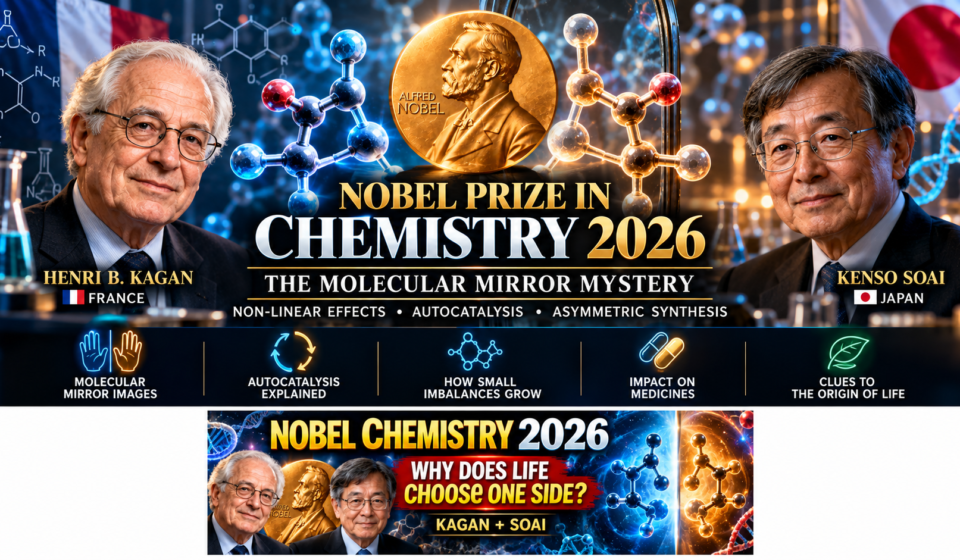
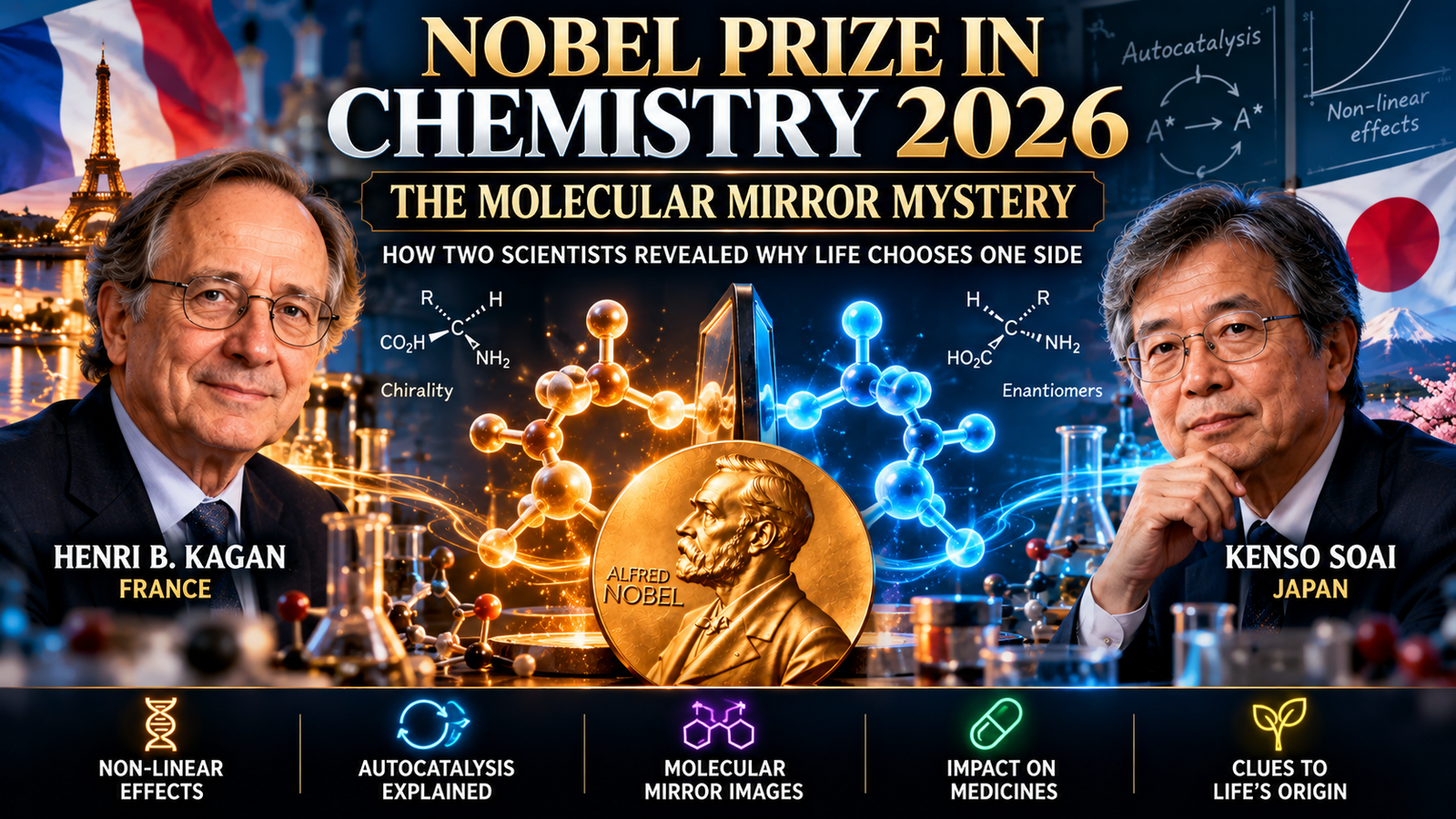
The 2026 Nobel Prize in Chemistry has been awarded jointly to Henri B. Kagan of France and Kenso Soai of Japan for their discovery of non-linear effects and autocatalysis in asymmetric organic synthesis.
Their work addresses one of chemistry's most fascinating questions: Why does life overwhelmingly prefer one of two possible mirror-image forms of certain molecules?
Chemistry often sounds like a world of atoms, bonds and complicated equations. But the Nobel Prize in Chemistry 2026 takes us into something surprisingly intuitive: the difference between a left hand and a right hand.
Many molecules exist in two forms that are mirror images of each other. They may contain exactly the same atoms and have the same connections, yet their three-dimensional arrangements are different. These molecular twins are called enantiomers.
The extraordinary thing is that biological systems are highly selective about which version they use. This phenomenon is known as homochirality.
Henri Kagan and Kenso Soai made landmark discoveries showing how chemical reactions can be pushed toward one molecular “handedness” rather than producing equal amounts of both. Their work has been particularly important for asymmetric synthesis and pharmaceutical chemistry.
Who Won the Nobel Prize in Chemistry 2026?
| Laureate | Country | Recognised Work |
|---|---|---|
| Henri B. Kagan | France | Non-linear effects in asymmetric organic synthesis |
| Kenso Soai | Japan | Asymmetric autocatalysis and amplification of molecular chirality |
The Royal Swedish Academy of Sciences announced the award in Stockholm on 7 October 2026. The two laureates will share the 2026 Nobel Chemistry prize amount of 12 million Swedish kronor. :chatgpt-content-reference{index="1"}
What Did Henri Kagan and Kenso Soai Discover?
The official citation is:
“For the discovery of non-linear effects and autocatalysis in asymmetric organic synthesis.”
In simple terms, their research helped scientists understand and control reactions in which molecules can develop a particular three-dimensional orientation.
Instead of accepting a chemical mixture containing both mirror-image forms, chemists can use carefully designed reactions to favour one form.
This is incredibly important because biological systems can distinguish between molecular shapes.
What Are Molecular Mirror Images?
Imagine putting your left hand in front of a mirror. The reflection looks like a right hand. Both hands contain the same basic components, but you cannot perfectly superimpose one on the other.
Some molecules behave in exactly the same way.
These molecules can have identical chemical formulas and bonding patterns while differing in their three-dimensional arrangement.
Chemists call this property chirality, derived from the Greek word associated with “hand”.
Easy Way to Remember Chirality
Chiral molecule = molecular left hand / molecular right hand.
The two versions can look almost identical chemically, but biological systems may respond to them very differently.
What Is Homochirality?
Homochirality describes the striking preference of biological systems for one molecular handedness.
Amino acids provide a famous example. Although amino acids can exist in mirror-image forms, proteins in living organisms overwhelmingly use one particular configuration.
Sugars involved in biological processes also display strong stereochemical preferences.
This created a profound scientific puzzle:
The Big Question
If chemistry can naturally produce two mirror-image molecules, how did life end up overwhelmingly choosing one?
Scientists have investigated this question for more than a century. The 2026 Nobel Prize recognises discoveries that helped demonstrate how such asymmetry can arise and become dramatically amplified.
Henri Kagan’s Important Breakthrough
Henri Kagan made a decisive contribution in 1986 by discovering a way to manipulate asymmetric chemical reactions that produced a much greater imbalance between molecular mirror images than scientists had previously expected.
This phenomenon became important in understanding non-linear effects.
In a simple linear relationship, a small change in the starting conditions might lead to a proportional change in the result.
Chemistry can sometimes behave very differently.
A small difference in the composition of a chiral catalyst can produce a much larger difference in the molecular handedness of the resulting product.
That amplification is central to understanding how a tiny initial imbalance can potentially become a major stereochemical preference.
Kenso Soai and the Chemistry That “Makes More of Itself”
Kenso Soai took the story further through his pioneering work on asymmetric autocatalysis.
Autocatalysis is a fascinating chemical process in which a product of a reaction helps catalyse the same reaction that produces it.
Think of it as a chemical feedback loop.
Autocatalysis in One Sentence
The product helps make more of the product.
In asymmetric autocatalysis, the chiral product can act as a catalyst that promotes formation of more molecules with the same molecular handedness.
This creates the possibility of self-amplification of chirality.
The 1995 Soai Breakthrough
In 1995, Soai and colleagues published landmark work showing experimentally that autocatalysis could amplify a small initial enantiomeric excess.
Their research demonstrated that an initially modest imbalance could be increased through an asymmetric autocatalytic reaction. :chatgpt-content-reference{index="2"}
This was a major step toward understanding how tiny molecular asymmetries might become chemically significant.
The Astonishing 2003 Result
The story became even more remarkable in 2003.
Research involving Soai and colleagues demonstrated amplification of chirality from an extremely small initial imbalance to more than 99.5% enantiomeric excess after successive cycles of asymmetric autocatalysis. :chatgpt-content-reference{index="3"}
In other words, a tiny initial molecular preference could be enormously amplified.
This became one of the most fascinating demonstrations in the field of asymmetric autocatalysis.
What Does “Enantiomeric Excess” Mean?
Enantiomeric excess (ee) is a way of describing how much one enantiomer predominates over the other in a mixture.
If a chemical reaction produces exactly 50% of each mirror-image form, there is no enantiomeric excess.
If one form dominates strongly, the enantiomeric excess becomes high.
| Mixture | Meaning |
|---|---|
| 50% / 50% | No preference |
| 60% / 40% | Small preference |
| 90% / 10% | Strong preference |
| 99.5% / 0.5% | Extremely strong preference |
Why Does This Matter for Medicines?
This is where an apparently abstract chemistry discovery becomes highly practical.
Many pharmaceutical molecules are chiral. Their mirror-image forms can interact differently with biological targets because the human body is itself a highly three-dimensional chemical environment.
One molecular form may provide the desired therapeutic effect, while another can be less effective or potentially produce unwanted effects.
Therefore, the ability to selectively manufacture the desired molecular form is enormously valuable in drug development and pharmaceutical production. :chatgpt-content-reference{index="4"}
Why Asymmetric Synthesis Is So Important
Asymmetric synthesis refers broadly to chemical methods designed to favour the formation of one stereochemical form over another.
Modern pharmaceutical chemistry relies heavily on precise control of molecular structure.
The more accurately chemists can control molecular architecture, the more precisely they can design compounds for particular biological functions.
Kagan and Soai's work therefore sits at the intersection of fundamental chemistry and practical molecular design.
Could This Help Explain the Origin of Life?
This is perhaps the most fascinating question raised by the Nobel-winning research.
Scientists have long wondered how the strong molecular handedness found in living systems could have emerged from an environment where basic chemistry might initially have produced both mirror-image forms.
Asymmetric autocatalysis provides an experimentally studied mechanism in which a tiny initial imbalance can be amplified dramatically.
That does not mean Kagan and Soai have solved the complete origin-of-life question. Rather, their chemistry provides an important framework for studying how molecular asymmetry could be generated and amplified.
Soai's research has specifically explored the relationship between asymmetric autocatalysis and the origin of homochirality. :chatgpt-content-reference{index="5"}
The “Chemical Feedback Loop” Explained Simply
- A reaction begins with a tiny molecular imbalance.
- One molecular handedness becomes slightly more abundant.
- The chiral product can act as an asymmetric catalyst.
- The catalyst promotes formation of more molecules with the same handedness.
- The imbalance becomes larger.
- Repeated cycles can dramatically amplify the original preference.
This is why asymmetric autocatalysis is so conceptually powerful: it creates a chemical feedback mechanism capable of amplifying chirality.
Why the 2026 Nobel Chemistry Prize Is Different
The prize is not simply about discovering a new molecule or inventing a new industrial process.
It addresses a deeper question about how chemical asymmetry can emerge and become amplified.
The Nobel Committee described the work as a solution to a chemical mystery that had challenged scientists for more than a century. :chatgpt-content-reference{index="6"}
Henri Kagan vs Kenso Soai: Their Contributions
| Scientist | Major Contribution | Why It Matters |
|---|---|---|
| Henri B. Kagan | Non-linear effects in asymmetric synthesis | Showed how stereochemical outcomes can be amplified beyond simple proportional relationships |
| Kenso Soai | Asymmetric autocatalysis | Demonstrated powerful self-amplification of molecular chirality |
What Is the Pharmaceutical Impact?
The pharmaceutical industry frequently needs molecules with very specific three-dimensional structures.
Better asymmetric synthesis can potentially mean:
- More selective drug synthesis
- Greater control over active pharmaceutical ingredients
- Reduced formation of unwanted stereoisomers
- More efficient chemical processes
- Improved routes for producing complex molecules
- Better understanding of structure–activity relationships
The Nobel Committee has highlighted the importance of the discoveries for chemists designing reactions used in pharmaceutical manufacturing. :chatgpt-content-reference{index="7"}
2026 Nobel Prize in Chemistry: Why Students Should Know This
This Nobel is especially useful for students studying chemistry, biology, medicine and biotechnology because it connects several important concepts:
- Organic chemistry
- Stereochemistry
- Chirality
- Enantiomers
- Catalysis
- Autocatalysis
- Asymmetric synthesis
- Pharmaceutical chemistry
- Origin-of-life research
What Is the Prize Money in 2026?
The full Nobel Prize amount in 2026 is 12 million Swedish kronor. Kagan and Soai share the Chemistry prize. :chatgpt-content-reference{index="8"}
When Will the Nobel Chemistry Prize Be Presented?
The Nobel laureates will formally receive their medals and diplomas at the Nobel Prize ceremony in Stockholm on 10 December 2026, followed by the traditional Nobel banquet.
The Nobel Prize ceremonies are held on 10 December, the anniversary of Alfred Nobel's death. :chatgpt-content-reference{index="9"}
Nobel Prize 2026: What Has Been Announced So Far?
| Date | Category | 2026 Laureates |
|---|---|---|
| 5 October | Physiology or Medicine | Karl Deisseroth, Peter Hegemann & Georg Nagel |
| 6 October | Physics | Francis Halzen |
| 7 October | Chemistry | Henri B. Kagan & Kenso Soai |
| 8 October | Literature | To be announced |
| 9 October | Peace | To be announced |
| 12 October | Economic Sciences | To be announced |
Read the Other Nobel Prize 2026 Articles
Continue the complete Nobel 2026 series on ExploreWithArvind:
- Nobel Prize 2026 – Complete Guide
- Nobel Prize in Medicine 2026 – Optogenetics
- Nobel Prize in Physics 2026 – Francis Halzen & IceCube
Official Sources and Further Reading
- Nobel Prize – Official Website
- Royal Swedish Academy of Sciences
- Nature – Asymmetric Autocatalysis and Amplification of Enantiomeric Excess
- Wiley – Amplification of Chirality to Greater Than 99.5% ee
- Royal Society of Chemistry – Asymmetric Autocatalysis
Frequently Asked Questions
Who won the Nobel Prize in Chemistry 2026?
Henri B. Kagan of France and Kenso Soai of Japan won the 2026 Nobel Prize in Chemistry.
Why did Henri Kagan and Kenso Soai win the Nobel Prize?
They were awarded the prize for discovering non-linear effects and autocatalysis in asymmetric organic synthesis.
What is homochirality?
Homochirality refers to the strong preference of biological systems for one molecular handedness among two possible mirror-image forms.
What is asymmetric autocatalysis?
It is a process in which a chiral product acts as a catalyst for its own formation, allowing molecular handedness to be amplified.
Why is chirality important in medicines?
Different molecular mirror images can interact differently with biological systems. Controlling which form is produced is therefore important in pharmaceutical chemistry.
How much money does the 2026 Nobel Chemistry winner receive?
The 2026 Nobel Prize amount is 12 million Swedish kronor for a full prize, shared between the two Chemistry laureates.
When is the Nobel Prize ceremony?
The Nobel Prize ceremony takes place on 10 December 2026 in Stockholm.
Final Takeaway: When Chemistry Learns to Choose a Side
The 2026 Nobel Prize in Chemistry is a powerful reminder that some of science's biggest mysteries can hide inside things that appear incredibly small.
A molecule may have a mirror image that looks almost identical. Yet that tiny difference can determine how the molecule behaves inside a living organism.
Henri Kagan showed how asymmetric chemical reactions could display powerful non-linear behaviour. Kenso Soai demonstrated how autocatalysis could amplify molecular handedness.
Together, their work helped transform a century-old chemical puzzle into an experimentally accessible field of research.
Their discovery also connects three enormous questions: How does chemistry work? How did life's molecular asymmetry emerge? And how can we build better medicines?
That is what makes the Nobel Prize in Chemistry 2026 more than another scientific award. It is a story about the extraordinary power of molecular “handedness” — and how a tiny chemical imbalance can potentially grow into something enormous.
NOBEL 2026 — THE IDEAS THAT CHANGED HUMANITY
Follow "ExploreWithArvind" for the next Nobel 2026 deep dive as the winners of Literature, Peace and Economic Sciences are announced.
Related