Nobel Prize in Physics 2026: Francis Halzen Wins for IceCube & Cosmic Neutrinos

Francis Halzen wins the 2026 Nobel Prize in Physics for IceCube and the discovery of high-energy astrophysical neutrinos. Learn how Antarctic ice became a cosmic telescope.
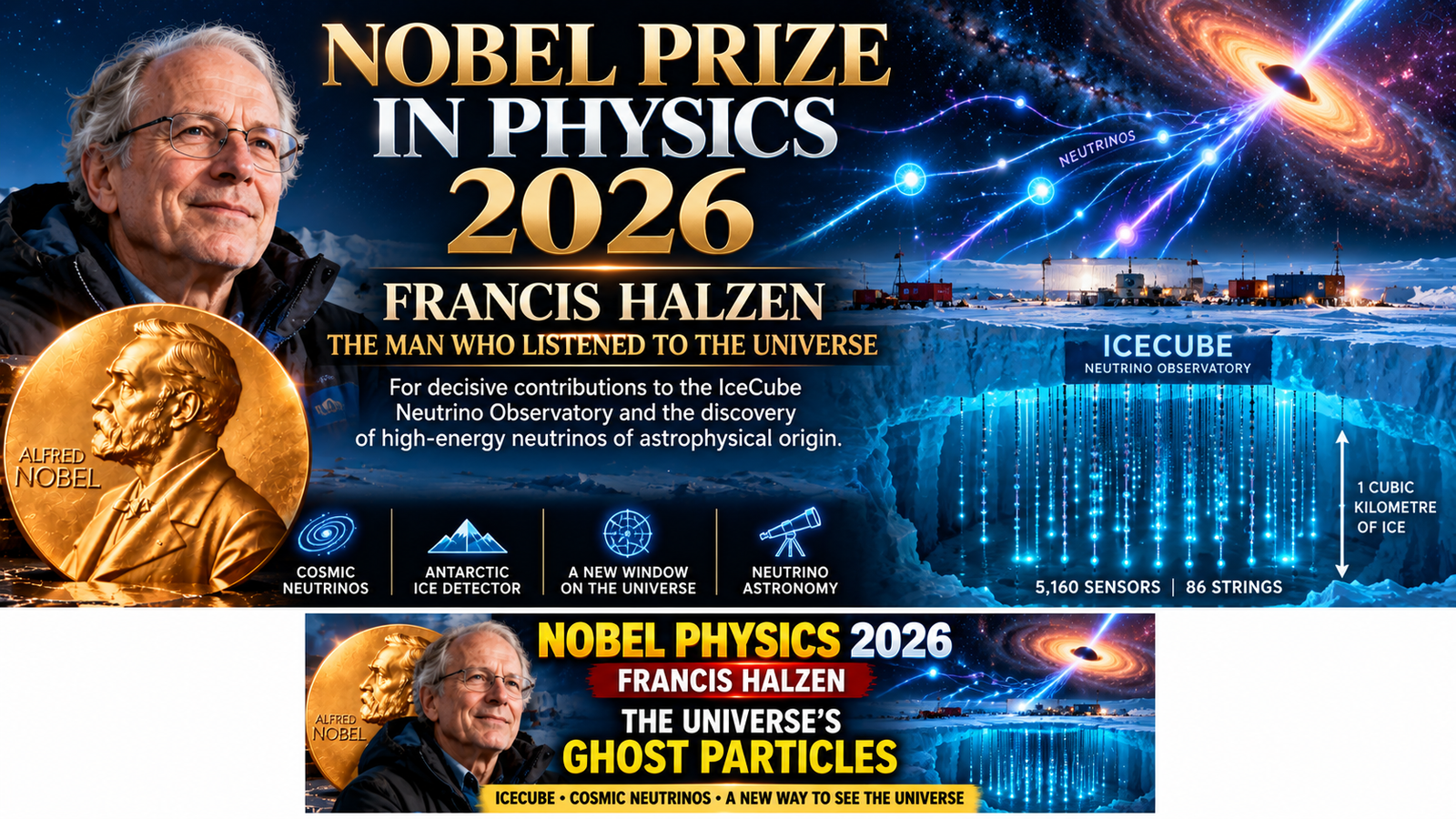
Table of Contents
ToggleNobel Prize in Physics 2026: Francis Halzen and the IceCube Telescope That Opened a New Window on the Universe
What if the universe has been sending us messages for billions of years — but we were listening with the wrong kind of telescope?
On 6 October 2026, the answer became part of Nobel Prize history.
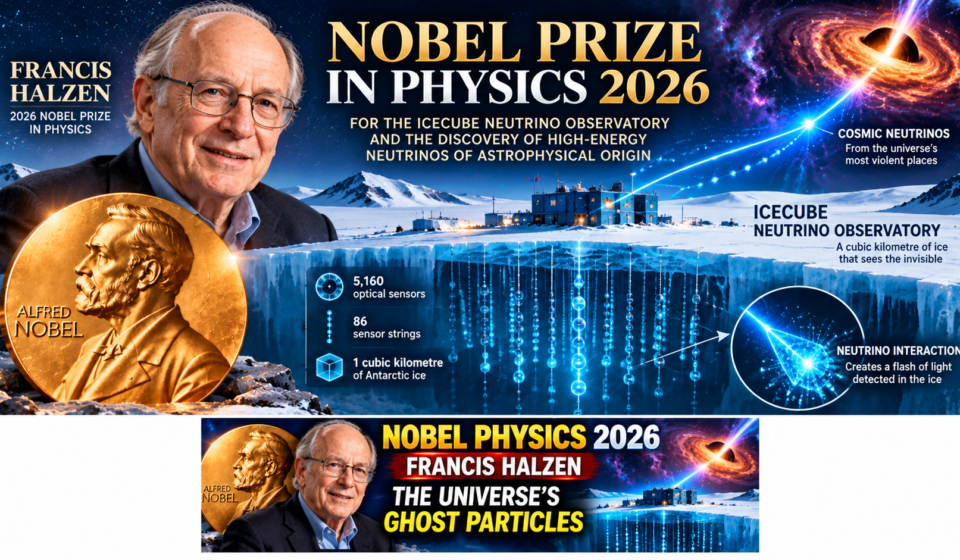
Francis Halzen has been awarded the 2026 Nobel Prize in Physics for his decisive contributions to the IceCube Neutrino Observatory and the discovery of high-energy neutrinos of astrophysical origin.
🏆 BREAKING NOBEL 2026
Nobel Prize in Physics 2026
Francis Halzen
“For decisive contributions to the IceCube Neutrino Observatory and the discovery of high-energy neutrinos of astrophysical origin.”
Prize amount: SEK 12 million
Halzen's Nobel-winning story is unlike an ordinary astronomy story. Instead of pointing a conventional telescope toward the stars, scientists built an enormous detector deep beneath the ice at the South Pole and waited for almost invisible particles called neutrinos to reveal where some of the universe's most powerful cosmic accelerators are hiding.
The result has helped establish neutrino astronomy — a new way of studying the universe.
And the most astonishing part?
The telescope is made largely from naturally occurring Antarctic ice.
🌌 Who Is Francis Halzen?
Francis Halzen is a Belgian-born physicist and a leading figure in particle physics, astrophysics and neutrino astronomy.
He is a professor at the University of Wisconsin–Madison and the principal investigator of the IceCube Neutrino Observatory.
Halzen was born in Belgium and earned his master's and PhD degrees at what is now KU Leuven. He joined the University of Wisconsin–Madison faculty in the early 1970s and has spent decades working at the intersection of particle physics, astrophysics and cosmology. :chatgpt-content-reference{index="2"}
His interest in neutrino astronomy began decades before IceCube became a reality. In 1987, he began working on AMANDA, an earlier-generation neutrino telescope that provided a proof of concept for what would eventually become IceCube. :chatgpt-content-reference{index="3"}
What started as an ambitious scientific idea eventually became one of the world's most remarkable particle detectors.
🧊 What Is the IceCube Neutrino Observatory?
Imagine taking an area of Antarctic ice roughly a kilometre across and turning it into a giant particle detector.
That is, in essence, IceCube.
The IceCube Neutrino Observatory is located at the geographic South Pole. Its detector uses 5,160 digital optical modules arranged along 86 strings embedded deep inside approximately one cubic kilometre of clear Antarctic ice. :chatgpt-content-reference{index="4"}
The sensors are buried deep enough to reduce the background noise created by ordinary cosmic-ray particles reaching Earth's surface.
When a high-energy neutrino interacts with matter inside the ice, it can create charged particles that travel through the ice and produce tiny flashes of blue light known as Cherenkov radiation.
IceCube's sensors detect these flashes.
Scientists then use the timing and pattern of the detected light to reconstruct information about the particle that produced the event.
🧊 ONE CUBIC KILOMETRE OF ICE
5,160 optical sensors
86 sensor strings
Deep beneath the South Pole
Listening for particles from the cosmos
👻 What Are Neutrinos?
Neutrinos are among the strangest particles known to science.
They have an extremely small mass, carry no electric charge and interact with matter extraordinarily weakly.
That means enormous numbers of neutrinos can pass through matter without being stopped.
In fact, neutrinos are passing through Earth — and through us — all the time.
Most pass through without leaving any detectable trace.
That is why neutrinos are sometimes described as “ghost particles.”
But their weakness is also their superpower.
Because neutrinos rarely interact with matter, they can travel enormous cosmic distances while preserving information about the violent environments in which they were produced.
🚀 Why Are High-Energy Neutrinos So Important?
The universe contains objects and events capable of producing energies far beyond anything humans can easily reproduce on Earth.
These include:
- 🌌 Supermassive black holes
- 💥 Exploding stars and extreme stellar events
- 🌀 Active galaxies
- ⚡ Cosmic-ray accelerators
- 🌠 Other extreme astrophysical environments
High-energy neutrinos can travel away from these environments and cross enormous distances.
Unlike charged cosmic rays, which are deflected by magnetic fields, neutrinos travel essentially along straight paths.
That makes them valuable cosmic messengers.
By detecting a neutrino and determining its direction and energy, scientists can investigate the distant astrophysical environment from which it originated.
🔭 A New Kind of Astronomy
Traditional astronomy largely depends on electromagnetic radiation — visible light, radio waves, X-rays, gamma rays and other forms of electromagnetic radiation.
But the universe can also be studied through other messengers.
Gravitational-wave observatories detect ripples in spacetime.
Cosmic-ray detectors detect energetic particles.
And IceCube detects neutrinos.
This broader approach is often called multi-messenger astronomy.
It allows scientists to combine different types of cosmic information to build a more complete picture of violent events in the universe.
💥 The 2013 Breakthrough That Changed Neutrino Astronomy
IceCube's importance became dramatically clear in 2013.
The IceCube Collaboration announced the observation of high-energy particle events that provided the first solid evidence for astrophysical neutrinos from cosmic accelerators.
The collaboration reported 28 very high-energy events that could not be adequately explained by neutrinos produced in Earth's atmosphere. :chatgpt-content-reference{index="5"}
This was a landmark moment.
For the first time, scientists had compelling evidence that neutrinos with enormous energies were arriving from beyond our solar system.
A new form of astronomy had effectively opened its eyes.
🌠 What Does “Astrophysical Origin” Actually Mean?
The phrase in the Nobel citation may sound complicated.
It simply means that these high-energy neutrinos originate from astrophysical sources outside Earth.
Instead of being produced only by processes in Earth's atmosphere, some neutrinos arrive from powerful cosmic environments.
These particles can carry information about conditions that are impossible to reproduce in laboratories on Earth.
That makes them valuable probes of the universe's most energetic phenomena.
🕳️ Can Neutrinos Help Us Understand Black Holes?
Potentially — and this is one of the most exciting aspects of neutrino astronomy.
Supermassive black holes at the centres of galaxies can power extraordinarily energetic environments.
When matter falls toward such a black hole, enormous amounts of energy can be released.
Some of these environments can accelerate particles to extreme energies.
Neutrinos produced in such environments can escape and travel through space.
Because neutrinos are not easily deflected or absorbed, they can provide clues about the environments where these extreme particles are produced.
IceCube has provided evidence linking high-energy neutrino emission to powerful astrophysical objects, including active galaxies, helping researchers investigate the origins of cosmic rays. :chatgpt-content-reference{index="6"}
🌌 How Does IceCube “See” Something It Cannot See?
This is perhaps the most fascinating part of the entire story.
IceCube does not photograph a neutrino.
Instead, it detects the physical consequences of a neutrino interaction.
Step 1 — A neutrino travels through space
A high-energy neutrino travels across enormous distances from its astrophysical source.
Step 2 — It reaches Earth
The neutrino passes through Earth with a very high probability of interacting with nothing.
Step 3 — Occasionally, it interacts in or around the detector
When the right interaction occurs, secondary charged particles are produced.
Step 4 — Cherenkov light appears
Those particles move through the ice and produce tiny flashes of blue Cherenkov light.
Step 5 — Sensors record the flashes
The thousands of optical sensors capture the timing and intensity of the light.
Step 6 — Scientists reconstruct the event
Computational analysis helps determine the neutrino's energy, direction and other properties.
💡 IN SIMPLE WORDS
IceCube does not see the neutrino itself.
It sees the tiny flash of light created when a neutrino finally interacts with matter.
🇦🇶 Why Build a Telescope at the South Pole?
At first glance, Antarctica seems like one of the worst possible locations for a scientific observatory.
It is extremely cold, remote and difficult to access.
But for IceCube, the Antarctic environment provides something extraordinarily valuable: vast quantities of clear, stable ice.
The ice acts as the detection medium.
It also provides shielding from many unwanted particles coming from above.
Halzen's vision was that the Antarctic ice itself could become a gigantic detector.
That idea required technological innovation, specialised drilling and enormous international scientific cooperation.
His scientific leadership was fundamental to turning that concept into IceCube. :chatgpt-content-reference{index="7"}
🔥 The Amazing Story of the Hot-Water Drill
Building IceCube was not simply a matter of placing sensors into existing holes.
Scientists and engineers had to drill deep into the Antarctic ice.
The project developed specialised hot-water drilling technology capable of creating deep holes into which strings of optical sensors could be lowered.
Halzen later described the project's early philosophy as essentially starting small, studying the ice and developing the drilling technology step by step until the team had the tools required to build a kilometre-scale detector. :chatgpt-content-reference{index="8"}
It was a remarkable combination of physics, engineering, logistics and scientific persistence.
🧑🔬 Francis Halzen's Long Journey to the Nobel Prize
One reason Halzen's Nobel story is particularly interesting is that it was built over several decades.
| Period | Milestone |
|---|---|
| Belgium | Studies physics and mathematics at KU Leuven. |
| 1970s | Begins his long academic career at the University of Wisconsin–Madison. |
| 1987 | Begins working on AMANDA, an early South Pole neutrino-telescope project. |
| IceCube era | Leads the development of the kilometre-scale IceCube neutrino observatory. |
| 2013 | IceCube produces compelling evidence for high-energy astrophysical neutrinos. |
| 2026 | Nobel Prize in Physics for decisive contributions to IceCube and the discovery of high-energy astrophysical neutrinos. |
Halzen's own academic profile says he began working on the IceCube project in 1987 through its predecessor AMANDA and has served as IceCube principal investigator since the project's development. :chatgpt-content-reference{index="9"}
🌍 IceCube Is Bigger Than One Scientist
Although the 2026 Nobel Prize in Physics is awarded to Francis Halzen, IceCube itself is a huge international scientific collaboration.
The detector's construction and scientific operation involved researchers, engineers and institutions from many countries.
This is an important aspect of modern science.
A Nobel Prize may recognise an individual scientist's decisive contributions, but discoveries of this scale often depend on the combined work of thousands of people across generations.
IceCube's scientific programme continues to involve international researchers analysing data from one of the world's most unusual observatories.
🔭 What Has IceCube Discovered Beyond the 2013 Breakthrough?
IceCube's scientific programme has continued to evolve.
The observatory has been used to study high-energy neutrinos, neutrino properties, cosmic rays and possible astrophysical sources.
Researchers have also identified evidence connecting neutrino emission to distant astrophysical sources and have detected neutrinos associated with our own Milky Way. :chatgpt-content-reference{index="10"}
IceCube has therefore developed from a bold detector concept into an important astronomical observatory.
🌌 The Next Giant Step: IceCube-Gen2
The Nobel Prize does not mark the end of the IceCube story.
Scientists are already planning the next generation.
IceCube-Gen2 is envisioned as a substantially larger detector that could expand the instrumented volume to approximately 8 cubic kilometres.
The goal is to increase the rate of neutrino detections dramatically and provide a much more detailed view of the high-energy universe. :chatgpt-content-reference{index="11"}
If successful, the next-generation observatory could help researchers identify more cosmic neutrino sources and investigate the physics of extreme astrophysical environments in greater detail.
💰 How Much Is the Nobel Prize in Physics 2026 Worth?
The 2026 Nobel Prize carries a monetary award of SEK 12 million.
Because Francis Halzen is the sole Physics laureate this year, the prize amount is awarded to him rather than divided among multiple Physics laureates.
The Nobel Prize also includes the prestigious Nobel medal and diploma.
More importantly, Halzen now joins the historic list of Nobel laureates whose work has fundamentally expanded humanity's understanding of nature. Contemporary reporting confirms the SEK 12 million award. :chatgpt-content-reference{index="12"}
🏆 Why Did Francis Halzen Win the Nobel Prize?
The Nobel citation captures two closely connected achievements.
1. Building IceCube
Halzen was instrumental in turning the idea of using Antarctic ice as a gigantic neutrino detector into a functioning scientific observatory.
2. Revealing high-energy astrophysical neutrinos
IceCube's observations demonstrated that extremely energetic neutrinos arrive from cosmic sources outside our solar system.
Together, these achievements opened a new observational window on the universe.
Instead of studying the cosmos only through light and other electromagnetic signals, scientists could now use neutrinos as cosmic messengers.
🌠 Why Neutrino Astronomy Could Change Our Understanding of the Universe
There are some cosmic environments where electromagnetic signals do not provide the complete picture.
High-energy photons can be absorbed or scattered.
Charged cosmic rays can be deflected by magnetic fields.
Neutrinos, however, can travel vast distances with comparatively little interaction.
This gives astronomers a new way to investigate the engines that produce the highest-energy particles in the universe.
In other words:
🌌 WE ARE LEARNING TO LISTEN TO THE UNIVERSE
NOT JUST LOOK AT IT.
🇮🇳 Why Should India Care About This Nobel Prize?
The 2026 Physics Nobel is highly relevant to India's growing interest in astronomy, particle physics, astrophysics and space science.
India has major research programmes in particle physics, cosmic rays, neutrino physics and astronomy.
Indian researchers have participated in international particle-physics and astrophysics collaborations, while Indian institutions continue to develop capabilities in neutrino and cosmic-ray research.
The broader lesson of IceCube is especially important for India's scientific future:
Some of the most important discoveries may require decades of investment in basic science before their full significance becomes visible.
For students considering physics, astronomy or engineering, the IceCube story is also a lesson in interdisciplinary thinking — combining physics, computing, engineering, materials, data analysis and international collaboration.
🎓 What Can Students Learn From Francis Halzen?
- Think long term: major discoveries can take decades.
- Do not underestimate basic science: today's fundamental question can become tomorrow's breakthrough.
- Combine disciplines: modern physics increasingly connects theory, computing, engineering and astronomy.
- Be willing to attempt difficult ideas: putting a kilometre-scale detector under Antarctic ice was once an extraordinary proposition.
- Collaboration matters: modern scientific discoveries often depend on international teams.
🔬 The Science in One Simple Example
Imagine a message travelling from an unimaginably distant galaxy.
The message is not a radio transmission.
It is a neutrino.
It travels through space for millions or billions of years.
It passes through planets, stars and enormous amounts of matter without interacting.
Eventually, one such particle reaches Earth.
It travels deep into the Antarctic ice.
And then — extremely rarely — it interacts.
The interaction creates a tiny flash of blue light.
One of IceCube's sensors detects it.
Scientists analyse the pattern.
And suddenly, humanity has a clue about an extraordinarily energetic event somewhere in the universe.
That is the magic of neutrino astronomy.
🌌 From Antarctic Ice to the Deepest Cosmos
Francis Halzen's Nobel story is therefore much bigger than an experimental detector.
It is a story about changing the way humanity observes reality.
For centuries, astronomy was dominated by what we could see.
Then technology allowed us to observe radio waves, X-rays and gamma rays.
Gravitational-wave detectors later allowed us to detect ripples in spacetime.
IceCube added another messenger: high-energy neutrinos.
Each new messenger reveals something that previous instruments could not easily show us.
📅 Nobel Prize 2026: What Happens Next?
The Physics announcement is the second major Nobel announcement of the 2026 Nobel Week.
| Date | Prize | Status |
|---|---|---|
| 5 October | Physiology or Medicine | ✅ Announced |
| 6 October | Physics | ✅ Francis Halzen |
| 7 October | Chemistry | Upcoming |
| 8 October | Literature | Upcoming |
| 9 October | Peace | Upcoming |
| 12 October | Economic Sciences | Upcoming |
The official Nobel schedule confirms that the 2026 Nobel announcements run from 5 to 12 October, with Physics announced on 6 October and Chemistry next on 7 October. :chatgpt-content-reference{index="13"}
❓ Frequently Asked Questions
Who won the Nobel Prize in Physics 2026?
Francis Halzen won the 2026 Nobel Prize in Physics.
Why did Francis Halzen win the Nobel Prize?
He was recognised for decisive contributions to the IceCube Neutrino Observatory and the discovery of high-energy neutrinos of astrophysical origin.
What is IceCube?
IceCube is a neutrino observatory at the South Pole that uses thousands of optical sensors embedded deep inside Antarctic ice to detect the light produced when neutrinos interact.
What are neutrinos?
Neutrinos are extremely weakly interacting subatomic particles with very small masses and no electric charge. Because they interact so rarely with matter, they can travel enormous distances through the universe.
Why are neutrinos called ghost particles?
They are sometimes called ghost particles because they can pass through enormous amounts of matter without interacting.
How does IceCube detect neutrinos?
IceCube detects tiny flashes of Cherenkov light produced when neutrino interactions create charged particles that travel through the Antarctic ice.
How large is IceCube?
The detector instruments approximately one cubic kilometre of Antarctic ice using 5,160 digital optical modules arranged along 86 strings.
What was the major IceCube breakthrough?
In 2013, the IceCube Collaboration reported the first solid evidence for a flux of high-energy neutrinos of astrophysical origin.
What is neutrino astronomy?
Neutrino astronomy is the study of astronomical objects and cosmic events using neutrinos as messengers from space.
How much money does the 2026 Physics Nobel carry?
The 2026 Nobel Prize carries SEK 12 million. Francis Halzen is the sole Physics laureate this year.
Is IceCube being expanded?
Yes. The proposed IceCube-Gen2 observatory is intended to provide a much larger detection volume and significantly increase the number of high-energy neutrinos that can be studied.
🔗 Official Sources & Further Reading
- Official Nobel Prize Website
- Nobel Prize 2026 Announcement Schedule
- IceCube Neutrino Observatory — Official Website
- IceCube Press Guide
- Francis Halzen — University of Wisconsin–Madison
- Nobel Prize 2026 Series — ExploreWithArvind
🌟 Final Word
The 2026 Nobel Prize in Physics is not simply a story about a scientist, a detector or a particle.
It is a story about changing the way humanity sees the universe.
Francis Halzen had the vision to turn a seemingly impossible idea — using Antarctic ice as a gigantic neutrino telescope — into reality.
IceCube then gave scientists evidence that some of the most energetic neutrinos reaching Earth originate from violent astrophysical environments far beyond our planet.
These particles travelled through the cosmos almost undisturbed before leaving tiny traces in Antarctic ice.
And those tiny flashes of blue light have opened an entirely new window on the universe.
🌌 THE UNIVERSE HAS BEEN TALKING
ICECUBE TAUGHT US HOW TO LISTEN.
Nobel Prize in Physics 2026 • Francis Halzen
This is Post #3 of the ExploreWithArvind Nobel Prize 2026 series — “The Ideas That Changed Humanity.”
Next in the series: Nobel Prize in Chemistry 2026 — the discovery that could redefine how we understand matter, molecules and materials.
Related