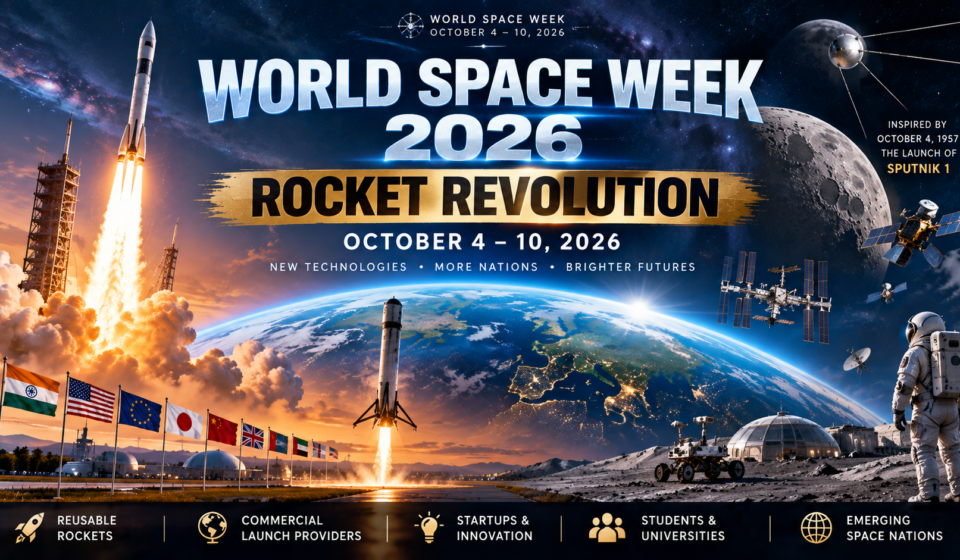
World Space Week 2026: Rocket Revolution, Reusable Rockets & the New Space Race

Table of Contents
ToggleWorld Space Week 2026: The Rocket Revolution Changing Who Can Reach Space
World Space Week 2026 explores the Rocket Revolution transforming space access. Discover reusable rockets, commercial space, ISRO, SpaceX, startups and the future of humanity beyond Earth.
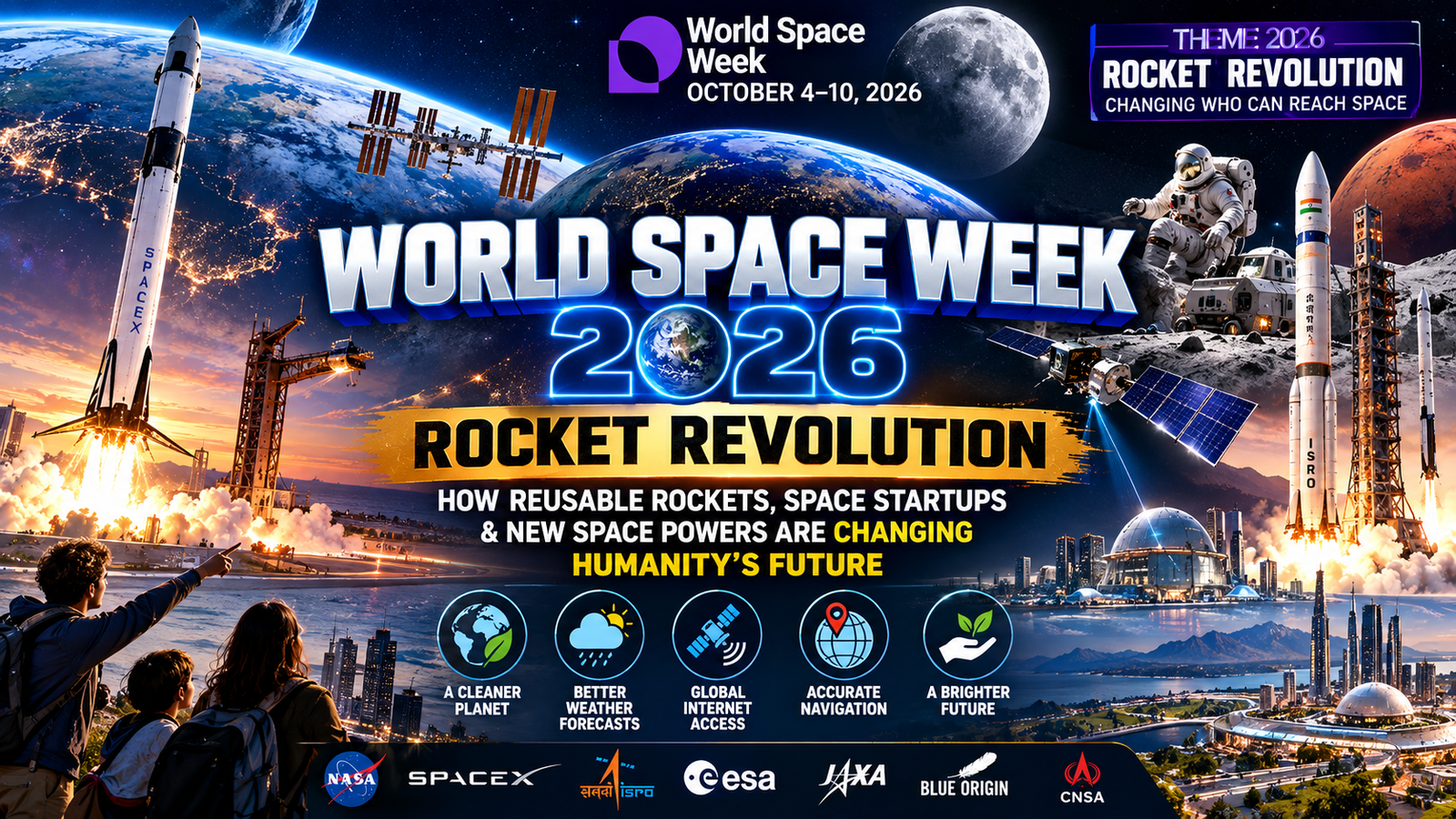
World Space Week 2026: The Rocket Revolution Changing Who Can Reach Space
Reusable rockets, commercial launch companies, space startups and emerging space powers are transforming humanity's relationship with space. But what does the Rocket Revolution actually mean for ordinary people on Earth?
World Space Week 2026 – Rocket Revolution and the changing future of space exploration.
🚀 We Are Entering a New Space Age
For decades, space seemed like a destination reserved for a handful of superpowers, government agencies and highly trained astronauts. Launching a rocket required enormous budgets, specialized infrastructure and years of preparation.
That picture is changing.
World Space Week 2026, celebrated globally from October 4 to October 10, puts that transformation at the centre of attention with this year's theme: “Rocket Revolution.”
The United Nations says the theme reflects the rapid transformation of space launch capabilities, including the growth of commercial launch providers, reusable rockets, university teams, startups and new national space actors.
In other words, the question is no longer simply:
The more interesting question is:
🌍 What Is World Space Week?
World Space Week is a United Nations-declared international observance held every year from October 4 to October 10.
The United Nations General Assembly proclaimed World Space Week in 1999 to celebrate the contributions of space science and technology to improving human life.
The dates themselves have historic significance. On October 4, 1957, the Soviet Union launched Sputnik 1, the first human-made Earth satellite, marking the beginning of the Space Age. October 10 is associated with the entry into force of the Outer Space Treaty in 1967.
Today, World Space Week has grown into a global platform for science education, space outreach, international cooperation and public engagement.
World Space Week by the Numbers
- Dates: October 4–10, 2026
- 2026 Theme: Rocket Revolution
- Global reach: 102+ countries
- Reported events: 50,000+ worldwide
- Purpose: Space science, technology, education and international cooperation
🛰️ Why Does World Space Week Begin on October 4?
October 4 is not an arbitrary date.
On October 4, 1957, Sputnik 1 became the first artificial satellite to orbit Earth. Its launch changed science, geopolitics, communications and humanity's understanding of what was technologically possible.
That small satellite also demonstrated something revolutionary: humans could build a machine capable of leaving the planet and operating in orbit.
Almost seven decades later, the Rocket Revolution is taking that idea much further.
The technology is no longer limited to proving that humans can reach orbit. The emerging goal is to make access to space more frequent, more flexible and potentially more commercially viable.
🔥 What Is the “Rocket Revolution”?
The phrase Rocket Revolution describes the rapid transformation taking place in the launch industry.
Traditionally, a rocket was largely treated as a disposable vehicle. After delivering its payload into space, major portions of the launch system were discarded.
Reusable launch technology challenges that model.
Instead of building every launch vehicle as a one-time-use system, engineers are developing vehicles and components that can return, be inspected, refurbished and launched again.
The wider revolution also includes:
- Reusable launch vehicles
- Commercial launch providers
- Smaller and cheaper satellites
- Private space companies
- University-developed rockets
- New launch nations
- Commercial lunar missions
- Private human spaceflight
- New satellite internet networks
- Advanced Earth-observation systems
♻️ Why Reusable Rockets Could Change Everything
One of the biggest technological shifts in modern spaceflight is rocket reusability.
If expensive launch hardware can be recovered and flown repeatedly, the economics and operational model of launching spacecraft can change significantly.
A reusable rocket does not automatically make every space mission cheap. Refurbishment, fuel, infrastructure, testing, safety and payload requirements still matter.
But reusability introduces something extremely valuable to the launch business:
The ability to use launch hardware more than once can support higher launch frequency and potentially change the economics of access to orbit.
The Rocket Revolution brings reusable launch vehicles, commercial space companies and new space powers into a rapidly expanding ecosystem.
💰 From Government Space Programmes to Commercial Space
For much of the Space Age, national governments dominated major space programmes.
Government agencies still remain central to space exploration and national space capabilities. However, private companies now play a much larger role in launch services, satellite communications, Earth observation, spacecraft manufacturing and other parts of the space economy.
This creates a much more diverse ecosystem.
| Old Space Model | Emerging Space Model |
|---|---|
| Primarily government-led | Government + commercial ecosystem |
| Large traditional missions | Large missions + smaller commercial missions |
| Limited launch cadence | Increasing launch frequency |
| Few major players | Agencies, companies, startups and universities |
| Space as national capability | Space as national capability + commercial market |
🌎 The New Global Space Landscape
The modern space sector is no longer defined by two countries alone.
The United States remains a major force in space exploration and commercial launch services. China has developed a large and sophisticated space programme. Europe maintains extensive capabilities through ESA and its member states. Japan has significant expertise through JAXA and its industrial partners.
India has also developed a broad national space programme through ISRO while expanding participation by private Indian companies.
Other countries are developing launch capabilities, satellites, research programmes and commercial space ecosystems.
The result is an increasingly international space economy.
🇮🇳 India's Role in the Rocket Revolution
India is an important part of this changing global space landscape.
The Indian Space Research Organisation has built extensive capabilities in launch vehicles, satellites, Earth observation, communications, navigation and planetary exploration.
India's space programme is now also moving toward a larger human-spaceflight and commercial ecosystem.
ISRO says India's Human Space Programme is progressing from short-duration human spaceflight missions under Gaganyaan toward the longer-term objective of a sustained human presence in low Earth orbit through the proposed Bharatiya Antariksh Station.
India is also encouraging greater private-sector participation while retaining ISRO's central role in advanced space research, national missions and frontier technologies.
India's Space Ambition
- 🚀 Indigenous launch vehicles
- 🌙 Lunar exploration
- ☀️ Solar science missions
- 🛰️ Earth observation
- 📡 Navigation and communications
- 👨🚀 Gaganyaan human spaceflight
- 🏗️ Bharatiya Antariksh Station vision
- 🏭 Growing private space ecosystem
📱 Space Is Already Part of Your Everyday Life
Space exploration is sometimes presented as something that happens far above Earth and has little connection with ordinary people.
That is misleading.
Satellites already support many systems used by billions of people.
🧭 Navigation
Satellite navigation helps smartphones, cars, aircraft, ships and logistics networks determine location and timing.
🌦️ Weather Forecasting
Weather satellites provide observations that help meteorologists track clouds, storms and atmospheric conditions.
📡 Communications
Satellites support communications across remote areas and can provide connectivity where terrestrial infrastructure is difficult to build.
🌾 Agriculture
Earth-observation satellites can provide information useful for monitoring crops, land and environmental conditions.
🌊 Disaster Management
Satellite imagery can help authorities observe floods, cyclones, wildfires and other large-scale events.
🌍 Climate Science
Satellites provide global observations of Earth's atmosphere, oceans, land and ice, contributing to scientific understanding of environmental change.
🛰️ The Satellite Revolution Is Just as Important as the Rocket Revolution
A rocket is only part of the story.
The payload travelling into space can be even more transformative.
Satellites provide the infrastructure behind navigation, communications, Earth observation, scientific research and many commercial applications.
As launch opportunities expand, companies and researchers can potentially deploy new generations of smaller and more specialized spacecraft.
This creates a cycle:
↓
More Launch Opportunities
↓
More Satellites & Experiments
↓
More Space Applications
↓
More Innovation
🌙 The Moon Is Becoming the Next Major Destination
The Rocket Revolution is not only about placing satellites around Earth.
One of its most ambitious consequences could be a sustained return to the Moon.
Government agencies and private companies around the world are working on technologies associated with lunar exploration, including landers, spacecraft, communications systems, scientific instruments and surface operations.
A future lunar economy could involve scientific research, communications infrastructure, resource studies and technologies needed for deeper-space missions.
But it is important to distinguish between what is technically demonstrated today and what remains an ambitious future objective.
🔴 And Then Comes Mars
Mars remains one of humanity's most ambitious long-term exploration targets.
The challenges are enormous: distance, radiation, life-support systems, communication delays, landing technology and the ability to operate independently for long periods.
Technologies developed for reusable launch systems, lunar missions, life-support systems, robotics and autonomous spacecraft could contribute to future deep-space exploration.
The journey to Mars therefore begins much closer to home — with technologies developed and tested around Earth and the Moon.
🚀 Why Space Startups Matter
One of the most interesting aspects of the current space transformation is the participation of startups.
A space startup can focus on a highly specific problem rather than attempting to build an entire national space programme.
Examples include:
- Launch vehicles
- Satellite components
- Earth-imaging systems
- Space communications
- Navigation technologies
- Space robotics
- In-space manufacturing
- Space data analytics
- Climate monitoring
- Scientific instruments
Universities are also becoming important sources of innovation and talent, especially in experimental rocketry, robotics and small satellites.
💡 What Is the “Space Economy”?
The space economy is much larger than astronauts and rockets.
It includes the businesses, infrastructure, services and technologies connected with space-based activities.
| Sector | Examples |
|---|---|
| Launch | Rockets and launch services |
| Satellites | Communications, navigation, Earth observation |
| Data | Satellite imagery and analytics |
| Space Infrastructure | Ground stations, spacecraft systems and networks |
| Human Spaceflight | Crewed spacecraft and orbital habitats |
| Science | Research and exploration missions |
🌍 The Rocket Revolution Also Has a Sustainability Question
The expansion of space activity creates opportunities, but it also raises important questions.
One is space debris.
Earth's orbital environment contains inactive spacecraft, spent rocket stages and fragments from previous missions. As the number of launches and satellites increases, responsible space operations become increasingly important.
Space sustainability therefore needs to develop alongside the commercial space industry.
The future of space cannot simply be about launching more. It must also involve safer operations, responsible orbital behaviour, better tracking and long-term stewardship of the space environment.
⚠️ What Happens If Space Gets Too Crowded?
Imagine Earth's orbit as a series of extremely busy highways — except there are no physical lanes and objects can travel at enormous speeds.
A collision between spacecraft or debris can generate additional fragments, potentially creating further hazards.
That makes tracking, collision avoidance, responsible spacecraft design and end-of-life planning increasingly important.
🤝 Space Is Becoming More International
The Rocket Revolution is sometimes described as a new space race, but competition is only part of the story.
Space missions frequently involve international cooperation, shared scientific objectives, commercial partnerships and multinational teams.
The International Space Station is one of the most visible examples of multinational cooperation in space.
Future lunar and deep-space programmes are also likely to require cooperation across governments, agencies, universities and private companies.
The UN continues to emphasize international cooperation and the peaceful use of outer space.
🔮 What Could Space Look Like by 2035?
Nobody can know exactly what the space industry will look like a decade from now. But today's technologies provide clues about the direction of travel.
- 🚀 More reusable launch systems
- 🛰️ Larger satellite networks
- 🌙 More lunar missions
- 👨🚀 More human-spaceflight activity
- 🤖 More autonomous robotics
- 📡 More satellite-based connectivity
- 🌍 More Earth-observation applications
- 🏭 Greater commercial participation
- 🎓 More university and student involvement
- 🌎 More countries participating in the space economy
Some of these developments are already underway, while others remain future possibilities rather than guaranteed outcomes.
🌟 Five Things the Rocket Revolution Could Change for Ordinary People
1. Better Connectivity
Satellite networks could expand connectivity to places where traditional infrastructure is difficult or expensive to deploy.
2. Better Weather Intelligence
More sophisticated Earth-observation systems could improve monitoring of storms and environmental conditions.
3. Faster Scientific Discovery
More frequent access to space could provide researchers with additional opportunities to conduct experiments.
4. New Industries
The growing space economy could create new businesses and specialized jobs in engineering, software, manufacturing, data science and science.
5. A New Generation of Space Professionals
Perhaps the most important change is cultural. Students who today watch rocket launches online could become tomorrow's engineers, scientists, entrepreneurs and astronauts.
🌎 Why World Space Week 2026 Matters
World Space Week is more than a celebration of rockets.
It is an opportunity to ask a much bigger question:
The answer will not come from one country or one company.
It will emerge from scientists, engineers, entrepreneurs, students, governments, universities and international organisations working — and sometimes competing — to solve extraordinary problems.
That is what makes the Rocket Revolution so fascinating.
🇮🇳 From India to the World: Why This Revolution Matters to Everyone
India's growing space capabilities are part of a much larger global transformation.
From NASA and ESA to JAXA, ISRO, commercial launch companies and emerging national programmes, the space ecosystem is becoming more diverse.
That diversity could ultimately benefit humanity through greater scientific collaboration, more technological innovation and broader access to space-based services.
For Indian readers, the story is especially relevant because India's space ambitions increasingly intersect with the global commercial space economy.
🔗 Official Space Resources
- United Nations – World Space Week 2026: Rocket Revolution
- United Nations – World Space Week
- World Space Week Association
- ISRO – Indian Space Research Organisation
- NASA – National Aeronautics and Space Administration
- European Space Agency
- JAXA – Japan Aerospace Exploration Agency
📖 Explore More on ExploreWithArvind
If you enjoy technology, innovation, travel and the stories shaping tomorrow's world, explore more articles on ExploreWithArvind.
📌 World Space Week 2026 – Quick Facts
| Event | World Space Week |
| Dates | October 4–10, 2026 |
| 2026 Theme | Rocket Revolution |
| Established by | United Nations General Assembly |
| Beginning date significance | Sputnik 1 launch – October 4, 1957 |
| Global reach | 102+ countries |
| Reported global events | 50,000+ |
❓ Frequently Asked Questions About World Space Week 2026
1. When is World Space Week 2026?
World Space Week 2026 is celebrated globally from October 4 to October 10, 2026.
2. What is the theme of World Space Week 2026?
The official theme for World Space Week 2026 is “Rocket Revolution.”
3. What does Rocket Revolution mean?
Rocket Revolution refers to the rapid transformation of space launch capabilities, including reusable rockets, commercial launch providers, startups, university teams and emerging national space actors.
4. Why does World Space Week start on October 4?
October 4 marks the anniversary of the launch of Sputnik 1 in 1957, the first human-made satellite to orbit Earth.
5. Why is October 10 important?
October 10, 1967, marks the entry into force of the Outer Space Treaty, an important international framework governing activities in outer space.
6. Why are reusable rockets important?
Reusable launch technology can allow expensive rocket hardware to be flown more than once, potentially supporting greater launch frequency and changing the economics of space access.
7. Is space becoming commercial?
Yes. Governments remain central to space exploration, but commercial companies increasingly participate in launch services, satellites, communications, Earth observation, spacecraft and other space activities.
8. What is India's role in the new space economy?
India has a major national space programme through ISRO and is also expanding private-sector participation. Its ambitions include human spaceflight through Gaganyaan and longer-term plans for sustained human presence in low Earth orbit.
9. How does space technology affect everyday life?
Space-based systems contribute to navigation, communications, weather monitoring, Earth observation, agriculture, disaster management and scientific research.
10. Is the Rocket Revolution only about rockets?
No. Rockets are the gateway, but the wider transformation includes satellites, spacecraft, launch services, space data, communications, research, robotics and the broader space economy.
11. Is Mars exploration part of the Rocket Revolution?
Future deep-space exploration can benefit from advances in launch technology, spacecraft, robotics and human-spaceflight systems. However, large-scale human missions to Mars remain a major future challenge.
12. Why is space sustainability important?
As the number of spacecraft and launches increases, responsible management of the orbital environment becomes increasingly important, particularly regarding space debris and collision risks.
🚀 The Rocket Revolution Has Already Begun
World Space Week 2026 arrives at an extraordinary moment.
Humanity is no longer simply asking whether it can reach space. We are entering an era in which governments, established space agencies, commercial companies, startups, universities and emerging space nations are all contributing to the next chapter.
The Rocket Revolution is about reusable launch systems, more frequent missions, expanding commercial participation and a growing ecosystem of technologies that connect space with everyday life on Earth.
From satellite navigation on a smartphone to weather forecasts, communications, Earth observation and future lunar missions, space is already much closer to our daily lives than many people realise.
And the most exciting part?
The next chapter of space exploration is not being written by one country alone.
🌍 Earth → 🛰️ Orbit → 🌙 Moon → 🔴 Mars → ❓ Beyond
World Space Week 2026 is therefore not simply a celebration of what humanity has achieved. It is an invitation to think about where we go next — and how responsibly we get there.
🌎 Share the Rocket Revolution
Suggested social caption:
🚀 World Space Week 2026 is here!
The theme is “Rocket Revolution” — and reusable rockets, commercial space companies, startups and new space powers are changing who can reach space. 🌍🛰️🌙
#WorldSpaceWeek #WorldSpaceWeek2026 #RocketRevolution #SpaceExploration #SpaceTechnology #ISRO #NASA #SpaceX #ReusableRockets #FutureOfSpace
Related