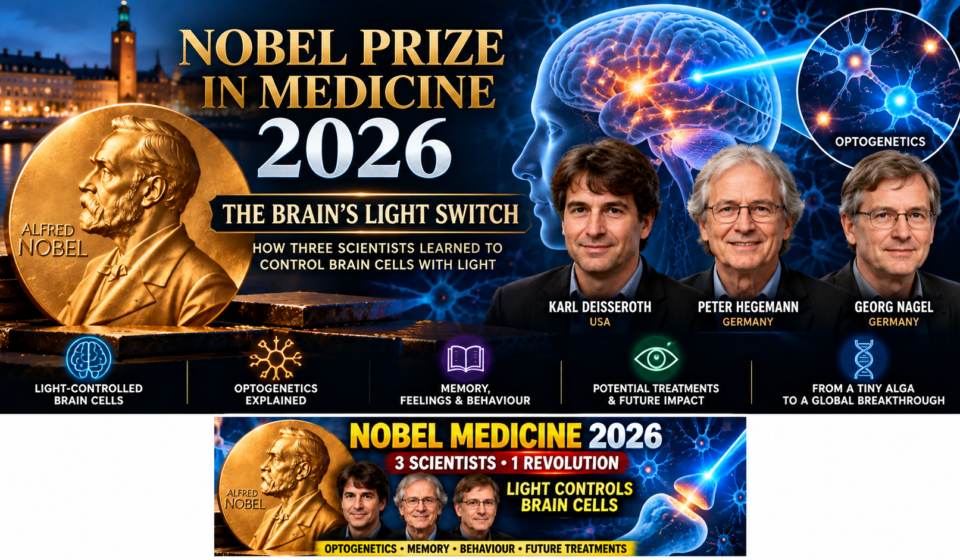
Nobel Prize in Medicine 2026: Karl Deisseroth, Peter Hegemann & Georg Nagel Win for Optogenetics

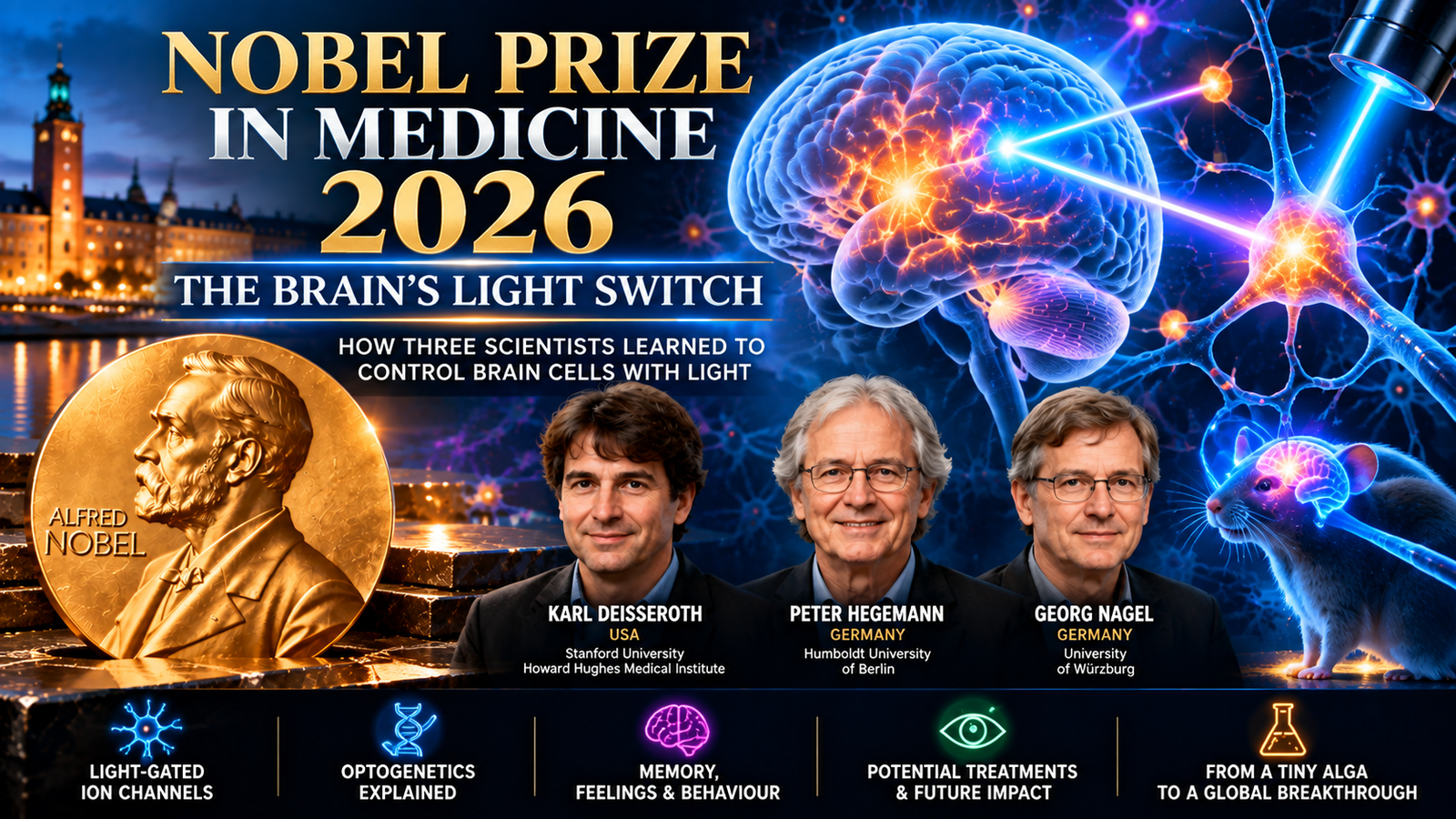
Karl Deisseroth, Peter Hegemann and Georg Nagel win the 2026 Nobel Prize in Medicine for optogenetics. Discover how their light-controlled brain research works and why it matters.
Table of Contents
ToggleNobel Prize in Medicine 2026: How Three Scientists Learned to Control Brain Cells With Light
What if scientists could switch individual brain cells on and off using light?
That extraordinary idea is at the heart of the 2026 Nobel Prize in Physiology or Medicine, awarded jointly to Karl Deisseroth, Peter Hegemann and Georg Nagel for their discoveries concerning light-gated ion channels and optogenetics.
The announcement on 5 October 2026 opened this year's Nobel Prize announcement week. The Nobel Assembly at Karolinska Institutet recognised work that has transformed neuroscience by giving researchers a remarkably precise way to investigate how individual nerve cells influence the living brain.
🏆 BREAKING NOBEL 2026
2026 Nobel Prize in Physiology or Medicine:
Karl Deisseroth • Peter Hegemann • Georg Nagel
For their discoveries concerning light-gated ion channels and optogenetics.
But what exactly is optogenetics? How can light control a neuron? Why did a protein discovered in a tiny single-celled alga become such a powerful tool for neuroscience? And could this research eventually help people with neurological or sensory disorders?
Let's understand the Nobel-winning discovery in simple language.
🧠 What Is the 2026 Nobel Prize in Medicine About?
The three scientists were recognised for discoveries that made it possible to control the activity of nerve cells using light.
This technique is known as optogenetics.
In simple terms, researchers can introduce genes that make selected nerve cells sensitive to light. Scientists can then use precisely controlled light to activate or inhibit those cells and observe what happens.
This gives neuroscientists something that was previously extremely difficult to achieve: the ability to study the role of specific groups of neurons with extraordinary precision.
According to Karolinska Institutet, optogenetics has opened new ways to investigate how nerve cells shape memories, feelings and behaviours in the living brain. :chatgpt-content-reference{index="1"}
💡 First, What Is Optogenetics?
The word itself provides a clue:
- Opto — relating to light
- Genetics — involving genes
Optogenetics combines genetic engineering and light to control specific cells.
Imagine a scientist wants to understand whether a particular group of neurons contributes to a certain behaviour.
Instead of simply watching those neurons, researchers can use optogenetic techniques to make selected cells respond to light. A carefully timed pulse of light can then trigger or suppress their activity.
This allows researchers to ask much more precise questions:
- What happens if these neurons become active?
- What happens if they are silenced?
- Which neural circuits influence a particular behaviour?
- Which cells are involved in forming a memory?
- How do different circuits interact?
That ability to move from correlation toward controlled experimentation is one reason optogenetics became so influential in neuroscience.
🔬 The Story Began With a Tiny Alga
The Nobel-winning story did not begin inside a modern brain laboratory.
It began with a much simpler organism.
Peter Hegemann was interested in how the single-celled green alga Chlamydomonas responds to light.
The organism can move toward a light source, and understanding this behaviour led researchers toward an extraordinary class of light-sensitive proteins.
Hegemann and Georg Nagel identified and investigated channelrhodopsin, a light-sensitive protein found in the alga.
The protein acts as a light-controlled channel. When exposed to blue light, the channel opens and charged ions can flow through it, producing an electrical effect in the cell.
Even more remarkably, the protein could make other cells responsive to light when introduced into them.
This observation eventually provided one of the crucial building blocks for optogenetics.
Karolinska Institutet describes Hegemann and Nagel's discovery of channelrhodopsin as the starting point for the development of the light-controlled approach that would become optogenetics. :chatgpt-content-reference{index="2"}
👨🔬 Who Is Karl Deisseroth?
Karl Deisseroth is an American neuroscientist and psychiatrist associated with Stanford University and the Howard Hughes Medical Institute.
His contribution was to help transform the light-sensitive protein discovery into a powerful method for controlling neurons.
Deisseroth and his collaborators introduced the gene for channelrhodopsin into nerve cells.
The result was remarkable.
Light could be used to trigger electrical activity in those neurons.
In subsequent experiments, the approach was extended into the brains of living animals, creating a powerful experimental tool for studying neural circuits.
According to Karolinska Institutet, Deisseroth demonstrated the breakthrough in nerve cells and subsequently made the light-controlled switch work in the brains of living mice. :chatgpt-content-reference{index="3"}
👨🔬 Who Is Peter Hegemann?
Peter Hegemann is a German biophysicist and professor at Humboldt University of Berlin.
His curiosity about how microorganisms detect light helped lead to the discovery and understanding of light-sensitive proteins that became fundamental to optogenetics.
His work helped reveal the molecular mechanism through which light could influence electrical activity in cells.
👨🔬 Who Is Georg Nagel?
Georg Nagel is a German scientist and professor at the University of Würzburg.
Working with Hegemann and other researchers, Nagel played a crucial role in establishing the properties of channelrhodopsins and demonstrating their ability to make cells respond to light.
The discoveries made by Hegemann and Nagel provided the biological tool that Deisseroth and others could then exploit for precise control of neural activity.
⚡ How Can Light Control a Brain Cell?
This sounds almost like science fiction, but the underlying concept is surprisingly elegant.
Step 1 — Choose the neurons
Scientists use genetic techniques to introduce specific genes into selected nerve cells.
Step 2 — Make the neurons light-sensitive
The introduced gene can cause the neurons to produce a light-sensitive protein such as channelrhodopsin.
Step 3 — Deliver light
Researchers use precisely controlled light to illuminate the target neurons.
Step 4 — Trigger or suppress activity
The light-sensitive proteins respond to specific wavelengths of light, changing the electrical state of the cells.
Step 5 — Observe the result
Scientists can then study how changing the activity of those neurons affects behaviour, perception, memory or other biological functions.
💡 IN SIMPLE WORDS
Scientists effectively created a biological light switch for selected nerve cells.
That switch gives researchers a powerful way to investigate what specific neurons actually do.
🧠 Why Is This Such a Big Deal for Brain Science?
The human brain contains an extraordinary number of interconnected nerve cells.
For decades, neuroscientists could observe patterns of brain activity, but determining whether a particular group of neurons actually caused a behaviour was much harder.
Optogenetics changed the experimental possibilities.
Instead of merely asking:
“Which neurons are active when this happens?”
researchers can ask:
“What happens if we deliberately activate these neurons?”
That difference is fundamental.
It has helped researchers investigate neural circuits associated with behaviour, emotions, learning and memory and has become a widely used research tool in neuroscience. :chatgpt-content-reference{index="4"}
🧩 What Are Light-Gated Ion Channels?
The phrase sounds highly technical, but the basic idea can be explained simply.
Ion channels are proteins that allow electrically charged particles, or ions, to move across cell membranes.
These movements are fundamental to the electrical signalling of nerve cells.
A light-gated ion channel is an ion channel whose activity can be controlled by light.
When the appropriate light reaches the protein, the channel changes state and allows ions to move through it.
In a neuron, that can influence whether the cell generates an electrical signal.
This is what gives optogenetics its remarkable precision.
🧬 From Algae to Neuroscience
The journey behind this Nobel Prize is a fascinating example of how basic science can eventually transform another field.
| Stage | What Happened? |
|---|---|
| Algae | Researchers investigated how single-celled algae respond to light. |
| Channelrhodopsin | Hegemann and Nagel helped reveal the properties of this light-sensitive protein. |
| Neurons | Researchers introduced the light-sensitive mechanism into nerve cells. |
| Light control | Light could be used to influence neural activity. |
| Living brains | The method was developed for studying neural circuits in living animals. |
| Modern neuroscience | Optogenetics became a major tool for investigating how neural circuits work. |
🧠 Could Optogenetics Help Treat Brain Diseases?
This is one of the most exciting questions surrounding the technology.
Optogenetics has primarily been a research technique, allowing scientists to understand neural circuits and disease mechanisms.
Researchers are also investigating potential therapeutic applications.
According to Karolinska Institutet, optogenetics is being used to investigate neural circuits relevant to neurological and psychiatric disorders, while researchers are also exploring applications such as restoring sight in people with visual impairment. :chatgpt-content-reference{index="5"}
However, it is important not to misunderstand this development.
Winning the Nobel Prize does not mean that optogenetics is already a routine treatment for neurological or psychiatric diseases. Much of its importance remains in research, while possible therapeutic applications continue to be investigated.
👁️ Could This Technology Help Restore Sight?
One particularly interesting area is vision.
Because optogenetics can make selected cells responsive to light, researchers have investigated whether the approach could potentially help restore visual function in certain circumstances.
This represents a completely different way of thinking about some forms of sensory impairment: instead of simply replacing a damaged structure, researchers can investigate whether remaining cells can be made responsive to artificial light signals.
Such research remains an area of scientific development and should not be interpreted as a universally available treatment.
🧠 What Has Optogenetics Taught Scientists About Memory?
Memory is not stored in one simple location inside the brain.
It involves complex networks of neurons and connections.
Optogenetics has given researchers a way to investigate specific neural circuits involved in learning and memory.
By manipulating particular neurons during controlled experiments, researchers can investigate whether those cells contribute to specific behaviours or memory-related processes.
This has helped move neuroscience closer to understanding not just where activity occurs, but also how particular neural circuits contribute to behaviour.
❤️ What About Feelings and Behaviour?
The same principle applies to emotional and behavioural neuroscience.
Researchers can investigate how specific groups of neurons influence behaviours and emotional responses by manipulating neural activity with high temporal precision.
This does not mean that scientists can simply “control human emotions with a flashlight.” That would be a sensationalised interpretation.
Instead, optogenetics provides researchers with an experimental tool for understanding the underlying neural circuitry in controlled scientific settings.
💰 Nobel Prize Money 2026: How Much Did the Winners Receive?
The three laureates will share the 2026 Nobel Prize amount of SEK 12 million.
Reuters reported that the full prize amount is 12 million Swedish kronor, shared among the three laureates. :chatgpt-content-reference{index="6"}
But the financial award is only one part of the Nobel recognition.
The laureates also receive the prestigious Nobel medal and Nobel diploma and become part of the history of one of the world's most recognised international awards.
👨🔬 The Three 2026 Nobel Medicine Laureates at a Glance
| Laureate | Country | Affiliation |
|---|---|---|
| Karl Deisseroth | United States | Stanford University / Howard Hughes Medical Institute |
| Peter Hegemann | Germany | Humboldt University of Berlin |
| Georg Nagel | Germany | University of Würzburg |
The affiliations and scientific contributions are reported by Karolinska Institutet and contemporary coverage of the announcement. :chatgpt-content-reference{index="7"}
🏆 Why This Nobel Prize Could Be Remembered
The significance of this year's Medicine Prize is not simply that the laureates developed another laboratory technique.
Optogenetics changed the questions scientists can ask about the brain.
For decades, the brain was often described as a vast network whose activity could be observed but not easily manipulated with cell-level precision.
Optogenetics introduced a powerful experimental “switch” that lets researchers investigate specific neural populations and circuits.
That is why the technology has become so influential across modern neuroscience.
🌍 A Nobel Prize About Understanding What Makes Us Human
At first glance, a protein found in algae may seem very far removed from human behaviour.
But that is precisely what makes this story so fascinating.
A question about how a microscopic organism detects light eventually contributed to a technology that helps scientists investigate how the human brain produces memory, emotion, behaviour and perception.
It is a powerful reminder that major scientific breakthroughs do not always begin with an obvious application.
Sometimes they begin with simple curiosity.
🇮🇳 Why Should India Pay Attention?
For India, the 2026 Medicine Nobel is particularly relevant to the growing importance of neuroscience, biotechnology, genetics, artificial intelligence and advanced medical research.
Indian universities, hospitals, biotechnology companies and research institutions are increasingly involved in neuroscience and translational research.
The Nobel-winning work also highlights a broader lesson for India's research ecosystem:
Fundamental research that may appear highly specialised today can become the foundation of tomorrow's technologies.
That is perhaps one of the most important lessons students and young researchers can take from this Nobel story.
🔬 What Happens Next in Nobel Week 2026?
The Medicine announcement has now opened the Nobel Prize 2026 announcement week.
| Date | Category |
|---|---|
| 5 October | Physiology or Medicine — Deisseroth, Hegemann & Nagel |
| 6 October | Physics |
| 7 October | Chemistry |
| 8 October | Literature |
| 9 October | Peace |
| 12 October | Economic Sciences |
ExploreWithArvind will continue following the Nobel 2026 announcements with individual explainers for each category.
❓ Frequently Asked Questions
Who won the Nobel Prize in Medicine 2026?
Karl Deisseroth, Peter Hegemann and Georg Nagel jointly won the 2026 Nobel Prize in Physiology or Medicine.
Why did Karl Deisseroth, Peter Hegemann and Georg Nagel win the Nobel Prize?
They were recognised for discoveries concerning light-gated ion channels and optogenetics, a technology that allows researchers to control the activity of specific nerve cells using light.
What is optogenetics?
Optogenetics is a research technique combining genetic methods and light to control the activity of selected cells, particularly neurons.
What is channelrhodopsin?
Channelrhodopsin is a light-sensitive protein discovered in microorganisms such as algae. It became a key biological component in the development of optogenetics.
Can optogenetics control the human brain?
Optogenetics is primarily a neuroscience research technique. It should not be interpreted as a technology that currently allows people to remotely control human brains with light.
Can optogenetics treat neurological diseases?
Researchers are investigating potential therapeutic applications, including work related to neurological disorders and visual impairment. However, many such applications remain under research and are not routine treatments.
How much is the 2026 Nobel Prize worth?
The full 2026 Nobel Prize amount is SEK 12 million. The Medicine prize is shared by the three laureates.
Where can I read the official Nobel announcement?
The Nobel Prize's official website provides announcements, background information and Nobel laureate information.
🔗 Official Sources & Further Reading
- Official Nobel Prize Website
- Karolinska Institutet — 2026 Nobel Prize in Physiology or Medicine
- Official Nobel Prize 2026 Announcement Schedule
- Nobel Prize 2026 — ExploreWithArvind Series
🌟 Final Word
The 2026 Nobel Prize in Physiology or Medicine is a story about an extraordinary scientific journey — from a tiny light-sensitive protein in an alga to a revolutionary technique for studying the living brain.
Peter Hegemann and Georg Nagel helped uncover the light-sensitive biological machinery, while Karl Deisseroth helped turn that discovery into a powerful method for controlling neural activity.
Today, scientists around the world use optogenetics to ask questions about the brain that were once extraordinarily difficult to answer.
And that may be the most fascinating part of this Nobel story:
💡 SOMETIMES, THE KEY TO UNDERSTANDING THE BRAIN...
IS SIMPLY LEARNING HOW TO TURN ITS LIGHTS ON AND OFF.
This is Post #2 of the ExploreWithArvind Nobel Prize 2026 series — “The Ideas That Changed Humanity.”
Next, we turn our attention to Physics.
Related